
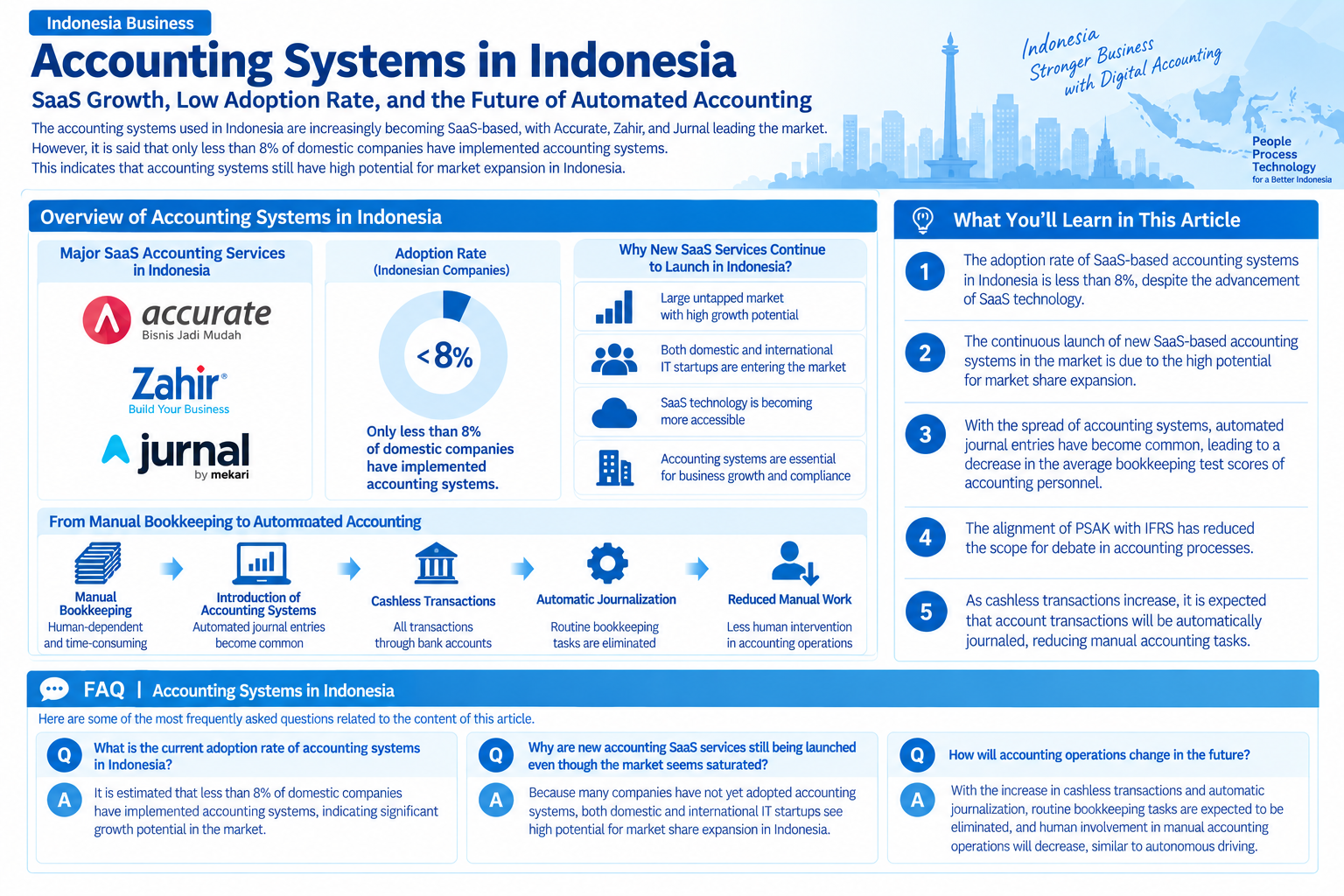
The accounting systems used in Indonesia are increasingly becoming SaaS-based, with the well-known local SaaS services Accurate, Zahir, and Jurnal leading the market. However, it is said that only less than 8% of domestic companies have implemented accounting systems.
This is the reason why new SaaS-based accounting systems continue to be launched in what appears to be a saturated Indonesian market, and it can be seen that both domestic and international IT startups judge that accounting systems still have high potential to expand their market share locally.
In Indonesia, automatic journal entries through the spread of accounting systems have become commonplace, and while the average bookkeeping test scores of corporate accounting staff have declined over the past five years, their English communication skills have improved.
Although accounting operations have long been systematized, manual work inevitably had to intervene somewhere due to the lack of unified criteria for the dual aspects of acquisition cost and current valuation. This difficulty arose from evaluating assets while considering the concept of time in the two-dimensional world of accounting software and ledgers, creating journal entries for transactions where physical goods do not move. However, with the Indonesian accounting standard PSAK aligning with the global standard IFRS, there is now less room for debate in accounting processes.
As cashless transactions become increasingly prevalent and all corporate transactions are conducted through bank accounts, it is expected that account transactions will be automatically journalized, eliminating routine bookkeeping tasks. Similar to autonomous driving, the involvement of humans in manual accounting tasks is anticipated to decrease.
This blog writes about accounting-related topics that help those who, like me, are involved in work related to Indonesia, to understand the context of various phenomena encountered in daily life and business settings.
What this article covers
- The adoption rate of SaaS-based accounting systems in Indonesia is less than 8%, despite the advancement of SaaS technology.
- The continuous launch of new SaaS-based accounting systems in the market is due to the high potential for market share expansion.
- With the spread of accounting systems, automated journal entries have become common, leading to a decrease in the average bookkeeping test scores of accounting personnel.
- The alignment of PSAK with IFRS has reduced the scope for debate in accounting processes.
- As cashless transactions increase, it is expected that account transactions will be automatically journaled, reducing manual accounting tasks.
Differences Between Perpetual Inventory System and Three-Way Method in Accounting Systems
Meaning of Month-End Inventory Transfer in Three-Way Method
In the three-way method (inventory valuation method) system, inventory transactions do not generate accounting journal entries, and at the end of the month, the opening inventory amount is manually transferred to the Opening Stock account, and the month-end inventory amount is transferred to the Closing Stock account (a contra account in P/L).
This synchronizes accounting with inventory, transferring the Opening stock account and Closing stock account, and Purchase (purchase account) to COGS (cost of goods sold account) to calculate the cost of goods sold. Subsequently, all P/L account balances are transferred to the Net Income account to calculate the gross profit.
In manual accounting, all P/L accounts are transferred to the Net-Income account at the end of the month to calculate Profit, but in system accounting, the intermediate calculations for creating P/L and B/S can be black-boxed, so transfer journal entries are not generated. Instead, the three-way method is used to calculate cost reports (material cost, manufacturing cost, cost of goods sold) and assemble P/L and B/S.
The process of calculating gross profit on P/L using the three-way method is as follows:
- Record Purchase (purchase) during the month, and calculate total revenue - total expenses = pre-transfer gross profit (all purchases for the month are recorded as expenses)
- At the end of the month, transfer opening inventory and month-end inventory to create BS, {(total revenue account balance + Closing Stock) - (total expense account balance + Opening Stock) = gross profit. The difference reflects inventory changes, completing B/S, and P/L's gross profit is accurate, but cost of goods sold is not yet present.
- Create P/L by separating revenue into sales and other revenue, and expenses into cost of goods sold and other expenses, {Sales - (Opening Stock + purchases for the month - Closing Stock)} + other revenue - other expenses = gross profit
In systems using the perpetual inventory method, accounting journal entries are generated with each inventory transaction, and inventory valuation is done using FIFO or moving average method. Changing the order of transactions will not calculate the correct valuation amount. Additionally, even though the three-way method is not used to calculate cost of goods sold, the way it is written in the P/L section for cost of goods sold often causes confusion.
Contents of Closing Adjustment Journal Entries
At the time of closing, special adjustment journal entries are required according to accounting rules. This ensures that financial statements are accurately reflected.
First, there are virtual transaction journal entries such as accumulated depreciation and allowance for doubtful accounts. Although these do not have actual transaction counterparts, they play an important role in financial statements. Accumulated depreciation indicates a decrease in assets, and allowance for doubtful accounts is for preparing for future bad debts.
- (Debit) Depreciation Expense (Expense) (Credit) Accumulated Depreciation - Machinery (Contra Asset)
- (Debit) Allowance for Doubtful Accounts Provision (Expense) (Credit) Allowance for Doubtful Accounts (Contra Asset)
- (Debit) Provision for Retirement Benefits (Expense) (Credit) Retirement Benefits Liability (Liability)
Next, there are journal entries to expense supplies. This is recorded as supplies expense, indicating a decrease in supplies.
- (Debit) Supplies Expense (Credit) Supplies
Inventory transfers are also important. By transferring the opening inventory amount and month-end inventory amount, inventory and accounting are synchronized, accurately reflecting assets in B/S and profits in P/L.
- (Debit) Opening Stock 800 (Credit) Inventories 800
- (Debit) Inventories 1000 (Credit) Closing Stock 1000
Additionally, material costs, manufacturing costs, and cost of goods sold for the month are calculated using the three-way method. This enables cost management in manufacturing.
- (Debit) COGS 800 (Credit) Opening Stock 800
- (Debit) Closing Stock 1000 (Credit) COGS 1000
- (Debit) COGS 400 (Credit) Purchase 400
All expense and revenue accounts are transferred to the profit and loss account, displaying revenue, which is a credit balance, in P/L and B/S. This clarifies the company's profit situation.
- (Debit) Profit and Loss (Net income) 80 (Credit) Total Expenses 80
- (Debit) Total Revenue 100 (Credit) Profit and Loss (Net income) 100
- (Debit) Profit and Loss (Net income) 20 (Credit) Revenue (Net profit) 80
The balance of the profit and loss account is displayed as Net Profit in B/S, and at the end of the year, profit is appropriated by transferring to retained earnings or unpaid dividends.
In cost management systems, month-end inventory is valued using the lower of cost or market method, and the evaluation unit price is automatically set in the month-end evaluation unit price master with the previous month's end evaluation unit price. A new unit price is automatically set or changed at a fixed rate at the end of this month, generating an evaluation loss journal entry and updating the carryover inventory valuation amount for the next month.
The month-end inventory amount is calculated using the weighted average method, and inventory valuation is possible at the weighted average unit price as Month-To-Date even during the month. Inventory quantity during the month can be negative without issue, but the weighted average unit price at the end of the month is applied in accounting.
-
-
The Difference Between the Perpetual Inventory Method and the Periodic Method in Accounting Systems
Benefitofperpetual?。Whendoesperiodicfit?。Whatdecidesatgo-live?。
続きを見る
The Flow of Net Income Being Retained Earnings and Profit Appropriation
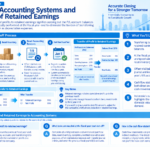
Net assets are recorded in the net assets section of the B/S in one of four forms: statutory capital at the time of company establishment or capital increase, capital reserve from non-operating stock issuance, retained earnings from operating profits, and earned surplus reserve as a pool for dividends. Capital reserves and retained earnings are considered retained earnings.
Items with "profit" have passed through the P/L once, while items with "capital" are unrelated to management and are procured from shareholders. Retained earnings are where P/L profits are housed, and earned surplus reserve is accumulated as a source for dividends.
Due to the long-term deflation, large Japanese companies have accumulated retained earnings, resulting in retained earnings being abnormally large compared to statutory capital. Under Indonesian company law, from the perspective of creditor protection, there is an obligation to accumulate capital reserves up to 20% of statutory capital.
Generally, companies expected to grow aim for growth through reinvestment, such as purchasing fixed assets, rather than returning profits to shareholders through dividends, and thus maintain a thicker layer of retained earnings.
Transfer of current term profit to earned surplus reserve
- (Debit) Profit and Loss (Net income) 80 (Credit) Total Expenses 80 (Transfer all expense items to profit and loss)
- (Debit) Total Revenue 100 (Credit) Profit and Loss (Net income) 100 (Transfer all revenue items to profit and loss)
- (Debit) Profit and Loss (Net income) 20 (Credit) Retained Earnings 20 (Transfer the credit surplus of the profit and loss account to retained earnings)
Dividends from earned surplus reserve
- (Debit) Retained Earnings 10 (Credit) Earned Surplus Reserve 10 (Pool retained earnings into earned surplus reserve)
- (Debit) Earned Surplus Reserve 10 (Credit) Dividend Payable 10
- (Debit) Dividend Payable 10 (Credit) Cash and Deposits 10
Subsequent movement of cash and deposits
- (Debit) Machinery 5 (Credit) Cash and Deposits 5
By carrying forward as retained earnings, the cash and deposit balance is also carried forward, and the subsequent movement of cash and deposits occurs independently of the above net asset movements, meaning retained earnings are not held as cash and deposits within the company.
-
-
The Relationship Between Corporate Retained Earnings and the Three Financial Statements
Corporate retained earnings do not necessarily exist as cash within the company. In Indonesia, capital surplus must be accumulated up to 20% of legal…
続きを見る
Standard Format for Explaining Business Activities: The Three Financial Statements
Flow of Accounting Processes
The flow of accounting processes begins with mid-month operations. First, journal entries are made, and purchases are processed as expense accounts. Next, stock closing procedures are carried out, implementing stock closing.
After that, accounting closing procedures are performed, closing accounts receivable (A/R), accounts payable (A/P), and the journal. Revaluation is also conducted at this stage. Subsequently, accounting closing is performed.
Depreciation expenses are recorded, and products at the beginning and end of the month are transferred to the opening stock account and closing stock account to synchronize inventory. Furthermore, the opening stock account, closing stock account, and purchase account are transferred to the cost of goods sold account to calculate the cost of goods sold, and the opening stock account and closing stock account are eliminated.
Expense and revenue accounts are transferred to the Net-Profit account to calculate the cost of goods sold. In the trial balance (T/B), the balance of the profit and loss statement (P/L) accounts is zeroed. Finally, the balance of inventory and accounting is updated.
- Mid-month operations: Journal entry (purchases as expense accounts)
- Stock closing procedures: Stock closing
- Accounting closing procedures (A/R, A/P, Journal)
- Revaluation
- Accounting Closing
- Trial Balance (T/B): P/L account balance is zero
- Balance Update (Inventory and Accounting)
Preparation of Financial Statements
The preparation of financial statements includes the Cost of Goods Manufactured Report (COGM Report), Profit and Loss Statement (P/L), Balance Sheet (B/S), and Cash Flow Statement (C/F).
- Cost of Goods Manufactured Report (COGM Report)
- Profit and Loss Statement (P/L)
- Balance Sheet (B/S)
- Cash Flow Statement (C/F): Cash basis P/L
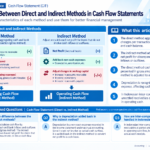
The cash flow statement is prepared using two methods: the direct method and the indirect method. In the direct method, transactions are aggregated with cash flow codes from the G/L and displayed in total. In the indirect method, the difference between accrual basis and cash basis is obtained from the trial balance T/B balance, adjusted by adding and subtracting.
- Depreciation expense is added (as it was subtracted from Net Profit in the accrual basis P/L)
- A/R balance is subtracted (as the A/R balance did not fully convert to Cash/Bank)
- A/P balance is added (as the A/P balance prevented cash/bank outflow)
Cash basis profit is calculated by adding depreciation expense to Net Profit (accrual basis current period net profit), subtracting A/R balance, and adding A/P balance.
-
-
Understanding the Three Financial Statements and Basic Accounting Knowledge
The three financial statements are the Profit and Loss Statement, Balance Sheet, and Cash Flow Statement. Understanding these is essential for generating…
続きを見る
Differences Between Direct and Indirect Methods in Cash Flow Statements
Under the accrual basis, sales are recorded as revenue when an invoice is issued to the customer, and purchases are recorded as expenses when an invoice is received from the supplier. However, the actual movement of cash occurs when payments are received from customers and made to suppliers.
- Profit and loss (accrual basis) is the movement of assets: recognized when sales (A/R) or expenses (A/P) occur
- Cash flow (cash basis) is the movement of money: recognized at the time of cash inflow and outflow for sales (A/R) and expenses (A/P)
Under the cash basis, regardless of when transactions occur, cash flow is recognized when cash moves, aligning profit and loss (movement of revenue and expenses) on the P/L with cash flow (movement of inflows and outflows). However, since most companies use accrual accounting, profit and loss are recognized when transactions occur, regardless of cash movement. This creates a discrepancy between cash flow and profit and loss on the P/L, necessitating a separate cash flow statement (C/F) to manage cash flow.
It is only at the time of transaction occurrence that it can be determined whether cash deposits are used for operations, investments, or financing. Unlike B/S or P/L, where accounts can be grouped and pasted into a C/F format, a cash flow code must be selected during journal entry to indicate where it should appear on the C/F form.
Under IFRS, the preparation of C/F using the direct method is mandatory. This involves aggregating the pluses and minuses of cash/bank in the G/L, displaying them in total, and categorizing them by counterpart account in a vertical format.
- Operations: Operation (P/L)
- Income from sales and expenditure for purchases
- Investment: Investment (B/S debit)
- Sale and purchase of assets, issuance or collection of receivables
- Finance: Finance (B/S credit)
- Borrowing or repayment of debt
In accounting systems, the direct method of C/F, which displays transaction amounts in total from the G/L based on cash flow codes, is easier to prepare for the operations section. However, in the indirect method, which analyzes cash backing for the net profit on the P/L, cash flow codes are not needed and can be generated from account balances of receivables, payables, and depreciation expenses.
- Direct Method: Aggregates the pluses and minuses of cash/bank for each transaction (total display) in cash flow from operating activities
- (+) Income from A/R settlement ⇒ Add C/F code to A/R settlement journal
- (-) Expenditure for direct material costs ⇒ Add C/F code to direct material cost payment journal
- (-) Expenditure for manufacturing overhead ⇒ Add C/F code to indirect labor cost and expense payment journal
- (-) Expenditure for SGA ⇒ Add C/F code to SGA payment journal
- Indirect Method: Adjusts net profit (difference between revenue and expenses) on an accrual basis to net profit on a cash basis (difference between inflow and outflow).
- (+) Net Profit ⇒ Net profit for the period on an accrual basis
- (+) Depreciation Expense ⇒ Amount that was negative net profit on the P/L on an accrual basis (Cash/Bank does not move)
- (-) Increase in A/R ⇒ Amount not received as Cash/Bank
- (+) Increase in A/P ⇒ Amount not paid as Cash/Bank
- Both the direct and indirect methods differ only in the operations section, while the investment and finance sections are the same, with the cash balance at the end of the previous month carried over to the current month.
Unrealized foreign exchange gains and losses on foreign currency deposits due to month-end revaluation are reflected in the cash flow statement.
- Realized gains and losses at the time of A/R and A/P settlement (Forex Gain-Realized) are not recorded in C/F as they are not Cash/Bank.
- If unrealized gains and losses (Forex Gain-Unrealized) due to revaluation of foreign currency Cash/Bank balances are not adjusted on the C/F statement, the balance on the C/F statement will not match the actual cash balance. Foreign exchange gains and losses related to A/R and A/P, which are not Cash/Bank, are not recorded in C/F.
For cash transactions, "profit = increase in cash"; however, in accrual accounting, "profit + liabilities balance due to revenue recognition + depreciation expense - receivables balance due to expense recognition = increase in cash," and in the indirect method of the cash flow statement, unsettled receivables balance is adjusted as a negative in operating cash, while unsettled liabilities balance and depreciation expense are adjusted as positives in operating cash.
The benefit of depreciation expense is not that cash actually increases.
- It has a tax-saving effect by classifying it as a non-taxable income through loss recognition.
- One can feel happier that the actual cash flow IN was more than the profit on the P/L.
Even if non-expense expenditures increase, such as land (real estate) without depreciation, it does not result in tax savings, but there is a possibility of generating cash as a gain on sale outside of operations if the value increases.
Both fixed assets and inventories are initially capitalized and gradually expensed (postponement of expensing). The meaning of "recovering past investment funds through depreciation" is that investment funds are indirectly recovered through the tax-saving effect of recognizing expenses as losses.
Profit of 12 million yen on P/L. Plus of 12 million yen on C/F (operations section).
- (Debit) Cash 12,000,000 (Credit) Sales 12,000,000
■ June: Purchase of molding machine with cash payment of 12 million yen
Profit of 0 yen on P/L. Minus of 12 million yen on C/F (investment section)
- (Debit) Machine 12,000,000 (Credit) Cash 12,000,000
■ July: Depreciation expense of 100,000 yen recorded
Loss of 100,000 yen on P/L. 0 yen on C/F (operations section).
- (Debit) Depreciation 100,000 (Credit) Accumulated Depreciation 100,000
-
-
Differences Between Direct and Indirect Methods in Cash Flow Statements
The direct method aggregates cash and bank changes per transaction to calculate cash flow and cash balance. The indirect method adjusts the accrual-based…
続きを見る
Accounting System Cut-off and Retained Earnings Processing
I joined a financial system company as a new graduate in 1995. At that time, I heard that in bank accounting, 'deposits are recorded on the credit side.' When a customer opens a checking account, the following journal entry is made.
From the bank's perspective, a checking account is money entrusted by the customer, so it becomes a liability and is recorded on the credit side.
This 'deposits are recorded on the credit side' in bank accounting can be explained within the scope of corporate accounting. As usual, the debit is recorded on the left and the credit on the right.
Regarding the balance of payments, it is recorded on a cash basis as 'inflow of funds is credit/outflow of funds is debit,' rather than 'increase in assets is debit/decrease in assets is credit' as in corporate accounting. Conventionally, it is written in reverse (credit on the left, debit on the right) so that it can be visually read from positive (left) to negative (right).
In corporate accounting, the right (debit) is positive and the left (credit) is negative, but in the balance of payments, based on the source of funds, the right (credit) is positive and the left (debit) is negative.
In the case of exports, corporate accounting is recorded as follows.
(Debit) Cash and Deposits 100 (Credit) Sales (Export) 100
■Balance of Payments
(Credit) Export (Inflow of Funds) 100 (Debit) Cash and Deposits 100
In the case of imports, corporate accounting is recorded as follows.
(Debit) Purchases (Import) 80 (Credit) Cash and Deposits 80
■Balance of Payments
(Credit) Cash and Deposits 80 (Debit) Import (Outflow of Funds) 80
In the case of direct investment from overseas, corporate accounting is recorded as follows.
(Debit) Cash and Deposits 200 (Debit) Sales (Direct Investment to Japan) 200
■Balance of Payments
(Credit) Direct Investment to Japan (Inflow of Funds) 200 (Debit) Cash and Deposits 200
As shown, there are differences in the recording methods of corporate accounting and balance of payments, but each adopts a recording method suited to its purpose.
-
-
Cut-off in Accounting Systems and Handling of Retained Earnings
Transferring current period profits to retained earnings zeroes out P/L account balances. The system cut-off is typically performed at the fiscal year-end…
続きを見る
Change of Functional Currency Due to Rupiahization of Domestic Transactions in Indonesia
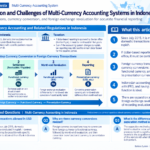
In accounting operations, there are three flows of currency conversion: realized foreign exchange gains and losses at the time of settlement of receivables and payables, unrealized foreign exchange gains and losses at the end of the month, and conversion from functional currency to presentation currency. This results in conversion from foreign currency to functional currency and then to presentation currency.
The difference between the rate at the time of A/P recognition upon invoice arrival and the rate at the time of A/P settlement is the confirmed realized profit (Forex Gain-Realized). Additionally, the foreign exchange gains and losses due to A/P revaluation at the month-end rate are treated as unrealized profit (Forex Gain-Unrealized).
When revaluating receivables and payables at the end of the month, if the profit or loss compared to the previous month is important, the separation method is used to update the invoice price to the latest valuation. If the profit or loss compared to the acquisition is important, the reversal method is used to revert to the acquisition valuation at the beginning of the next month.
■ Separation Method to Separate Acquisition Cost
Month-end foreign exchange revaluation journal entry (valuation loss of 10 compared to acquisition this month)
- (Debit) Unrealized Loss 10 (Credit) A/R 10
Next month-end foreign exchange revaluation journal entry (valuation loss of 2 compared to previous month-end)
- (Debit) Unrealized Loss 2 (Credit) A/R 2
In this way, the valuation gains and losses compared to the previous month-end on the P/L are updated as the fair value of A/R on the B/S.
■ Reversal Method to Maintain Acquisition Cost
Month-end foreign exchange revaluation journal entry (valuation loss of 10 compared to acquisition this month)
- (Debit) Unrealized Loss 10 (Credit) A/R 10
At the beginning of the next month, reverse the journal entry to revert A/R to the acquisition valuation.
- (Debit) A/R 10 (Credit) Unrealized Loss 10
Next month-end foreign exchange revaluation journal entry records the profit or loss on the P/L against the A/R price at acquisition (valuation loss of 12 compared to acquisition last month)
- (Debit) Unrealized Loss 12 (Credit) A/R 12
When using the previous month-end rate as the flat rate for foreign currency transactions in the current month, no realized foreign exchange gains and losses occur at settlement, but unrealized foreign exchange losses occur at month-end foreign currency revaluation. In this case, since the previous month-end rate is set in the transaction rate of the exchange rate master on the last day of the current month, it is necessary to set a rate for revaluation in addition to the transaction rate and TAX rate.
When making offsetting journal entries to correct foreign currency transaction journal entries, it is important to enter the rate at the time of the transaction, otherwise, even if the balance is zero in the transaction currency base, a balance will remain in the functional currency base. In accounting systems where accounts in different currencies can be set for debit and credit, it is necessary to always balance in the functional currency base.
-
-
Implementation and Challenges of Multi-Currency Accounting Systems in Indonesia
The implementation of multi-currency accounting systems in Indonesia faces challenges due to mandatory rupiah-based transactions and the need for IFRS…
続きを見る
Profit and Loss Method by Revenue and Expense Approach and Property Method by Asset and Liability Approach
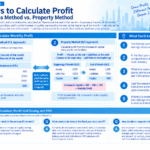
The profit and loss method based on the revenue and expense approach and the property method based on the asset and liability approach have different methods of profit calculation. In the profit and loss method, the profit for the month is calculated as "end-of-month revenue - end-of-month expenses." On the other hand, in the property method, it is calculated as the increase in capital, "(beginning-of-month assets - beginning-of-month liabilities) - (end-of-month assets - end-of-month liabilities)," and both result in the same amount.
- The profit, which is the difference between Expense and Revenue in the profit and loss method, becomes the increase in Equities in the property method, establishing the trial balance equation Asset+Expense=Liabilities+Equities+Revenue.
In Japan, after creating the P/L, the revenue and expense approach is adopted, where asset, liability, and capital items that will be sources of revenue and expenses in future periods are additionally recorded as B/S. The tax law valuation is used as the accounting valuation, and special profit and loss treatment is done when depreciation is completed. This approach strongly reflects the profit and loss method.
- If IFRS is thoroughly implemented and a complete fair value accounting principle is adopted, it will no longer be possible to process depreciation under the country's unique tax laws and record the residual value as an impairment loss.
Under IFRS, the asset and liability approach is adopted, where impairment and reversal of fixed assets, available-for-sale financial assets, etc., are evaluated at fair value to accurately create the B/S and clarify whether the asset situation can generate cash flow in the future. This approach strongly reflects the property method.
System compliance with IFRS is a matter of timing for making journal entries.
- Accrual-based revenue recognition (shipment or inspection basis in the automotive industry)
- Fair value evaluation of fixed assets (impairment and reversal)
-
-
Profit & Loss Method and Property Method
The monthly profit under the Profit and Loss Method is calculated as "Revenue at the end of the month – Expenses at the end of the month," whereas the monthly profit under the Property Method is the increase in capital expressed as "(Assets at the beginning of the month – Liabilities at the beginning of the month) – (Assets at the end of the month – Liabilities at the end of the month)," and both methods yield the same amount.
続きを見る
Processing with Shipment and Receipt Standards under the Accrual Principle
In the Indonesian automotive parts industry, based on the principle of simultaneous shipment and sales, provisional receivables (A/R Accrued) and sales, purchases, and provisional payables (A/P Accrued) are recorded in the transaction occurrence month, and the profit and loss statement (P/L) and balance sheet (B/S) for the month are prepared. The invoice is merely a unit for aging management of billing and payment, and a unit of cash flow.
- (Debit) A/R Accrued 100 (Credit) Sales 100
- (Debit) A/R Accrued 100 (Credit) Sales 100
- (Debit) A/R 200 (Credit) A/R Accrued 200
In imports by sea, there is a discrepancy between the invoice date and the delivery date, but it is recorded as goods in transit upon invoice arrival, and transferred to the purchase account after the arrival of the shipment, managing it as inventory on board.
- (Debit) Goods In Transit 300 (Credit) A/P 300
- (Debit) Purchases 300 (Credit) Goods In Transit 300
For exports under FOB (Free On Board), the reason for setting the sales recording date to the B/L date (Bill of Lading) is based on the trade terms that "the costs and risks are borne until loading onto the ship, and thereafter are borne by the importer," making the B/L date the delivery date of the goods.
-
-
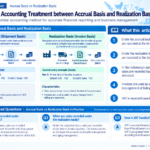
Differences in Accounting Treatment between Accrual Basis and Realization Basis and Practical Application
The accrual basis records revenue and expenses when transactions occur, while the realization basis records them when goods or services are transferred and…
続きを見る
Managing Onboard Inventory and Unreceived Invoice Inventory in the Accounting System
Construction In Progress is a temporary account used to manage construction costs, material costs, labor costs, and expenses that are prepaid or advanced until the completion of construction or the handover of the building. Equipment imported from Japan becomes the company's asset at the time of departure under an FOB contract, but until CIF costs are finalized, it is temporarily recorded in the Construction In Progress account without being incorporated into fixed assets.
The CIF costs (Cost, Insurance and Freight) in Indonesia mainly include the following three:
- Freight charge
- PIB (Pemberitahuan Impor Barang, Import Declaration)
- SPPB (Surat Persetujuan Pengeluaran Barang, Customs Clearance Permit)
The Construction In Progress account is a temporary storage place for assets not subject to depreciation, and if it remains unnaturally long, it becomes subject to audit.
Work In Process or Cost of Uncompleted Contracts is used to distinguish buildings under construction as products for sale.
Onboard inventory of imported materials is recorded as goods in transit. If the CIF costs associated with procurement are small, they are recorded as procurement expenses, but if they are large, they need to be transferred to procurement and converted into COGS.
The commonly heard incoterms trade conditions between Japan and Indonesia are the following three:
- EXWorks (Ex Works)
- FOB (Free On Board)
- CIF (Cost, Insurance and Freight)
Equipment is recorded in the Construction In Progress account when it becomes onboard inventory, and it is capitalized as a fixed asset and depreciated based on its useful life when it is brought into the factory and put into use.
-
-
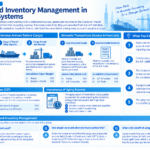
Details of Accounting Processes in Invoice and Inventory Management
This article explains the accounting processes involved in managing invoices and inventory. It covers the treatment of Goods-In-Transit, handling of delayed…
続きを見る
The Flow of Goods and Money Connecting Accrual and Cash Basis
In accrual accounting, revenues and expenses are recognized without accompanying cash. To adjust this to a cash basis, it is necessary to be aware of the movement of goods (inventory) and money in the production management system.
In cash basis accounting, the outstanding balance of accounts receivable (A/R) that has been incurred but not yet settled is the revenue balance that has not been converted into cash. Even if sales are recognized based on the shipping standard, they are pooled as provisional receivables until the invoice arrival date and need to be adjusted as a negative operating cash flow. The same applies to provisional liabilities not yet recorded as liabilities.
- (Debit) A/R Accrued 100 (Credit) Sales 100
Invoice Arrival Date
- (Debit) A/R 110 (Credit) A/R Accrued 100
- (Credit) VAT Out-payable 10
Revenues and expenses processed through accrued accounts (prepaid expenses, deferred revenues, accrued expenses, unearned revenues) are also important. Depreciation expenses of fixed assets must also be considered.
The complexity of corporate accounting arises because revenues and expenses are recorded on an accrual basis. It would be simpler if recorded on a cash basis, but it is important that profits are shown on the P/L. By adjusting the balances of receivables and payables and depreciation expenses to prepare the cash flow statement, management information on a cash basis can be obtained.
-
-
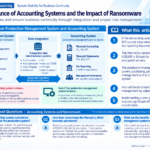
The Importance of Accounting Systems and the Impact of Ransomware
The importance of accounting systems is highlighted by their role in creating P/L and B/S data and enabling tax reporting. Ransomware like WannaCry poses a…
続きを見る
Key Points for Implementing a Fixed Asset Management System in Indonesia
In Indonesia, fixed asset management involves classification based on useful life into 4, 8, 12, and 20 years, with straight-line and declining balance methods used for depreciation. The straight-line method aims to reduce initial cost burden and generate profits quickly, while the declining balance method aims to expense early and reduce profits for tax savings.
Basic functions include acquisition, depreciation, and transfer, with each journal entry being important. For acquisition, the journal entry is (Debit) Fixed Assets 1000 (Credit) Liabilities 1000. For depreciation, it is recorded as (Debit) Depreciation Expense 100 (Credit) Accumulated Depreciation 100. Transfers do not incur costs but require transfer journal entries for profit and loss management by department or line.
Special loss management includes impairment, removal, disposal, and sale. Impairment is done in the currency at the time of acquisition and must be done carefully. Under IFRS, the reversal of impaired fixed assets is allowed. For removal, the journal entry is (Debit) Accumulated Depreciation 100 (Credit) Fixed Assets 1000. Disposal is recorded without an evaluation amount, and if the sale price exceeds the residual value, it is recorded as a gain on sale. For sales, the journal entry is (Debit) Accumulated Depreciation 100 (Credit) Fixed Assets 1000.
In mold depreciation management, when mold materials are purchased and processing begins, they are recorded as construction in progress and transferred to fixed assets when completed. The distinction between current and fixed assets is based on whether they can be converted to cash within a year, but molds are classified as fixed assets due to their high acquisition cost. Auxiliary molds with small acquisition costs may be treated as consumables, but can also be processed as fixed assets. As fixed assets, they are recorded as negative assets using the indirect method, with cumulative amounts listed on the B/S.
-
-
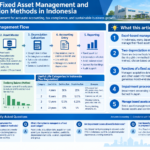
Details of Fixed Asset Management and Depreciation Methods in Indonesia
In Indonesia, fixed asset management often relies on Excel, with few companies using dedicated systems. Depreciation methods include the straight-line and…
続きを見る
The Fascination and Challenges of Accounting in Indonesia
The Challenge of Introducing the Concept of Time to Transactions That Have Not Occurred in the Real World
The real world is a three-dimensional space formed by up and down, left and right, front and back. However, in accounting, we introduce the concept of time to transactions that occur in this three-dimensional space, and record them with an awareness of a four-dimensional space.
Even though transactions have not occurred in the real world, we consider past purchases and acquisitions of machinery (fixed assets), stationery (inventory), and prepaid insurance premiums (assets as rights to receive treatment for free or at a discount) as contributions to acquiring sales for the current month. We convert the contribution of these assets into monetary terms and record them as expenses.
- Accrual Accounts
- accrued expense: A/P accrued liabilities
- accrued revenue: A/R accrued assets
- deferred expense: VAT-IN prepaid or Advanced Payment assets
- deferred revenue: VAT-OUT payable or Down Payment liabilities
These are four types of B/S items used to process transactions where the timing of cash flow and profit and loss recognition differ as they become revenue or expenses over time.
- Development costs and research and testing expenses, which are deferred assets, are temporarily considered as assets rather than expenses for the current period alone, and are allocated over the period during which the effect of these expenses is expected.
- Prepaid expenses, deferred assets, inventory, and fixed assets are initially recorded as assets, thereby postponing (deferred=postpone) the expense recognition.
Interpreting Events from an Accounting Perspective
Interpreting events from an accounting perspective means seeing the flow of goods and cash (cash and current deposits) underlying corporate activities. Studying the Japan Chamber of Commerce and Industry bookkeeping test is useful not only for practical work but also for understanding the context of everyday life situations.
Economic news labeled as "inappropriate accounting" usually aims at one of three things: tax evasion, embezzlement (misappropriation), or window dressing. All involve false statements in securities reports, leading to distorted P/L and B/S figures, with shareholders being the most affected.
Examples of inappropriate accounting include off-the-book transactions, circular transactions, transfer pricing, loss concealment (tobashi), and impression manipulation (reclassification). For instance, in off-the-book transactions, selling at a "friend price" reduces taxable income subject to corporate tax, raising suspicions of kickbacks. In circular transactions, sales are double-counted to inflate figures. In transfer pricing, selling cheaply to overseas branches with lower tax rates reduces taxable income in Japan.
- [Off-the-Book Transactions]: Selling at a "friend price" reduces taxable income subject to corporate tax, raising suspicions of receiving off-the-book kickbacks.
- [Circular Transactions]: Toshiba's practice of double-counting sales when providing LCD displays to subcontractors for a fee is an example of "circular transactions."
- [Transfer Pricing]: Selling cheaply to overseas branches with lower tax rates reduces taxable income in Japan and becomes taxable income for the local corporation, increasing consolidated profits.
- [Loss Concealment (Tobashi)]: Concealing losses by "tobashi" of non-performing loans with latent losses to non-consolidated affiliates at book value.
- [Impression Manipulation (Reclassification)]: Reclassifying financial engineering business losses as M&A losses from acquiring paper companies to improve the impression of losses.
Regarding royalties and commissions, the account items used by the Japanese headquarters for investment recovery from the Indonesian local corporation can be problematic. If classified under manufacturing cost items, it is Production Royalty; if under SGA items, it is Sales Commission. However, they may be denied by the tax office as transfer pricing.
- The account items used by the Japanese headquarters for investment recovery from the Indonesian local corporation are classified as Production Royalty under manufacturing cost items, Sales Commission under SGA items, and dividends as dividend payable under liabilities, but are often denied by the tax office as transfer pricing.
- Even if recognized as legitimate royalty expenses to the Japanese headquarters, the royalty amount is recalculated based on transfer pricing regulations, and a 20% withholding tax (PPH26) on overseas services is collected.
- While investment recovery in the form of dividends is ideal, it is difficult to record as dividends unless there are consecutive years of operating profit, so Royalty is expensed at the applicable rate according to the item at the time of Sales recording.
Through these examples, the importance of interpreting events from an accounting perspective is understood.
-

-
Basic Accounting Knowledge and Practical Experience in Indonesia
Accounting involves recording transactions by dividing them into debits and credits to maintain balance. Cash flow management adjusts accrual-based entries…
続きを見る
Meaning of Deducting from Manufacturing Cost or Cost of Sales through Transfer to Other Accounts
Transfer to other accounts is a method used when material defects or spoilage occur, where WIP or manufacturing expenses are not directly reduced, but are indirectly transferred to other accounts through a transfer account. This is similar to the treatment of depreciation expenses or allowance for doubtful accounts.
For example, the allowance for doubtful accounts and accumulated depreciation accounts are negative asset contra accounts, and like the expense recognition of supplies, the expense recognition for the month of use is performed. This allows for maintaining the acquisition cost of fixed assets on the B/S while understanding the net amount after deduction.
- (Debit) Depreciation Expense (Credit) Accumulated Depreciation (Liability Account)
- (Debit) Provision for Doubtful Accounts (Credit) Allowance for Doubtful Accounts (Liability Account)
Deduction means "subtracting the excess amount recorded in manufacturing cost or cost of sales," and when using transfer to other accounts, it becomes a deduction from manufacturing cost (transfer to a different item within manufacturing cost called spoilage cost).
Material costs are input at the initial process, and processing costs accumulate at each stage. Spoilage costs are extra costs incurred due to spoilage within the current month's manufacturing expenses, so they are classified as a different cost, neither material cost nor processing cost.
Just as allowance for doubtful accounts and depreciation expenses deduct the expense recorded amount from the acquisition cost of fixed assets on the B/S, spoilage costs are recorded using the indirect method by deducting from the total manufacturing expenses on the P/L through transfer to other accounts.
Prototypes of products are deducted from the cost of sales.
Items that should have been ending finished goods but were not are transferred from cost of sales to SGA.
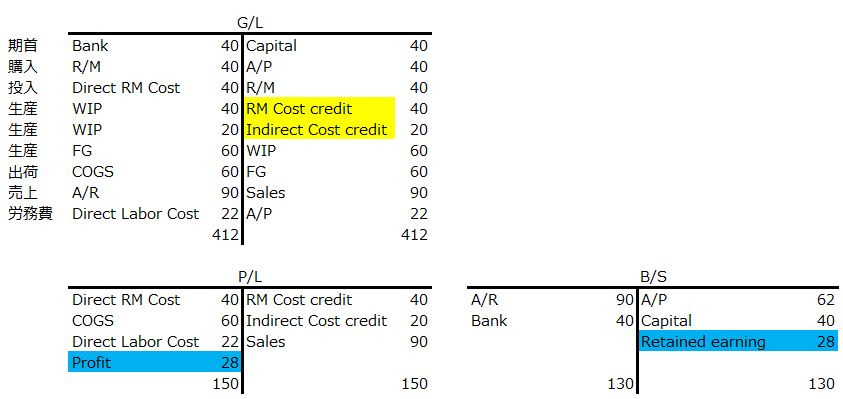
To leave the balance of incurred expenses recorded in input results, it is indirectly transferred to the manufacturing results asset (F/G) as a negative cost (R/M Cost Credit) account, and the remaining F/G balance after being costed as a positive cost (COGS) at the time of sale remains as the asset of ending finished goods.
Production results are a set of journal entries for input results and manufacturing results.
- Input Results
- (Debit) Direct R/M Cost (Credit) R/M
- Manufacturing Results
- (Debit) F/G (Credit) R/M Cost Credit (Expense Contra Account)
- (Credit) Direct Labor Cost Credit (Expense Contra Account)
- When Labor Costs are Determined
- (Debit) Direct Labor Cost (Credit) A/P
- At the Time of Sale
- (Debit) COGS (Credit) F/G
- (Debit) A/R (Credit) Sales
The balance of the expense contra (negative expense) account is included in the product (F/G), and by being costed (COGS) at the time of sale, the current period Gross Profit is correctly calculated.
- At the Time of Closing
- Sales - COGS = Gross Profit
By transferring the opening stock to a positive cost and the closing stock to a negative cost, the portion that was fully expensed at the time of purchase but remained in the closing stock is deducted, and the profit and loss are determined.
Through transfer to other accounts, such as transferring spoilage costs within manufacturing cost or removing them from cost of sales, the costs are merely rearranged within the total expenses. Inventory shrinkage in the material warehouse is transferred to SGA through WIP transfer to other accounts, input losses or spoilage costs in the manufacturing process are transferred within manufacturing cost through WIP transfer to other accounts, and prototypes in the product warehouse are transferred to SGA through product transfer to other accounts.
-
-
Indirect Deduction of Manufacturing Costs and COGS through Account Transfers
Indirect deduction of manufacturing costs and COGS through account transfers involves processing spoilage costs without directly reducing WIP or…
続きを見る
Data Discrepancies Commonly Occurring at Month-End in Indonesian Business Systems
In Indonesia, foreign-owned companies (PMA) are treated as large enterprises, meaning they are required to undergo external audits even if they would be considered small or medium-sized enterprises in Japan. Under Japanese corporate law, only large enterprises with capital of 5 billion yen or more or liabilities of 20 billion yen or more are mandated to have accounting audits, but the regulations differ in Indonesia.
External audits typically involve accounting audits by external auditors, but since the establishment of JSOX (rules on internal control under the Financial Instruments and Exchange Act established in 2006), operational audits evaluating compliance with internal controls have also been emphasized.
Examples where A/P and A/R balances do not match G/L account balances include the following cases:
- The B/S beginning balance of A/R and the previous month's A/R Aging balance do not match because A/R journal entries (such as Credit Note/Debit Note) are directly entered from the G/L.
- The monthly A/R list does not match the G/L Sales because part of the A/R is processed as a Down Payment, and the Sales have not yet been recorded. It is necessary to transfer the Down Payment to Sales according to the progress.
- When recording A/R and A/P, it may not be possible to separate between departments, leading to an inability to manage inter-departmental profit and loss in accounting.
- Adjustments (discounts, taxes, exchange rates) made in the G/L after closing can cause discrepancies between the total monthly A/R list and the current month's A/R total in the G/L.
- The exchange rate revaluation target is the current A/R balance, so if the previous month's revaluation is incomplete and the current month's settlement is prematurely entered, the previous month's A/R balance may be 100, but the G/L revaluation is done against 98, resulting in incorrect unrealized exchange gain/loss journal entries.
- Since the G/L A/R does not have department codes, it cannot be compared with the departmental aggregation of A/R. B/S accounts are not subject to profit and loss management, so the G/L may not have department codes or may have a representative department. To perform departmental aggregation in the G/L, it is necessary to carry over the sales department in charge at the time of order registration to A/R or to input the sales department in charge when A/R occurs, thereby carrying over the department code to A/R settlements and the G/L, and carrying over the departmental and currency-specific balances as the beginning balance of the next month.
To resolve these issues, it is important to review system settings and operational methods and establish appropriate internal controls.
-
-
Accounting System Discrepancy Issues in Japanese Manufacturing Companies in Indonesia
Data discrepancies in Japanese manufacturing companies in Indonesia are common due to functional integration issues between business systems. These…
続きを見る
Impact of Inventory Discrepancy Accounting on Profit
The method of handling inventory discrepancies varies depending on whether the manufacturing department is charged as manufacturing costs, reducing gross profit, or the sales department is charged as selling and administrative expenses, reducing operating profit. Specifically, the following four methods can be considered:
- Expense Recognition (Debit) Expense (Credit) Work in Progress
- Temporary Account Transfer (Debit) Temporary Account (Credit) Work in Progress
- Offset by Increasing Fixed Asset Valuation (Debit) Increase in Fixed Asset Valuation (Credit) Work in Progress
- Offset with Retained Earnings or Legal Reserves (Debit) Retained Earnings (Credit) Work in Progress
If there is an input omission when an NG occurs, correcting the manufacturing record results in "Defective Cost/Work in Progress," which compresses gross profit by incorporating it into manufacturing costs. Additionally, if included in cost of sales as defective cost in month-end adjustment journal entries, it compresses gross profit. When recorded as an extraordinary loss under non-operating expenses, it also compresses operating profit.
President Nixon of the United States advocated for an "honorable withdrawal" to end the Vietnam War, but when systems exhaust field operators, "manualization of the system" can sometimes boost morale and improve work efficiency.
-
-
Impact of Inventory Discrepancy Accounting on Profit
The accounting treatment of inventory discrepancies affects gross and operating profits. Systemization may not always lead to increased efficiency.
続きを見る
Reasons Why Understanding Business Operations Is Necessary Even When Promoting DX in Indonesia
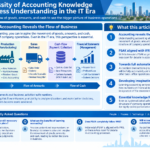
Automation through IT increases accuracy and improves work efficiency. However, for complex thinking and innovation, it is essential to have a systematic memory of the basics of business operations. Even with the advent of real-time translation machines, learning English does not become unnecessary. While translation machines can handle reading and writing on the spot, there are limitations to the ideas generated within the framework of converting between Japanese and English.
No matter how much information can be searched in this era, the depth of thought differs depending on whether the knowledge is internalized. If knowledge does not come to mind instantly when needed, it is as if it is unknown. Memorized knowledge acts as a hook, connecting with new knowledge and experiences to form a line, leading to an understanding of business operations as a form of education.
-
-
The Necessity of Accounting Knowledge and Business Understanding in the IT Era
Understanding accounting helps visualize the movement of goods, amounts, and cash, revealing company operations. With PSAK aligning with IFRS, accounting…
続きを見る
Revenue and Operational Improvement in Indonesia Post-COVID
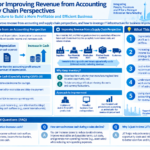
In the world of accounting, it is said that "cash is generated from profit and depreciation." This means that a company's cash sources are twofold: profit and depreciation. Depreciation is an expense without cash outflow, and it is merely a numerical play that the actual profit is higher by the amount of depreciation than the current profit amount on the P/L. Rather than physically generating cash, it means that by deducting depreciation from profit, taxable income is reduced by the amount of depreciation, thus lowering the tax burden = increasing cash.
During the COVID pandemic from 2020 to 2021, the decline in operating rates caused fixed costs such as labor and equipment costs to be heavily allocated to the cost of products with low output, increasing costs and squeezing profits. As a fundamental solution, it is necessary to improve operations such as just-in-time production, which starts manufacturing when materials are received and ships when completed, multi-skilled workers, and converting internal setups to external setups.
By implementing these improvements, companies can build an efficient production system and enhance profitability.
-
-
Methods for Improving Revenue from Accounting and Supply Chain Perspectives
Explore methods for improving revenue from accounting and supply chain perspectives, utilizing IT infrastructure for business improvement. Systemization is…
続きを見る
The Concept of Assets as Debit and Liabilities as Credit
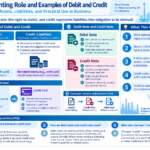
Debit is your own money, and credit is borrowed money. When considering the source of payment, debit is an asset (debit side), and credit is a liability (credit side).
Amount adjustments without transactions are done using a Debit Note (DN) or Credit Note (CN).
- The right to claim overpaid amounts is issued to the other party with a Debit Note, and a claim is made. Some companies refer to invoices as Debit Notes.
- The obligation to pay over-received amounts is issued to the other party with a Credit Note, indicating that claiming is acceptable.
To clearly indicate "this photo is not mine but borrowed," a photo credit (credit side) signifies the occurrence of a liability. Additionally, a reduction in additional software licenses means a decrease in assets, resulting in a credit.
-
-
The Accounting Role and Examples of Debit and Credit
Debit represents assets and credit represents liabilities. Debit notes and credit notes are important tools for adjusting asset changes.
続きを見る
Development of Attendance Management and Payroll System in Indonesia
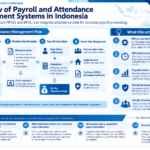
In Indonesia, it is common to use a time card (kartu absensi) to record clock-in and clock-out times. These time cards not only stamp the time when punched but also store data in internal memory, and some types allow data to be extracted in CSV file format via USB.
Additionally, in the Indonesian labor environment, high overtime rates are applied, such as 1.5 or 2 times the basic hourly wage for weekday overtime, and 2, 3, or 4 times for holiday overtime. This creates a situation where it is difficult to generate profit even when orders increase. As a result, there are reports of cases where it is challenging to achieve the break-even point, leading to a busy workload without increased profits.
-
-
Overview of Payroll and Attendance Management Systems in Indonesia
In Indonesia, payroll involves deducting personal income tax PPh21 and health insurance BPJS from salaries. Attendance management systems utilize time cards…
続きを見る
Capital Lease Contracts Depreciated as Lease Assets
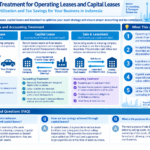
An operational lease is essentially the same as renting an asset from a leasing company, but capital leases (finance leases from the leasing company's perspective) and sale & leaseback are treated as one's own lease assets, resulting in depreciation expenses. After the lease period ends, these are transferred to fixed assets.
Let's explain the issue of double occurrence of PPN (value-added tax) that was once problematic. When purchasing an asset, PPN-In occurs, and when selling it to a leasing company, PPN-Out occurs. When the leasing company pays the debt and the asset is returned to the company at the end of the lease contract, PPN-In occurs again, resulting in value-added tax occurring twice in a single leaseback transaction. Furthermore, when the asset becomes the leasing company's, it can no longer be recorded as a loss through depreciation.
In the sale and leaseback method, after purchasing the asset, a contract is made with the leasing company. This contract is a financial transaction, and since no asset transfer occurs, it is non-taxable. At the end of the lease contract, only a transfer from lease assets to fixed assets is made. This allows for the reduction of lease liabilities over a long period without selling the asset, unlike short-term liabilities (A/P) that need to be settled quickly.
This prevents the occurrence of PPN-Out from selling to the leasing company and suppresses large expenditures at the time of machine purchase.
- (Debit) Plant & Machinery 1,000,000 (Credit) Lease A/P 1,000,000
- (Debit) PPN-in 110,000 (Credit) A/P 110,000
Lease contract amount
- (Debit) Lease asset 1,000,000 (Credit) Plant & Machinery 1,000,000
Monthly lease payment
- (Debit) Lease A/P 27,777 (Credit) Bank 27,777
- (Debit) Depreciation 8,333 (Credit) Accumulated depreciation 8,333
After the lease contract period ends, conversion of lease assets to fixed assets
- (Debit) Plant & Machinery 1,000,000 (Credit) Lease asset 1,000,000
At the time of monthly payment
- (Debit) Depreciation 8,333 (Credit) Accumulated depreciation 8,333
In this way, in a capital lease contract, the lease asset is depreciated and treated as a fixed asset after the lease period ends.
-
-
Accounting Treatment for Operating Leases and Capital Leases
Operating leases involve renting assets and recording them as expenses, while capital leases record leased assets as fixed assets with depreciation…
続きを見る
Processing of Prepaid and Deferred Revenue in Accounting Systems
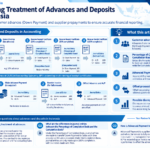
Deferred revenue from clients is not immediately recorded as sales but is first processed as a Down Payment. It is then transferred to sales and recorded as such upon obtaining the Surah Terima Berita Acara (receipt certificate).
- (Debit) A/R 50 (Credit) Down Payment 50
■ Upon receipt of 50% of the Surah Terima Berita Acara for DP
In the case of the Percentage of Completion Basis
- (Debit) Down Payment 25 (Credit) Sales 25
In the case of the Completion Basis
- No journal entry
■ Upon receipt of the remaining Surah Terima Berita Acara for DP
In the case of the Percentage of Completion Basis
- (Debit) Down Payment 25 (Credit) Sales 25
In the case of the Completion Basis
- (Debit) Down Payment 50 (Credit) Sales 50
■ Upon receipt of the Surah Terima Berita Acara for the entire order amount
- (Debit) A/R 50 (Credit) Sales 50
Since it is processed as a Down Payment, the conversion to sales may span across months. During the period between shipment (service provision) and invoice issuance, comparing the A/R balance and sales in the accounting G/L on a monthly basis will show a discrepancy with excess AR.
Prepayments to suppliers (Deferred expense) are not immediately recorded as purchases but are processed as Advanced Payment and transferred to purchases to be recorded as expenses upon confirmation.
- (Debit) Advanced Payment 100 (Credit) A/P 100
- (Debit) Purchase 100 (Credit) Advanced Payment 100
-
-
Accounting Treatment of Advances and Deposits in Indonesia
In Indonesia, advances from customers are processed under the Down Payment account when the invoice is issued. Discrepancies may occur between the invoice…
続きを見る
Paid and Free Supply to Subcontractors in Indonesia
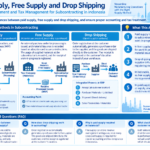
In drop shipping processes, where suppliers ship directly, 'receipt record + purchase registration + shipment record + sales registration' are executed together upon receipt. If a return from a customer occurs, both a sales return and a purchase return need to be executed. If only a sales return is performed, inventory will remain in the virtual warehouse for direct shipping, where there should be no stock.
Additionally, canceling a supplier direct shipping process should automatically trigger the cancellation of sales registration, shipment record, and purchase registration through the cancellation of the receipt record. If only the shipment record is canceled, the shipment record linked to the direct shipping will be lost when the receipt record is canceled, potentially causing data inconsistencies.
Free supply involves the movement of materials, so there is no journal entry. Paid supply involves selling materials to subcontractors and buying them back as products, but to avoid double booking of sales for the material portion during product sales, sales are not recorded for subcontractors, and the material reduction is recorded as accounts receivable (asset).
(Debit) Accounts Receivable 120 (Credit) Materials 100
(Credit) Material Supply Profit 20
Paid supply involves selling materials, which are supply items, to subcontractors, making them assets of the subcontractor. When buying back the product after subcontractor processing at 'material cost + processing cost', accounts receivable is transferred to subcontracting processing costs.
Paid supply is similar to regular sales transactions, with the difference from supplier direct shipping being whether the subcontractor orders the materials or the customer orders the product, from the perspective of journal entries.
-
-
Accounting Treatment and Tax Management of Paid and Free Supply
Paid supply involves selling materials to subcontractors and purchasing the work-in-progress after processing. In Indonesia, paid supply is required as free…
続きを見る
Key Points for Implementing an Accounting System in Indonesia
How to Design Chart of Accounts
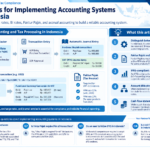
In designing the chart of accounts, it is important to subdivide cash accounts (cash, current deposits, fixed deposits) using sub-accounts. Cash should be divided by currency (IDR, USD, JPY, etc.), and current deposits should be divided by bank & currency (SMBC-IDR, BOTM-USD, etc.).
Since the G/L is accompanied by department codes, customer codes (employee codes), and currency codes, there is no need to subdivide A/R or A/P accounts by department, customer, or currency. Group them based on the nature of the customer, such as within or outside the group, and domestic or international.
The accounting system has RDLC or Crystal Report templates for management reports that aggregate revenue and expense accounts horizontally by department and customer from the P/L menu. However, if you want to aggregate amounts by row vertically, you need to separate accounts by department and customer.
- Subdivide cash accounts (cash, current deposits, fixed deposits) using sub-accounts. Cash should be divided by currency (IDR, USD, JPY, etc.), and current deposits should be divided by bank & currency (SMBC-IDR, BOTM-USD, etc.).
- Since the G/L is accompanied by department codes, customer codes (employee codes), and currency codes, there is no need to subdivide A/R or A/P accounts by department, customer, or currency. Group them based on the nature of the customer, such as within or outside the group, and domestic or international.
- The accounting system has RDLC or Crystal Report templates for management reports that aggregate revenue and expense accounts horizontally by department and customer from the P/L menu, but if you want to aggregate amounts by row vertically, you need to separate accounts by department and customer.
The design of the chart of accounts plays an important role in a company's financial management. Proper subdivision and grouping enable efficient data management and analysis.
-
-
Key Points for Implementing Accounting Systems and Tax Compliance in Indonesia
Implementing an accounting system in Indonesia requires distinguishing between tax and BI rates. Faktur Pajak is essential for VAT declarations, with a PPN…
続きを見る
Essential Tax Knowledge in Indonesia When Implementing an Accounting System
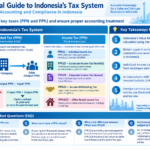
In Indonesia, there is a tax equivalent to Japan's consumption tax called PPN (VAT = Value Added Tax). The Indonesian tax system adopts the invoice method, calculating PPN payments and refunds based on the Faktur Pajak (Tax Invoice). This method determines the tax amount based on invoices, differing from the bookkeeping method.
Regarding income tax, PPh21 is the personal income tax withheld from salaries. Corporate income tax includes PPh25 (Bulanan), which is a monthly payment based on the estimated tax amount calculated from the previous year's income, and PPh29 (Tahunan), which is the balance paid at the end of the year after withholding.
There is also PPh23, which is withholding tax on service income obtained by Indonesian residents, PPh4(2) on office rental fees, and PPh26, which is withholding tax on service income (such as dividends) obtained by non-residents of Indonesia.
This tax knowledge is crucial when implementing an accounting system in Indonesia.
-
-
Detailed Explanation of Indonesia's Tax System and Accounting Procedures
This article provides a detailed explanation of Indonesia's tax system and accounting procedures, focusing on Value Added Tax (PPN) and Income Tax (PPh). It…
続きを見る
Manufacturing DX Achieved with Hanafirst ERP's Accounting Module
By generating automatic journal entries from business data such as sales, purchasing, and cash flow, and integrating them into the general ledger, the dependency on manual input in accounting can be reduced. The control of monthly closing processes such as period lock, foreign currency revaluation, VAT, and fixed assets can also be gradually strengthened.
From the perspective of implementing the principles of the accounting hub (accrual basis, inventory synchronization, closing process) on the field system side, the module design and implementation order are organized.
FAQ | Accounting Systems and Journal Entries
We organize common questions that arise in practice at the accounting hub according to the principles in the main text.
What is the difference between the perpetual inventory system and the periodic inventory system?
The perpetual inventory system records inventory increases and decreases each time, while the periodic inventory system organizes purchases, carryovers, and cost of goods sold at the end of the period. In systemization, the design points are how to connect the timing of warehouse entries and exits with the general ledger.
What is the significance of adopting the accrual basis with the shipping and receiving criteria?
It is the principle of recognizing revenue and expenses based on the occurrence of transactions rather than cash flow. By recording sales and purchases at the timing of shipping and receiving, monthly profit and loss and inventory become closer to the actual business conditions.
What does the Hanafirst accounting module automate?
It generates automatic journal entries from business data such as sales, purchases, and cash flow, integrating them into the general ledger. It can also gradually enhance controls for monthly closing, such as period locking, foreign currency revaluation, VAT, and fixed assets.