


Regarding the concern, “Does advancing IT eliminate the need to spend time understanding the essence of operations?” I would answer that understanding operational mechanisms is beneficial because it enables one to imagine how the world works. If you understand bookkeeping, you can envision the movement of goods, amounts, and cash, as well as the mechanisms of company management. Accounting System in Indonesia The cloudification of accounting systems is advancing in Indonesia, with the three major local cloud systemsAccurate, Zahir, and Jurnalleading the market. However, in reality, it is said that fewer than 8% of domestic companies have implemented accounting systems. This is why new cloud-based accounting systems continue to be launched in what might seem like an already saturated Indonesian market. It suggests that both domestic and international IT startups see significant potential for cloud accounting systems to expand their market share locally. In Indonesia, automated journal entries due to the widespread use of accounting systems have become commonplace, and over the ... 続きを見る

The Most Critical Concern: “Does Advancing IT Eliminate the Need to Spend Time Understanding Operations?”
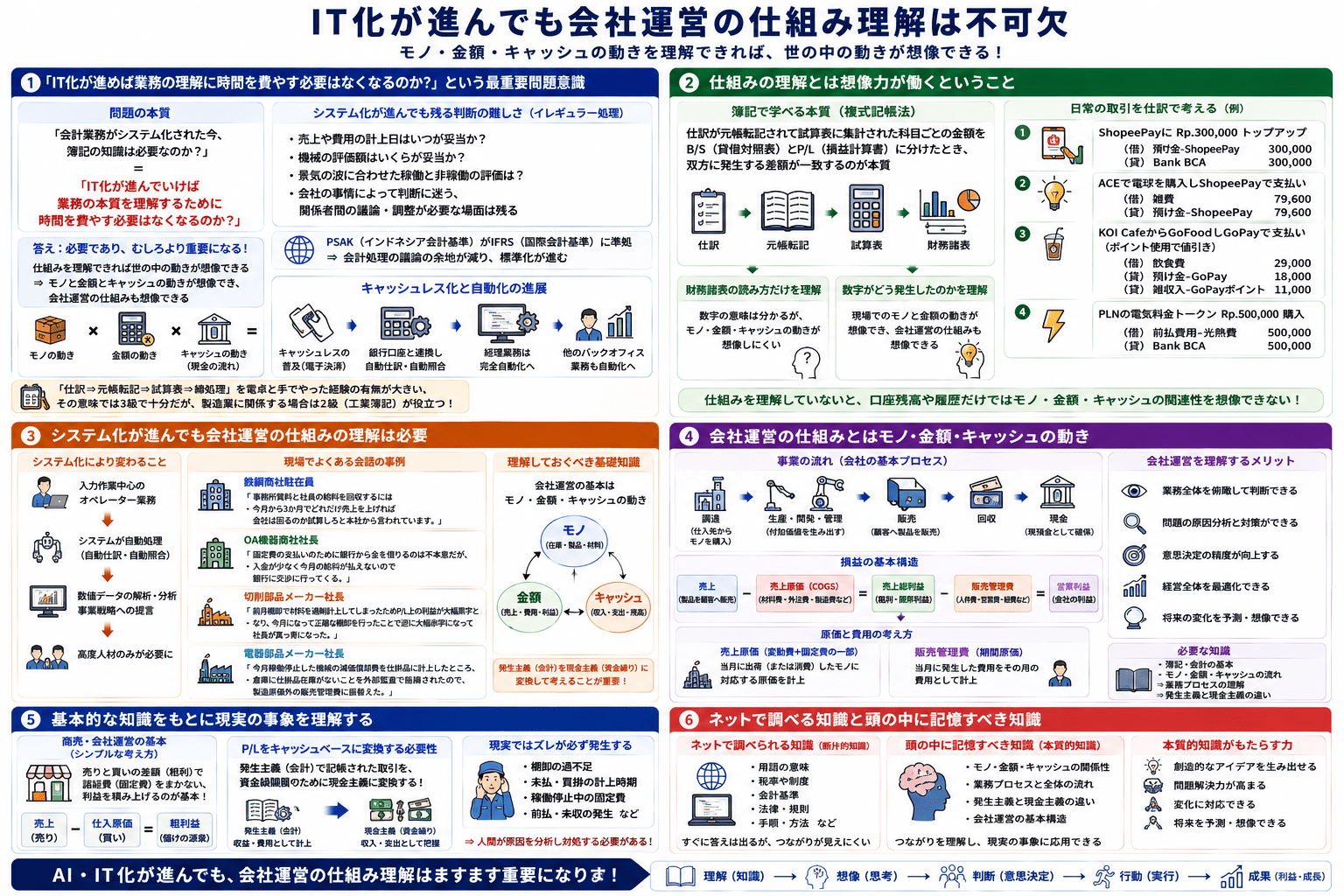
The question, “Is bookkeeping knowledge necessary now that accounting tasks are systemized?” can be rephrased as, “Does advancing IT eliminate the need to spend time understanding the essence of operations?” For someone like me, whose livelihood involves developing and implementing business systems, this is a profoundly important concern.
Even as systemization has progressed, operations still encounter irregular cases requiring judgment based on company circumstances—e.g., “What’s the appropriate posting date for sales or expenses?” or “What’s a fair valuation for machinery purchased and operated intermittently due to economic cycles?” These situations often necessitate discussions and adjustments among stakeholders, hindering full automation. The Fun and Challenges of Accounting Conceived in Indonesia Accounting is a puzzle-like mechanism where a single transaction is recorded on two sides—debit and credit—incorporating the difference between expenses and revenues into net assets, balancing the equation "Assets = Liabilities + Net Assets." Cash flow management involves adjusting accrual-based transaction entries to a cash basis to track the movement of cash and deposits. 続きを見る
This difficulty stemmed from the lack of unified judgment criteria between acquisition cost (historical cost) and current valuation (market value). In the two-dimensional world of accounting software or ledgers, incorporating the concept of time to evaluate and record physically invisible transaction entries was challenging. However, with Indonesia’s accounting standard, PSAK (Pernyataan Standar Akuntansi Keuangan), aligning with the global IFRS (International Financial Reporting Standards), the room for debate in accounting treatments has decreased.

In Indonesia, bank ATM cards double as debit cards, and digital payment methods like GoPay, OVO, and ShopeePay—offering cashback and point perks—have become widespread. Personally, I rarely use cash in daily life anymore. If all corporate transactions also become cashless, linked to bank accounts with automatic journal entries and system-bank reconciliation checks becoming standard, accounting tasks would be fully automated, paving the way for automation in other back-office functions like sales and purchasing.
In such a scenario, once departmental tasks are automated, the necessary knowledge shifts to understanding the company’s overall operational mechanisms as an organization—specifically, “the movement of goods, amounts, and cash,” which I consider the essence of operations.
Understanding Mechanisms Means Engaging Imagination
What bookkeeping teaches is the essence of double-entry bookkeeping: when journal entries are posted to the ledger and aggregated into trial balance amounts, separating them into balance sheet (B/S) and profit and loss (P/L) accounts results in matching differences on both sides. There’s a significant gap in imagination between merely understanding how to read financial statements and grasping how the figures in those statements came to be—imagining the movement of goods, amounts, and cash.
For example, today I topped up ShopeePay with Rp.300,000, bought a light bulb at ACE using ShopeePay (earning points), ordered from KOI Cafe via GoFood and paid with GoPay using points for a discount, and purchased a Rp.500,000 PLN electricity token via BCA mobile banking.
- Top-up ShopeePay via BCA Virtual Account
(Debit) Prepaid-ShopeePay Rp.300,000 (Credit) Bank BCA Rp.300,000 - Purchase light bulb at ACE, paid with ShopeePay
(Debit) Miscellaneous Expense Rp.79,600 (Credit) Prepaid-ShopeePay Rp.79,600 - Order from KOI Cafe via GoFood, paid with GoPay
(Debit) Meal Expense Rp.29,000 (Credit) Prepaid-GoPay Rp.18,000
(Credit) Miscellaneous Income-GoPay Points Rp.11,000 - Purchase PLN electricity token
(Debit) Prepaid Expense-Utilities Rp.500,000 (Credit) Bank BCA Rp.500,000
The points accumulated via ShopeePay today will eventually be used and recorded as miscellaneous income. While I feel I’ve saved money at the point of payment, by month-end, when I check my BCA transaction history and GoPay/ShopeePay balances without recalling what I bought, it’s hard to imagine the connections between goods, amounts, and cash movements.
You can understand financial statement mechanics without studying bookkeeping, but studying it enables you to imagine on-site activities—meaning you can envision the movement of goods, amounts, and cash, and thus the mechanisms of company management.
This is why, beyond English, accounting is often cited in discussions about “what students should study,” and recently programming too, for similar reasons. Even if you don’t work in IT, in today’s IT-driven world, knowing the mechanisms of programs controlling visible hardware (akin to systems engineering in the Information Processing Exam) lets you imagine how the world works.
Understanding Company Management Mechanisms Remains Necessary Even with Systemization
Recently, a friend running an accounting firm in Jakarta told me they’re starting bookkeeping classes for Indonesian accounting staff at Japanese companies. It made me realize Indonesia lacks accounting vocational schools like TAC or Ohara in Japan.
Accounting tasks, being easily standardized, are prime candidates for systemization among back-office functions. If the work centers on system input, staff with minimal bookkeeping knowledge can manage. As full automation advances, mere input operators may be the first to be cut.
In a fully automated world, companies won’t need back-office operators. Only highly skilled individuals who can analyze system-generated data and propose business strategies will remain.
For these skilled individuals, understanding company management mechanisms is essential. In times like now—when the WHO declares a pandemic and an economic crisis worse than the Lehman Shock looms—those who can objectively view operations and management to offer precise survival strategies are invaluable.
Company Management Mechanisms Are the Movement of Goods, Amounts, and Cash
A company’s purpose is to conduct business and generate profit. In Indonesia, local subsidiaries remit funds to Japan HQ under names like royalties or sales commissions for investment recovery while contributing to group-wide profit as part of consolidated financials.
To achieve this, the Indonesian subsidiary procures goods from suppliers, employs staff for production (development for software, management for trading firms), and sells products to customers, generating monthly revenue ultimately recovered as cash (cash and deposits).
The cost of procured goods, shipping, and employee salaries for development, production, or management form the cost of goods sold (COGS), while salaries for salespeople and campaign costs are selling, general, and administrative (SG&A) expenses.
- Sales – COGS = Gross Profit (Margin)
- Gross Profit – SG&A = Operating Profit
To clarify the costs incurred before selling products and earning profit, you must distinctly separate COGS (Cost of Goods Sold) for the products themselves and SG&A (Selling, General and Administrative expenses) for sales efforts.
While monthly SG&A expenses are always period costs incurred that month, the goods in that month’s COGS aren’t necessarily procured that month but are those shipped (or consumed) that month.
Moreover, concepts like procurement, production (development), and sales are recorded under accrual accounting as revenues and expenses when they occur. To monitor cash flow—the primary concern in real-world company management—you must convert these amounts to a cash basis, viewing income and expenditure movements.
Examples of Understanding Real Events Based on Basic Knowledge
Here are examples from actual customer conversations in Indonesia where understanding company management mechanisms was key to meaningful dialogue:
- HQ told me to calculate how much sales we need over the next three months starting this month to cover office rent and employee salaries and keep the company running.
For general retail or restaurants, you subtract procurement costs (variable costs) from sales to get gross profit (marginal profit), first covering fixed costs to break even, then building profit—an intuitive basic business model.
- I hate borrowing from the bank to pay fixed costs, but with low cash inflows, I can’t pay this month’s salaries, so I’m off to negotiate with the bank.
Fixed costs should ideally be covered by gross profit, but despite large P/L profits, low cash inflows forced this president to call a Japanese bank loan officer to cover salaries—a desperate move.
P/L transactions are recorded under accrual principles as expenses and revenues, so to see cash inflows, you must convert P/L to a cash basis, calculating how much cash operating activities generated.
- Last month’s inventory overstatement inflated P/L profits significantly. This month’s accurate count flipped it to a huge loss, leaving the president pale.
Unlike trading firms focusing on covering fixed costs with gross profit, manufacturers with diverse fixed costs emphasize COGS (variable costs plus fixed costs) and SG&A for sales.
Last month, (beginning material inventory + purchases – overstated ending inventory = understated COGS) led to (sales – understated COGS = overstated profit), a brief joy. This month, (overstated beginning inventory + purchases – ending inventory = overstated COGS) turned the P/L red, prompting an angry call—not a system issue, but an operational overstatement error.
- We posted depreciation for a machine halted this month to WIP, but an external audit flagged no WIP inventory in the warehouse, so we transferred it to SG&A outside manufacturing costs.
Manufacturing costs occur only in production months, but depreciation, a fixed cost, occurs regardless. Thus, (beginning WIP + manufacturing costs – ending WIP = manufacturing costs) showed an amount without corresponding goods movement.
Systems automatically record transactions under accrual principles, but discrepancies with on-site goods movement are common, requiring humans to analyze causes and understand cost generation processes.
Knowledge to Search Online vs. Knowledge to Retain in Memory
In an era where smartphones let you search for any information, why memorize company management mechanisms? It’s necessary for creative discussions based on real events, as shown above.
This parallels the debate: “If real-time translators exist, is English study unnecessary?” While a translator handles reading and writing, ideas born within the Japanese-to-English conversion framework are limited, and risks of miscommunication from differing thought patterns persist.
The movement of goods, amounts, and cash—the basics of company management—is the essence of operational knowledge. Unlike fragmented facts, it’s a source of new ideas for problem-solving. Rather than memorizing searchable facts, understanding and organizing essential knowledge systematically in your mind remains vital even in a systemized future.