


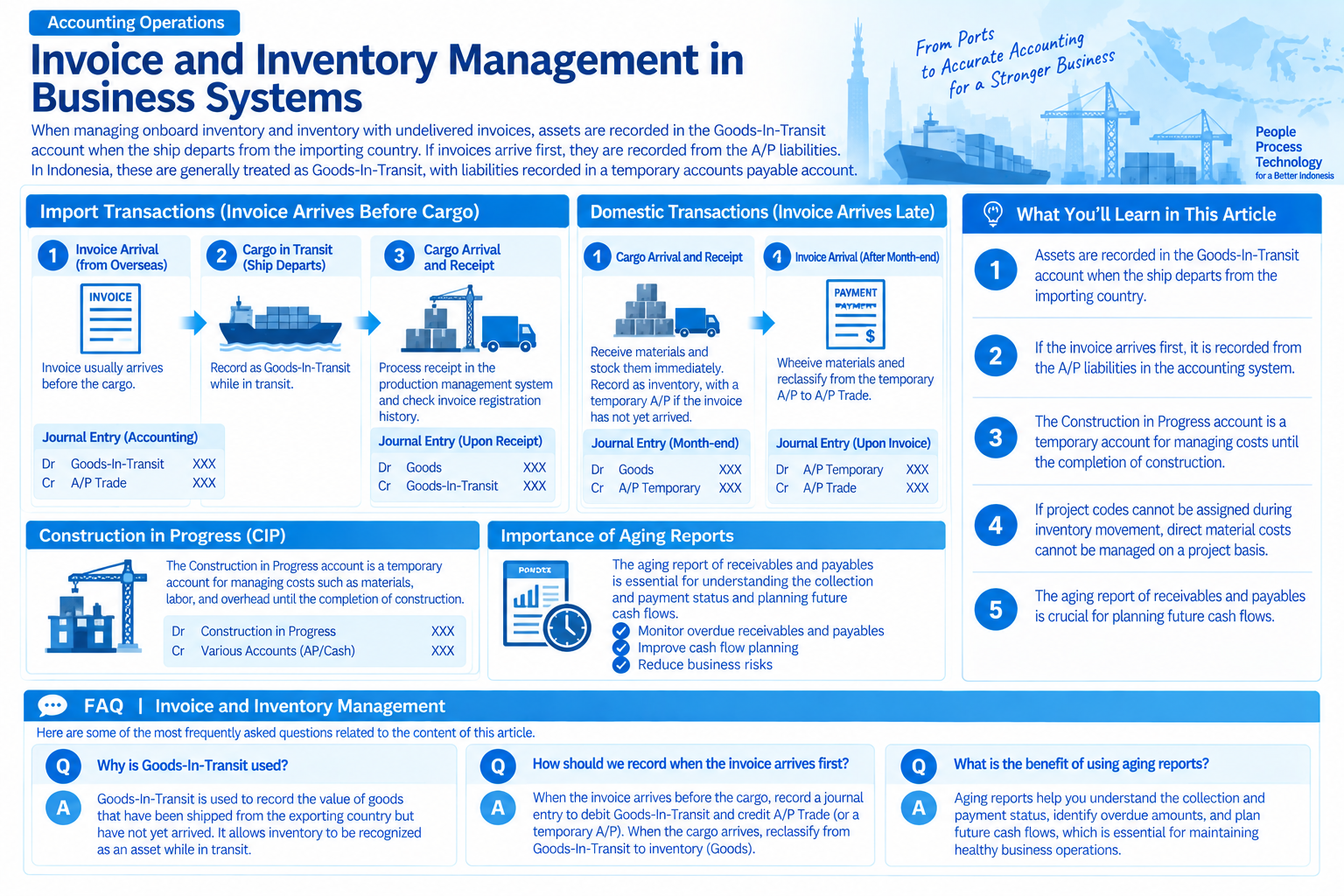
When managing onboard inventory and inventory with undelivered invoices in the business system, assets are recorded in the Goods-In-Transit account when the ship departs from the importing country. Goods shipped for consignment sales are recorded in the consignment account. In Indonesia, these are all treated as Good In Transit, and liabilities are recorded in the temporary accounts payable account.
-
-
Accounting Systems in Indonesia
The adoption rate of SaaS-based accounting systems in Indonesia is less than 8%, despite the advancement of SaaS technology. The continuous launch of new…
続きを見る
What this article covers
- Assets are recorded in the Goods-In-Transit account when the ship departs from the importing country.
- If the invoice arrives first, it is recorded from the A/P liabilities in the accounting system.
- The Construction in Progress account is a temporary account for managing costs until the completion of construction.
- If project codes cannot be assigned during inventory movement, direct material costs cannot be managed on a project basis.
- The aging report of receivables and payables is crucial for planning future cash flows.
Invoices Arrive Before Cargo in Imports
In imports from overseas, invoices usually arrive before the cargo. However, since the production management system cannot register undelivered invoices, they are recorded from the A/P liabilities in the accounting system. At this time, an automatic journal entry records the cargo in transit in the Goods-In-Transit account.
Automatic journal entry from accounting A/P upon invoice arrival
- (Debit) Good-InTransit (Credit) A/P trade
In subsequent months, when the cargo arrives, the production management system processes the receipt and registers the invoice, interfacing the receipt results to the accounting system. The interface system checks the A/P invoice registration history in the accounting system based on the receipt results of the production management system, and if the invoice is registered, it generates a journal entry to transfer from Good-In-Transit to Goods and registers it in the general ledger (G/L) of the accounting system.
Automatically generated in G/L from receipt and invoice registration process upon cargo arrival
- (Debit) Goods (Credit) Good-InTransit
The final settlement process is carried out using the A/P clearing function of the accounting system as usual.
Cases Where Invoices Arrive Late in Domestic Transactions
If the cargo from the supplier arrives and the invoice arrives within the month, normal receipt processing and invoice registration processing are performed. Using the interface system, the A/P invoice registration history of the accounting system is checked based on the receipt results of the production management system, and if the invoice is registered, it is registered in the A/P of the accounting system.
- (Debit) Goods (Credit) A/P trade
However, if the invoice arrives after the month-end, it becomes complicated. The received materials need to be immediately stocked and used, so receipt processing is performed, but invoice registration must be done in the same month as the receipt for month-end processing. To reflect the cost of production for materials used immediately upon receipt, a temporary invoice is registered even if the invoice has not arrived by the end of the month, and month-end processing and cost reflection are performed.
Automatically generated in the general ledger (G/L) from receipt and temporary invoice processing upon cargo arrival
- (Debit) Purchase expense (Credit) A/P-In-Transit (A/P Accrued)
Upon invoice arrival, the accrued account A/P Accrued is transferred to A/P.
Automatic journal entry from accounting A/P upon invoice arrival
- (Debit) A/P-In-Transit (A/P Accrued) (Credit) A/P trade
Accrued accounts (items that become expenses or revenues over time) are represented by accrued expenses, but A/P-In-Transit (A/P Accrued) is not an expense, making it difficult to assign an appropriate translation such as unrealized liabilities, pre-recorded receivables, or temporary accounts payable.
Construction in Progress and Work In Process Accounts
The Construction in Progress account is a temporary account used to manage costs such as advance payments or prepayments for construction costs, material costs, labor costs, and expenses until the completion or delivery of tangible fixed assets. When importing factory equipment from Japan under an FOB contract, it becomes the company's asset upon departure, but freight charges, customs duties listed on the PIB (import declaration), PPh21 taxes, SPPB (customs clearance permit) costs, and other CIF costs are incurred later, so they are temporarily recorded in the Construction in Progress account before the amount is finalized and incorporated into fixed assets.
The Construction in Progress account is limited to "fixed assets intended for internal use," and items under construction as fixed assets for sale are distinguished as Cost of Uncompleted Contracts, although this separation is not often seen in Indonesia. If they are inventory for future sale, they are recorded in the Work In Process account.
- (Debit) Construction in Progress (Credit) Current Account
- (Debit) Tangible Fixed Assets (Credit) Construction in Progress
Inventory Movement and Inventory Transfer
In ERP package systems for non-manufacturing industries, inventory movement processing may exist, but inventory transfer processing is often absent, which becomes a constraint when applying it to manufacturing industries. In manufacturing, purchased items undergo various processes and change form, eventually being shipped as products. To meet the requirements for changing materials into work in process with inventory movement to subcontractors, the following constraints exist in non-manufacturing systems linked with the accounting module.
- Project codes cannot be assigned for cost management during inventory movement (as no costs are incurred).
- Item codes cannot be changed in inventory management during inventory movement (as it is only a location move).
To meet the requirement of assigning project codes during the movement of materials (R/M) to subcontractors and managing them as work in process (WIP) by project, automatic journal entries must be generated during inventory movement, and management by project in the general ledger (G/L) must be possible. However, since no costs are incurred during inventory movement, project codes cannot be assigned and accumulated as costs in the work in process account.
To assign project codes during the movement of goods to subcontractors and manage costs by project in the ledger, and to change item codes, it is necessary to generate both receipt and payment records through inventory transfer. However, two-step processing of payment and receipt is required, and the transfer is performed with the following two journal entries.
- (Debit) Temporary (Credit) R/M
- (Debit) WIP (Credit) Temporary
If the project code is determined when receiving purchased items, it is possible to record them in the material account by project upon receipt. This allows project codes to be assigned in the ledger, enabling project-based cost management. However, realistically, it is rare for project codes or internal uses such as product groups to be determined at the time of material purchase, and it is common for the use to be determined during the receipt and payment process.
Timing of Expense and Revenue Occurrence
The timing of expense and revenue occurrence in business systems is classified into the following four categories.
- Upon invoice issuance (asset increase, sales increase)
- Upon material consumption (R/M Usage) (COGS increase, asset decrease)
- Upon invoice receipt (expenses to be later costed as COGS increase, liabilities increase)
- Upon other expense recognition (expense increase, liabilities increase)
Project codes can be assigned at these timings. However, if project codes cannot be assigned during inventory movement, direct material costs cannot be managed on a project basis until shipment. During subcontractor manufacturing, only factory overhead (FOH) and labor costs incurred during the period can be managed.
Only upon shipment is the overall cost management table, including direct material costs, completed. Additional material costs incurred on the subcontractor side can be assigned project codes and transferred to COGS upon invoice arrival from the subcontractor.
- (Debit) Expense work 100 (Credit) A/P 100
- (Debit) COGS 100 (Credit) Expense work 100
Case: An example of journal entry at the time of shipment includes the transfer of Shipping Clearing and Inv. Item.
- (Debit) Shipping Clearing 100 (Credit) Inv. Item 100
Case: Upon invoice issuance, transfers of A/R and Sales, COGS and Shipping Clearing are performed.
- (Debit) A/R 100 (Credit) Sales 100
- (Debit) COGS 80 (Credit) Shipping Clearing 80
Offset Processing by Contra Account
Transportation costs and other expenses are assigned project codes and accumulated in work in process. Upon revenue recognition, the accumulation of work in process is costed as COGS.
- (Debit) Transportation expense 100 (Credit) Petty Cash 100
Thus, at the time of transaction, a journal entry of expense plus asset minus occurs, but this expense should be reflected in COGS as work in process. In other words, it means that the valuation of work in process increases simultaneously with the occurrence of expenses.
- (Debit) WIP 100 (Credit) Transportation Payable 100
A contra account is used to offset a specific account, and the transportation expense is transferred to work in process using a temporary account (P/L account). However, since the balance of transportation expense remains in the trial balance (T/B), it can be included in the P/L as is.
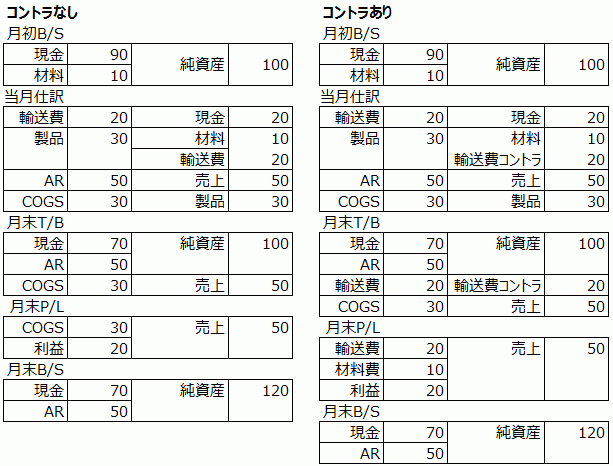
Examples of contra accounts include allowance for doubtful accounts and accumulated depreciation. These are negative asset accounts that indirectly reduce assets, allowing management of AR amounts in line with invoice amounts and maintaining acquisition amounts of fixed assets while understanding net amounts on the B/S.
- (Debit) Provision for doubtful accounts (plus expense) (Credit) Allowance for doubtful accounts (negative asset)
- (Debit) Depreciation expense (plus expense) (Credit) Accumulated depreciation (negative asset)
Method of Allocating Expenses to Projects
Direct material costs are automatically managed in the ledger by project code each time they are issued, but labor costs and factory overhead are allocated to projects when the amount is determined (e.g., at month-end). Labor costs are recorded as project costs based on "hourly rate x working hours" set in the employee master. However, since only one standard hourly rate can be set, manual adjustments are needed to reflect increased rates for holiday work or overtime when recording costs.
- (Debit) Salaries 200,000 (Credit) Bank 200,000
- (Debit) WIP 200,000 (Credit) Payroll payable (contra a/c) 200,000
A contra account is also needed to allocate labor costs to work in process. When calculating product costs at standard cost during the month, a journal entry to adjust the difference from actual costs at month-end is required.
Impact of Construction Projects on Cash Flow
In Indonesian factories, it usually takes about a week after product shipment to receive inspection completion reports from customers before invoice issuance is possible. However, in long-term construction projects, even if partial billing is possible based on progress, there may be a gap of several months between shipment and invoice issuance. This results in a backlog of orders that are registered but not yet recognized as sales.
Since it does not become revenue, profits on the P/L do not increase, and while waiting for invoice issuance, one must view a P/L in the red.
Regardless of profit, fixed costs are incurred at a constant amount each month. To avoid borrowing for fixed cost payments, management encourages sales to expedite invoice issuance. Sales secure customer approval for partial billing and feel reassured.
The aging report of receivables and payables is crucial for management to plan future cash flows. However, if there is a large backlog of orders, it becomes difficult to accurately grasp cash flow movements, and a system to input invoice issuance schedules upon order registration may be necessary.
Frequently Asked Questions | Accounting Processes in Invoice and Inventory Management
Based on the content of this article, frequently asked questions are briefly organized.
How is onboard inventory accounted for?
Onboard inventory is recorded in the Goods-In-Transit account when the ship departs from the importing country. Goods shipped for consignment sales are recorded in the consignment account, and in Indonesia, these are treated as Good In Transit. Liabilities are recorded in the temporary accounts payable account.
What is the process when invoices arrive late?
If invoices arrive after the month-end, temporary invoices are registered to immediately stock and use the received materials. This allows for month-end processing and cost reflection. Upon invoice arrival, the accrued account A/P Accrued is transferred to A/P.
How is the Construction in Progress account used?
The Construction in Progress account is a temporary account used for the construction or production of tangible fixed assets. When importing factory equipment, it is temporarily recorded in the Construction in Progress account before the amount is finalized and incorporated into fixed assets. If they are inventory for future sale, they are recorded in the Work In Process account.