


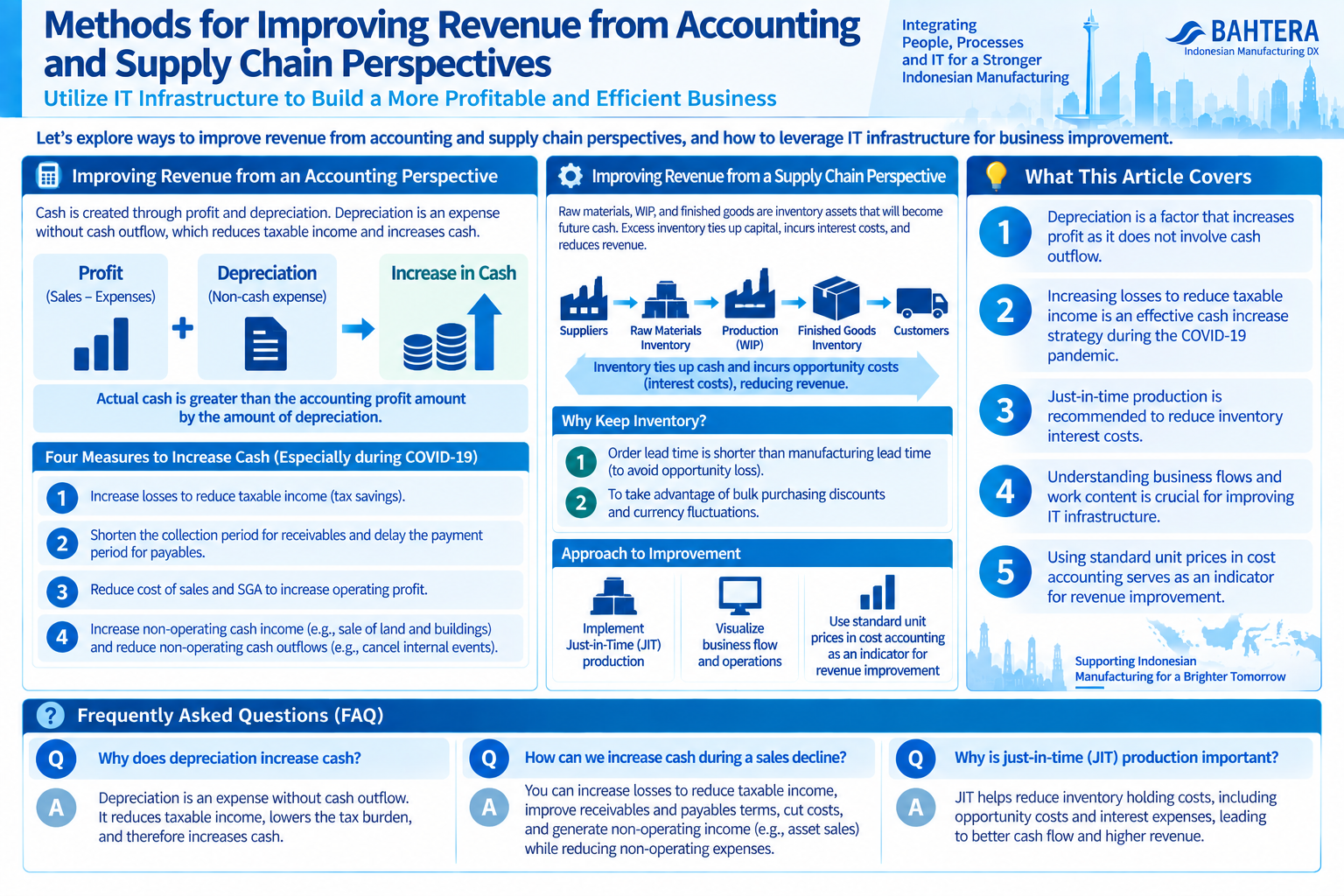
We will consider methods for improving revenue from accounting and supply chain perspectives, and how to utilize IT infrastructure for business improvement. To enhance operational efficiency, it is necessary to change the flow and structure of business data, and systemization is unavoidable.
-
-
Accounting Systems in Indonesia
The adoption rate of SaaS-based accounting systems in Indonesia is less than 8%, despite the advancement of SaaS technology. The continuous launch of new…
続きを見る
What this article covers
- Depreciation is a factor that increases profit as it does not involve cash outflow.
- Increasing losses to reduce taxable income is an effective cash increase strategy during the COVID-19 pandemic.
- Just-in-time production is recommended to reduce inventory interest costs.
- Understanding business flows and work content is crucial for improving IT infrastructure.
- Using standard unit prices in cost accounting serves as an indicator for revenue improvement.
Improving Revenue from an Accounting Perspective
In the world of accounting, it is often said that "cash is created through profit and depreciation." This means that a company's cash sources are twofold: profit and depreciation. Depreciation is an expense without cash outflow, meaning that actual profit is greater than the current profit amount on the P/L by the amount of depreciation. Rather than physically generating cash, depreciation reduces taxable income, lowering tax burdens and thus increasing cash.
In the context of declining sales due to the COVID-19 pandemic, there are four things that can be done to increase cash:
- Increase losses to reduce taxable income (tax savings).
- Shorten the payment terms for receivables from sales and delay the payment terms for liabilities from cost of sales.
- Reduce cost of sales and SGA to increase operating profit.
- Increase non-operating cash income through sales of land and buildings, and reduce non-operating cash outflows by canceling internal events.
Profit is "sales - expenses," and if core business sales do not increase, profit can only be increased by cutting expenses. In Jakarta, there are movements to reduce fixed costs by dismissing employees, terminating outsourcing contracts, cutting salaries, and canceling office space.
Throughout Indonesia, it is said that the number of employees dismissed (PHK) by April will reach 7 million, and as a result of brakes on office relocations and expansions, the occupancy rate of new office buildings in Jakarta is said to be around 70%.
Improving Revenue from a Supply Chain Perspective
Raw materials, WIP, and products are inventory assets that will become future cash, but they remain in warehouses, negatively impacting cash flow and causing opportunity losses in interest that could be earned if deposited in banks, as well as interest on loans for raw material procurement, thus squeezing revenue.
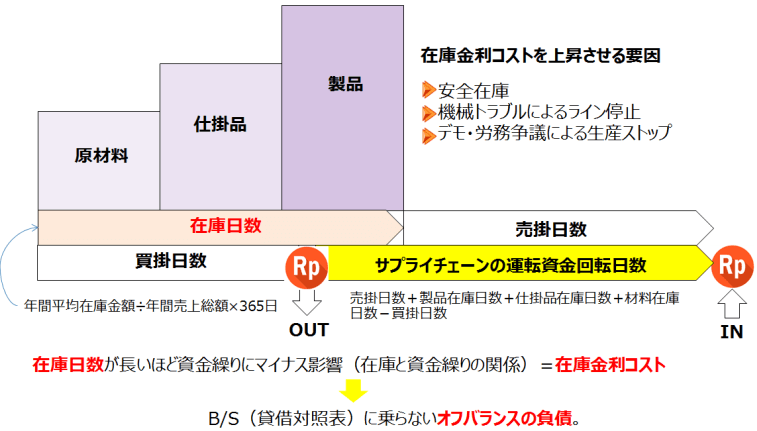
There are two reasons for holding inventory despite paying inventory interest costs. One is that the "order lead time" from receiving an order to shipment is shorter than the "manufacturing lead time" from start to finish, serving as insurance to cover the lead time difference. The other is the necessity of buffer inventory to prevent bottleneck processes that determine the productivity of the entire factory from stopping.
Case: Due to the US-China economic friction and the impact of COVID-19, reviewing imports from China, which has high supply chain risks, and establishing a system for local procurement that allows for immediate ordering and receipt at necessary times may be a business improvement possible now, as production has decreased due to the pandemic.
Starting production when materials arrive and shipping when completed, implementing just-in-time production, multi-skilled workers, and externalizing internal setups (preparing setups in advance to avoid stopping machines) can lead to improved production efficiency with limited workers after personnel reductions, contributing to revenue improvement.
Business Improvement from an IT Infrastructure Perspective
In building IT infrastructure, it is important to understand the current flow and content of operations, consider improvement methods for issues, and implement them into systems. Even with postponed IT investments due to the COVID-19 pandemic, business analysis and improvement can be pursued internally without spending money. The following two items are necessary for business analysis:
- Business flow: Necessary for an overview of the entire flow
- Work content: Necessary to understand the content of tasks that cannot be fully described in the business flow
When considering business improvement, it is based on the ECRS principles of Eliminate, Combine, Rearrange, and Simplify, reconstructing the business flow to achieve maximum results with minimal work burden, and creating a Standard Operation Procedure (SOP). To change how workers perform tasks, it is necessary to change the flow and structure of business data, but even if initially handled with Excel, systemization is unavoidable for improving operational efficiency.
In the post-COVID-19 business environment, it is expected that paperless and IoT initiatives will progress to minimize physical contact and sharing of items to reduce virus transmission opportunities, along with IT implementation for reviewing and improving existing operations.
Shifting from Cost Center to Profit Center
Cost accounting (actual cost) operations, which calculate how much cost was incurred in monthly production, are rarely systematized in Indonesia. Detailed calculations take time, and rough estimates do not provide the desired information. With more time available due to the pandemic, it is an excellent opportunity to review cost accounting methods from a revenue improvement perspective.
Revenue (profit) is "sales - expenses." From the perspective of expenses alone, business divisions may appear to incur only costs, but in reality, those expenses may drive significant sales. When reviewing cost accounting from a revenue improvement perspective, it is important to consider not only manufacturing costs but also to subtract the cost of sales and SGA from sales to view operating profit, incorporating management accounting elements.
- Manufacturing cost = Beginning WIP inventory + Manufacturing costs incurred during the month - Ending WIP inventory
- Cost of sales = Beginning finished goods inventory + Manufacturing cost during the month - Ending finished goods inventory
- Gross profit = Sales - Cost of sales
- Operating profit = Gross profit - SGA
In cost accounting for revenue improvement, upgrading the concept from cost center to profit center is necessary, moving from manufacturing cost to cost of sales, and from gross profit to operating profit.
Case: In Indonesia, there are many risks that drive up costs, such as the ongoing COVID-19 pandemic, volatile exchange rates and interest rates, annually rising minimum wages (UMK), supply chain power dynamics, unclear customs procedures during import/export, and tax risks. On the other hand, the demographic bonus, where the working-age population is more than twice the dependent population, is expected to continue until 2030, offering potential to boost sales.
In this high-risk, high-return country, both sales and expenses are determined by the flow of goods, money, and information through the supply chain in market-driven economic activities, making it challenging to continuously increase revenue. Post-COVID-19 revenue improvement strategies should not only focus on cost reduction but also include accurately understanding costs, concentrating capital on high-value-added businesses, and transforming business structures to enhance productivity.
Reviewing Cost Accounting
Unlike order-based cost accounting (job order costing), in mass production cost accounting (process costing), the lowest aggregation item is typically a cost center, such as departments, processes, machines, or product groups, as a perspective for revenue improvement. To understand the current flow and content of cost accounting operations, the following three points should be initially confirmed:
- What unit price is used for variable costs (direct material costs)?
⇒ Purchase price (individual)
⇒ Standard unit price
⇒ Total average unit price (aggregate) - How are fixed costs (labor costs, manufacturing overhead) calculated?
⇒ Standard unit price
⇒ Aggregate actual incurred amounts to cost centers and allocate: Requires aggregation of work hours and operating time. - What is the basis for cost accounting?
⇒ Input quantity base: Requires linking of actual results of what (child) was input where (parent).
⇒ Production quantity base: Standard usage number x standard unit price from the bill of materials (BOM)
When using standard unit prices for fixed cost calculations, it is necessary to pre-calculate labor costs as wage rates (how much per minute) x efficiency, and manufacturing overhead as allocation rates (how much per unit). While the standard for reconstructing business flow was "achieving maximum results with minimal work burden," the standard for how much of the actual incurred amounts, which are labor-intensive to calculate, should be adopted in variable and fixed cost calculations is solely "whether it can serve as an indicator for revenue improvement."
If it does not meet this purpose, it is considered best to utilize standard unit prices prepared in advance for actual cost accounting as much as possible.
Frequently Asked Questions | Methods for Revenue Improvement
In line with the content of this article, frequently asked questions are briefly organized.
What are the methods for revenue improvement from an accounting perspective?
Methods for revenue improvement from an accounting perspective include increasing losses to reduce taxable income, shortening the payment terms for receivables from sales, reducing cost of sales and SGA to increase operating profit, and increasing non-operating cash income through sales of land and buildings. These methods can improve cash flow and strengthen the financial position of the company.
What are the methods for revenue improvement from a supply chain perspective?
Methods for revenue improvement from a supply chain perspective include optimizing inventory and implementing just-in-time production. This can reduce inventory interest costs and improve cash flow. Additionally, advancing local procurement can reduce supply chain risks and establish an efficient production system.
What are the methods for business improvement utilizing IT infrastructure?
Methods for business improvement utilizing IT infrastructure include reviewing business flows and reconstructing operations based on the ECRS principles. This can improve operational efficiency and advance paperless and IoT initiatives. These efforts are important for enhancing the competitiveness of companies in the post-COVID-19 era.