


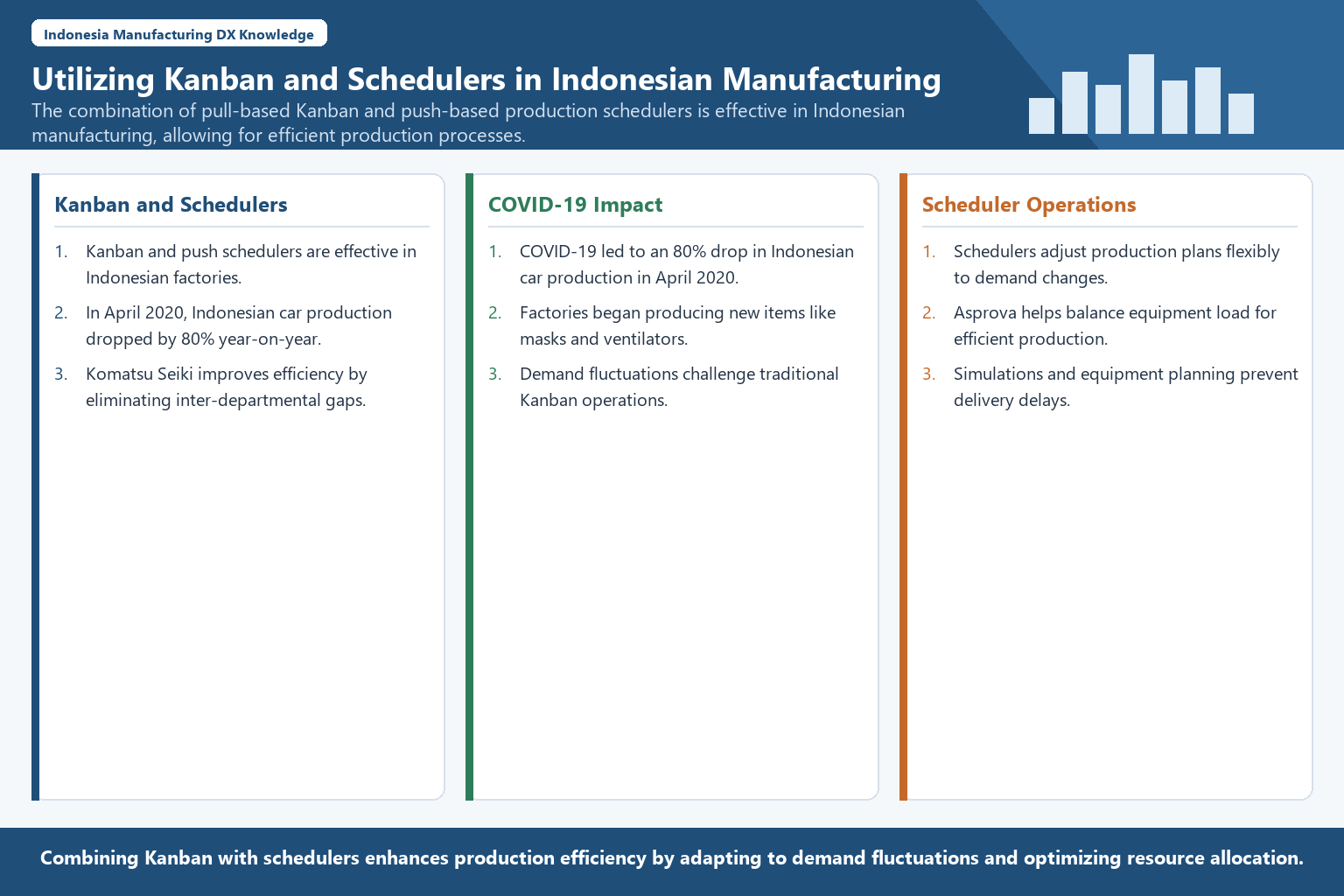
In Indonesian manufacturing, combining the pull-type kanban system, which excels in autonomous production adjustments, with push production schedulers that issue production instructions based on demand fluctuations is effective. This method enables efficient production processes.
-
-
Production Management Systems in Indonesia
The ultimate goal in manufacturing is to improve productivity and meet delivery deadlines. Understanding the differences between manufacturing cost, cost of…
続きを見る
What this article covers
- In Indonesian manufacturing, combining kanban and push-type production schedulers is effective.
- In April 2020, Indonesia's automobile production decreased by 80% compared to the previous year.
- Komatsu Seiki Kogyo Co., Ltd. improves operational efficiency by eliminating departmental discrepancies.
- Utilizing Asprova enables leveling equipment load.
- MRP systems optimize material arrangements to respond to demand fluctuations.
Changes in Indonesian Manufacturing During the Pandemic
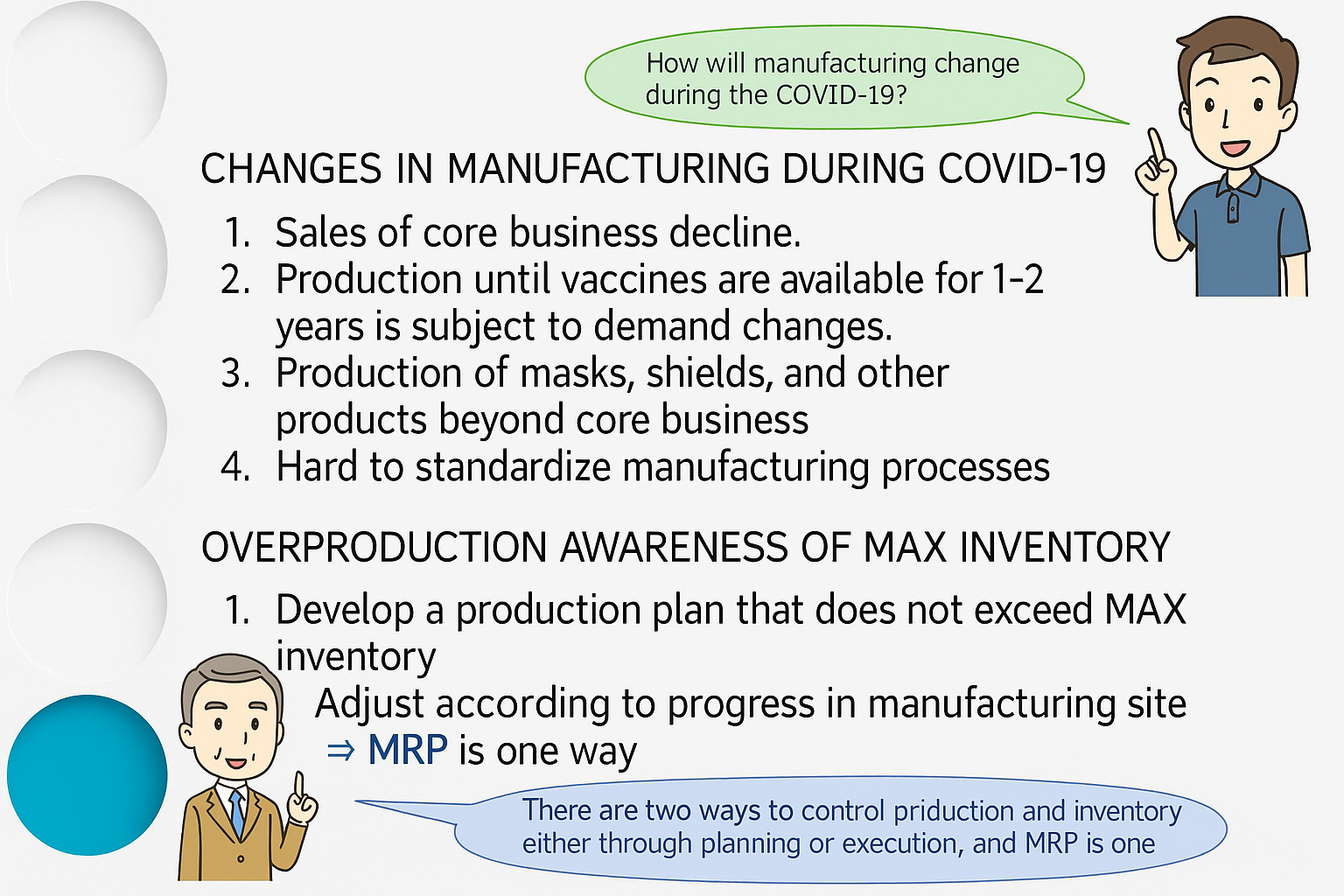
In April 2020, Indonesia's automobile production dropped by 80% compared to the same month the previous year. This situation may continue for 1-2 years until vaccines become widespread, with production based on demand fluctuations. Some factories have started producing new products like masks, shields, and ventilators, making production process leveling challenging. The demand for addressing shortages and excess inventory is also increasing.
Predictable demand fluctuations might have been manageable with experienced intuition, but unprecedented fluctuations could be difficult to handle. Additionally, not only COVID-19 but also natural disasters can halt material supply, with supplier issues occurring annually.
Many factories in Indonesia, where Toyota vehicles are prevalent, adopt Toyota's kanban system. However, some managers may be concerned about whether kanban is functioning as before. The production floor situation is changing as follows:
- Unprecedented demand fluctuations and new product production make it difficult to rely solely on experienced intuition.
- If workers are inexperienced, progress is inconsistent, requiring flexible responses.
- Kanban was an effective means of production adjustment, but the operational prerequisites have collapsed.
When demand fluctuations are significant, monthly leveling becomes difficult, and the pull-type kanban alone may not suffice. Push-type production instructions tailored to demand fluctuations are necessary. However, push-type production without conditions can lead to overproduction. Therefore, a hybrid production method combining flexible production volume instructions per process and kanban production adjustments to prevent overproduction is required.
Case: In Japanese factories in Indonesia, although the Toyota kanban system is adopted, demand fluctuations make traditional operations difficult. As a result, the introduction of a new production method combining push-type production instructions is being considered.
Key Point: In situations with significant demand fluctuations, the pull-type kanban alone is insufficient, and a combination with push-type production instructions is necessary.
Implementation Case: Komatsu Seiki Kogyo Co., Ltd.
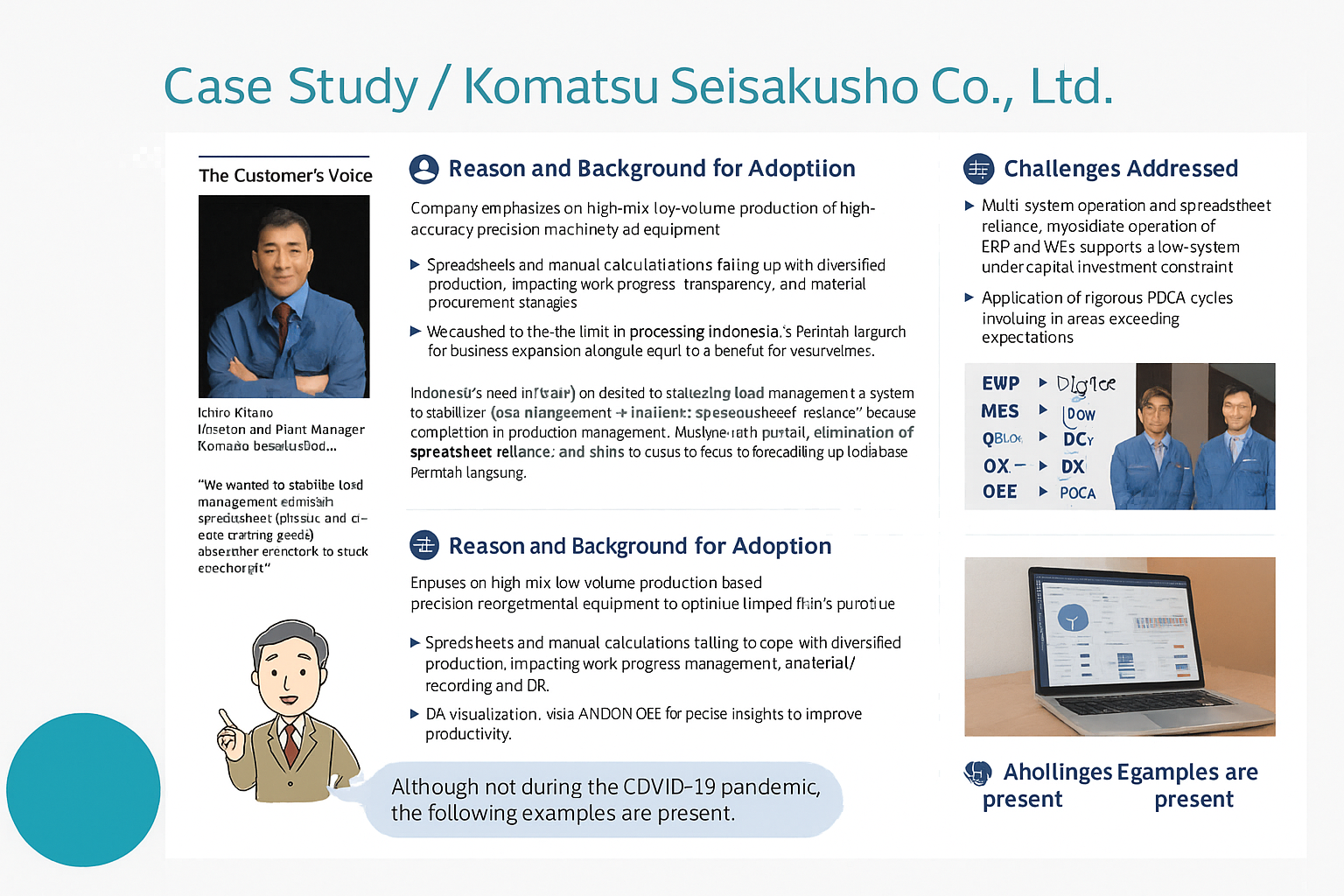
During the pandemic, information sharing and collaboration are crucial. As various information changes, objective indicators are needed to determine which tasks are affected and whether immediate action is required. Early awareness broadens response options. Therefore, the ability to quickly notice and communicate with related departments is a system requirement in times of high demand fluctuations.
Recently, news of secondary infection clusters in food factories in Germany and China has emerged, but it is not someone else's problem. To avoid close contact, unnecessary on-site adjustments should be minimized in factories. For example, reducing the need to search for materials due to shortages or repeatedly adjusting plans with manpower should be minimized.
As a result, systems that allow adjustments without going to the site have become essential. For instance, during the floods in Thailand, each factory showcased its BCP flood measures, and during the pandemic, BCP pandemic measures are also required.
There were issues with rigid planning for urgent items, delivery date changes, and quantity changes, where actual results did not match the numbers. In the machine manufacturing department with many constraints such as machine availability, personnel, and processing types, improving planning accuracy was necessary.
Case: At Komatsu Seiki Kogyo Co., Ltd., planning accuracy is enhanced to ensure reliable parts supply to manufacturers, allowing for detailed responses to urgent items, delivery date changes, and quantity changes. They eliminate discrepancies between purchasing, planning, manufacturing, and sales departments to improve operational efficiency.
Key Point: Bridging the gap between planning and actual results and sharing progress across departments expands the range of responses to urgent and delivery date changes.
Daily plans and progress for items can now be shared between departments, allowing each department, such as planning, production management, manufacturing, and sales, to check progress from their perspective. Large monitors are placed on-site to reference equipment, processes, parts, and orders, creating more flexibility and leeway.
To prevent shortages, safety stock is set high, and while drastic inventory reduction is not possible, linking plans and actual results maintains a certain level of inventory, reducing the need for human adjustments between departments, increasing freedom and motivation in each department.
Flow of Kanban System Operation in Indonesia
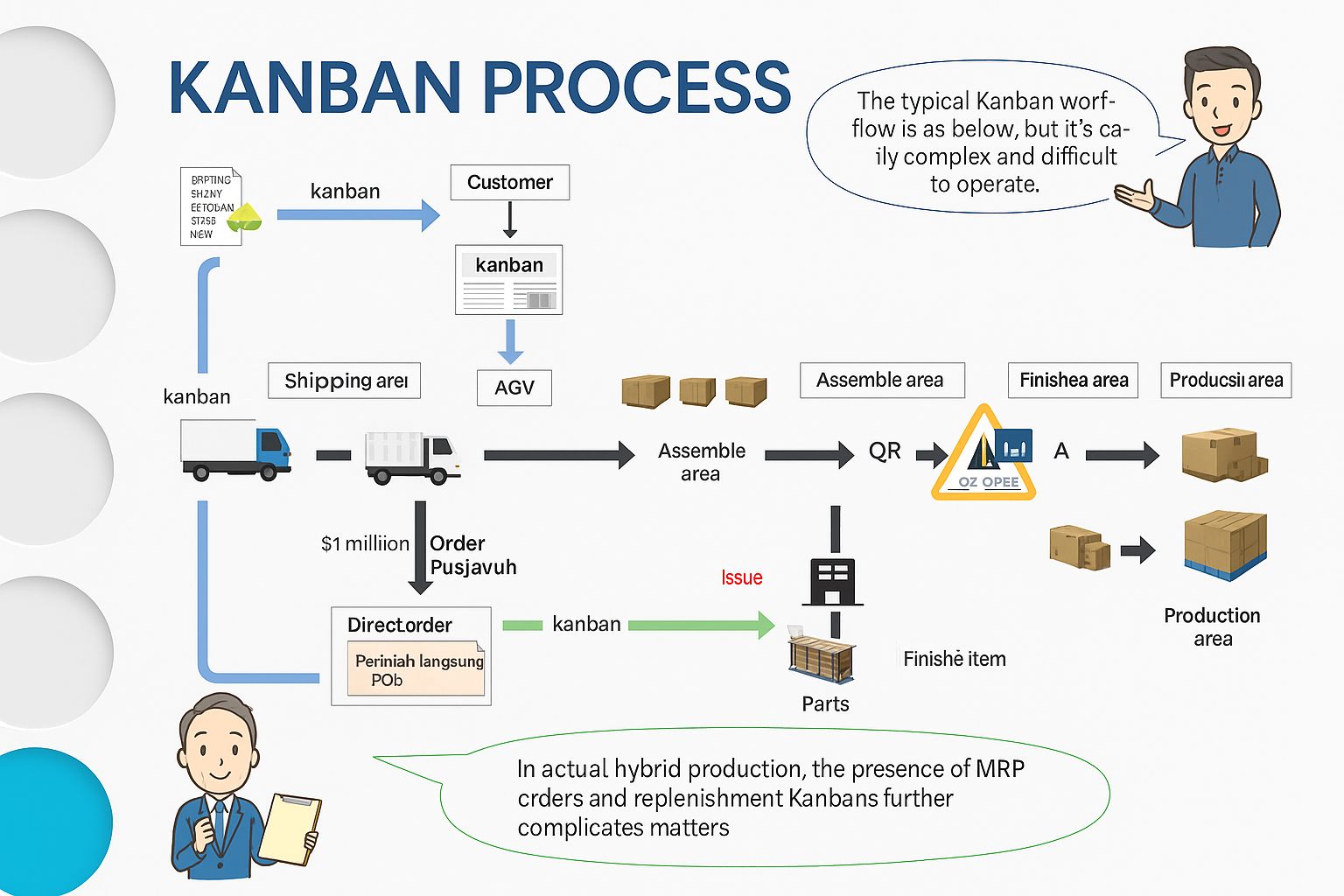
In batch production processes like molding, signal kanban is used as a work instruction for the molding area when intermediate inventory is accumulated and the inventory MIN is cut. The feature of the kanban system is to autonomously adjust production while preventing underproduction or overproduction by producing what is lacking on-site.
Case: In factories operating with the kanban system, when the previous process is a molding or pressing process, the takt or lot size differs significantly from the subsequent assembly process. Therefore, Asprova is introduced in the previous process, producing with MRP-based work instructions, while the subsequent process operates with the kanban system.
Key Point: Molding and pressing machines have many units, requiring equipment allocation plans that consider manufacturing efficiency, such as which equipment to produce on and how to minimize setups. Kanban alone cannot issue work instructions.
Prerequisites for Kanban System: Level Production
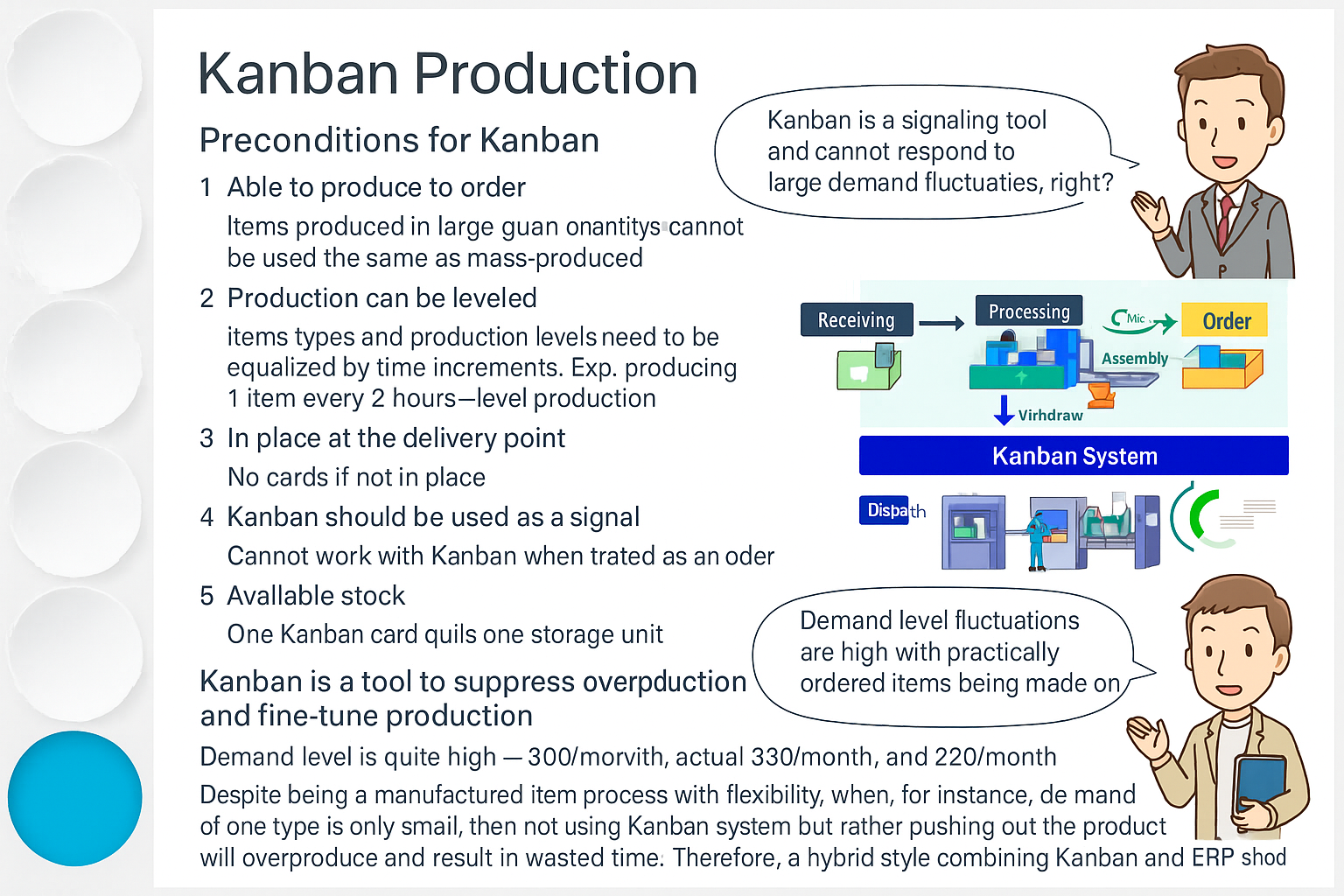
To implement the kanban system, the following conditions are necessary:
- Repetitive production
- Leveled production items
- High and stable production yield
- Minimal demand fluctuations
- Stores set up behind each process
- Minimize the number of items in the box
The kanban system produces only the necessary amount of necessary items. Ideally, the number of items in the box is minimized, aiming for one-piece flow, but considering machine production speed and on-site work efficiency, the box size is set with a certain number of items. However, in practical operations, box-unit production is inefficient, and some factories set local rules to produce after kanban accumulates.
Demand fluctuations make it difficult to calculate the number of kanban cards, and if local rules require adjusting kanban accumulation, operations may become complex.
Flow of Production Scheduler Operation in Indonesia
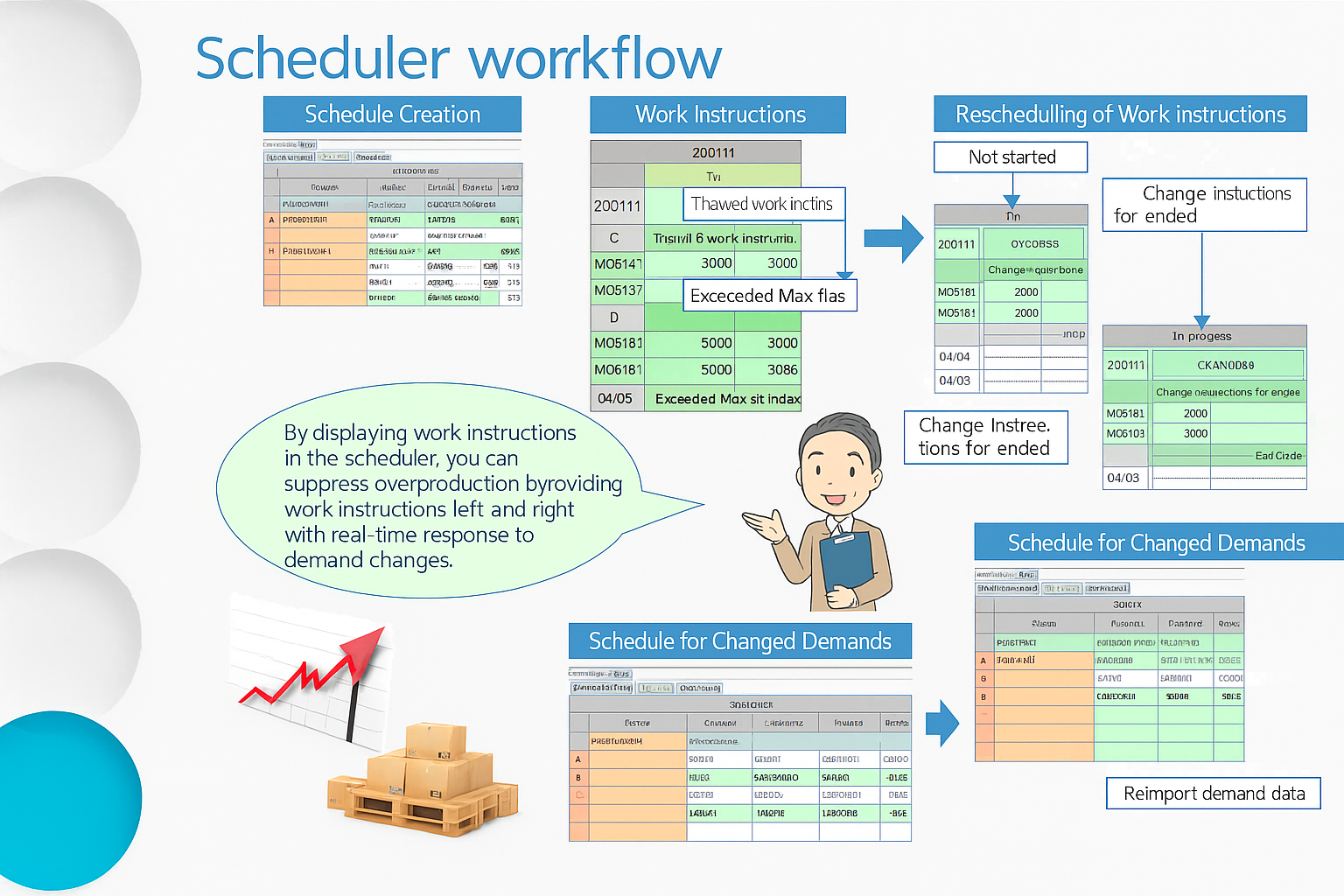
Having discussed the challenges faced by production sites affected by the pandemic, let's explain the specific operation of schedulers. Schedulers issue appropriate work instructions based on demand, displaying the completion of previous processes in green to indicate that the current process can start. Tasks exceeding MAX inventory are displayed in yellow, stopping work to adjust production timing, similar to the kanban system.
By signaling the status of previous and subsequent processes, it becomes clear what to produce next, allowing for early preparation and broader batch production.
Equipment transfers due to demand fluctuations and changes in material delivery status can also be adjusted timely. While the kanban system often adjusts the number of kanban cards based on monthly demand, schedulers with MRP functionality can calculate the number of kanban cards based on demand fluctuations. If monthly demand can be leveled, Asprova can also calculate the number of kanban cards, but responding to daily demand fluctuations and assessing the impact on each department may be challenging.
Case: In one factory, operations are conducted with multiple instructions, including in-process kanban, withdrawal kanban, and MRP-based work instructions, making it complex. Simplified operations may be possible by using a scheduler to manage instructions on one sheet and automatically removing kanban based on the status of previous and subsequent processes.
Key Point: Scheduler operation enables flexible production planning based on demand fluctuations, and combining it with the kanban system can improve production efficiency.
Production Scheduler Response to Demand Fluctuations
Leveling Equipment Load
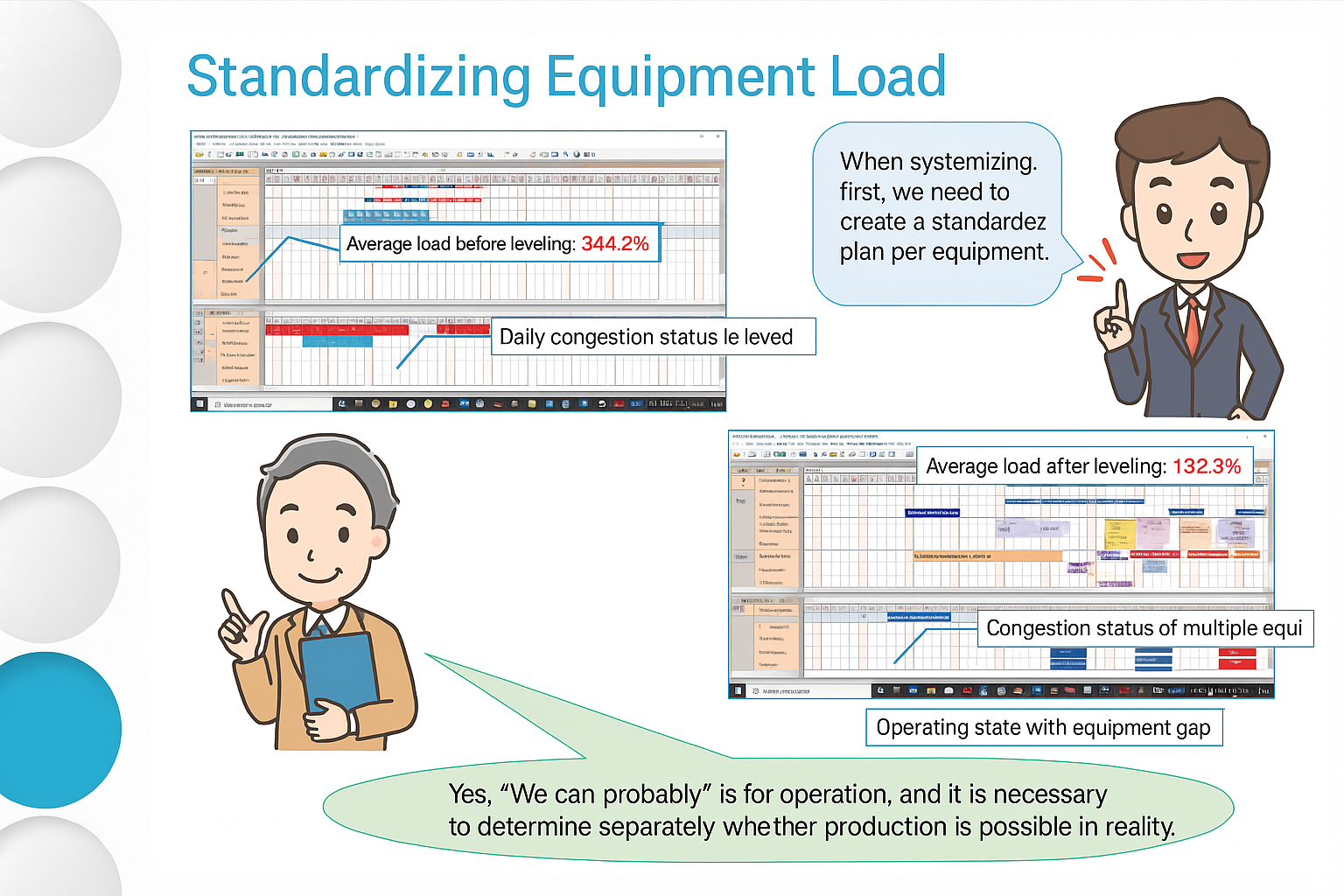
Case: In factories using Asprova, schedules are created with Asprova before kanban operation to determine whether production between processes is leveled, equipment capacity is sufficient, and overtime is necessary.
Key Point: Utilizing Asprova enables leveling equipment load, achieving efficient production planning.
Resolving Delivery Delays
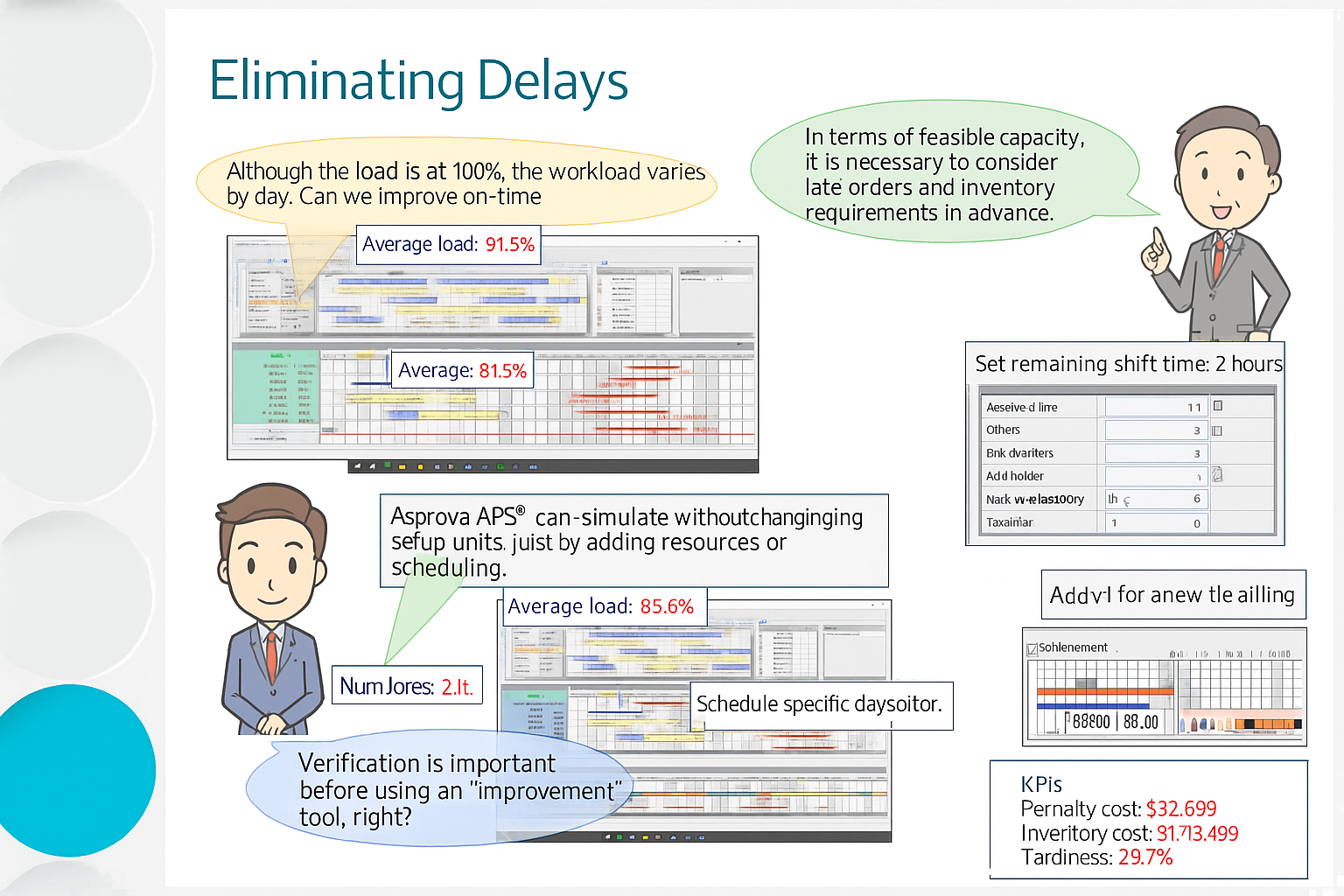 When operating with the kanban system, it is important to verify whether the production site can actually handle it. Once in operation, the kanban system autonomously circulates, so it is necessary to set conditions and simulate with a scheduler to ensure production without delivery delays.
Furthermore, in processes with many molding or pressing machines, there are many equipment constraints such as molds, jigs, and workers, requiring equipment allocation plans. This enables efficient production.
Case: In Japanese factories in Indonesia, when introducing the kanban system, detailed simulations of on-site conditions and equipment allocation planning significantly reduced delivery delays.
Key Point: Introducing the kanban system requires prior simulation and equipment planning. This prevents delivery delays and enables efficient production.
Progress Instructions for Work Instructions/Dispatch Tables
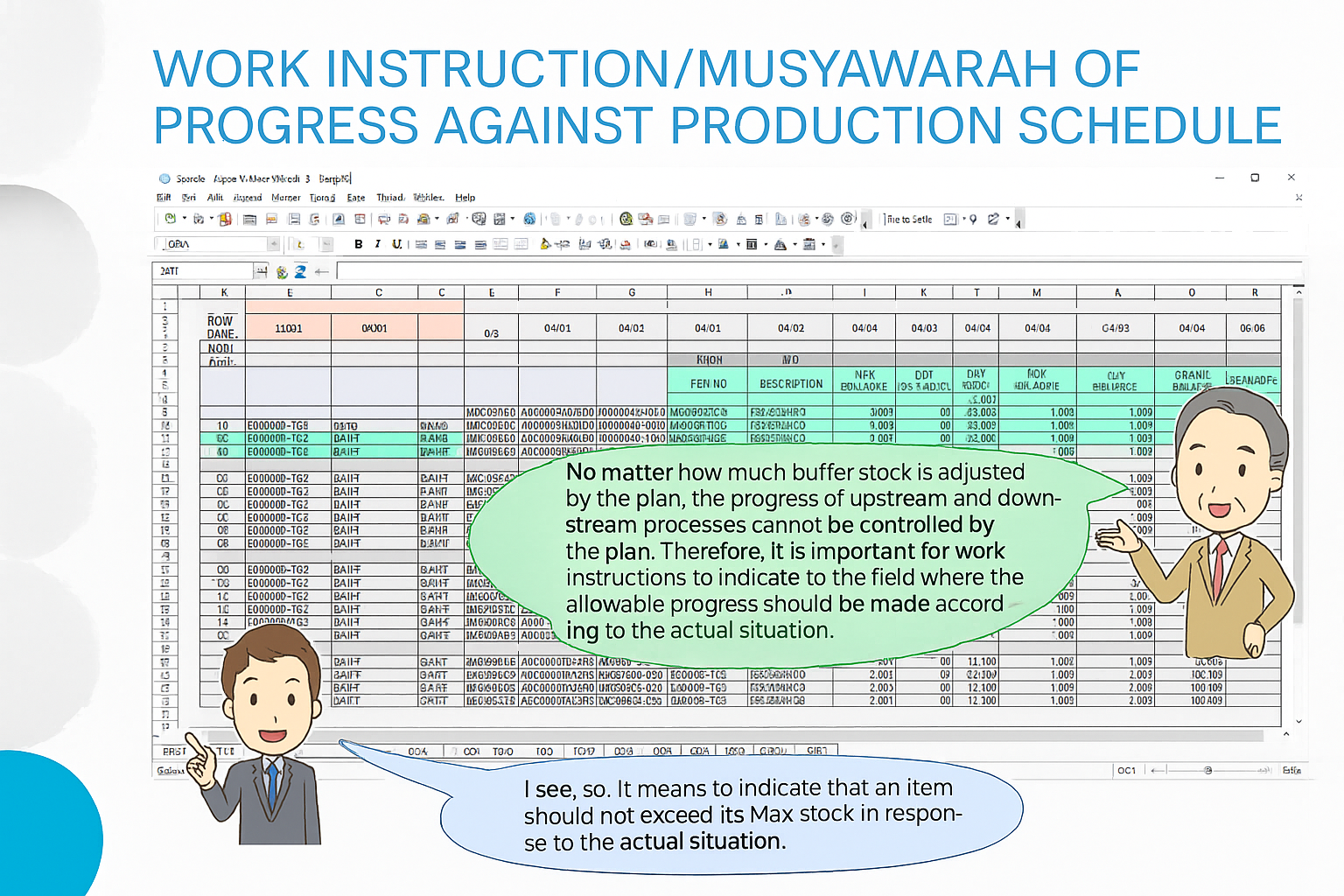
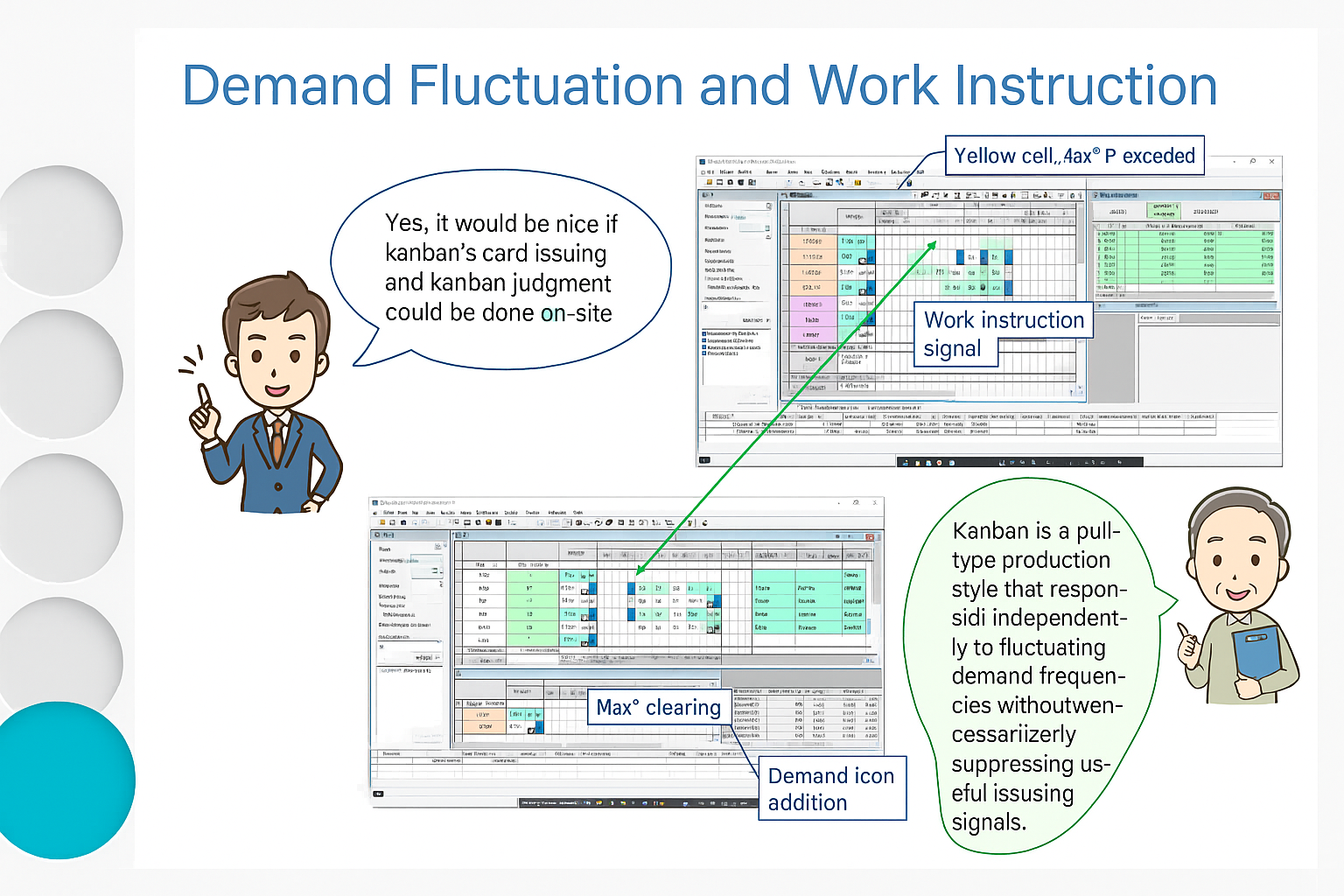
Green indicates previous process completion, yellow indicates exceeding MAX inventory and pending, and gray indicates unstarted previous process work, allowing adjustment of work start while checking the progress of previous and subsequent processes. Even if in-process inventory is adjusted in the plan, if the progress of previous and subsequent processes is delayed, it cannot be controlled as planned.
Therefore, it is important to present work instructions to the site based on actual results, indicating where to start and how far to proceed. This involves issuing instructions to prevent exceeding MAX inventory for that item based on actual results, and by referring to the completion of previous processes, it is possible to determine which local rule work to batch produce before kanban circulates.
Reducing Shortages, Line Stops, Material Procurement, and Inventory Allocation Adjustment
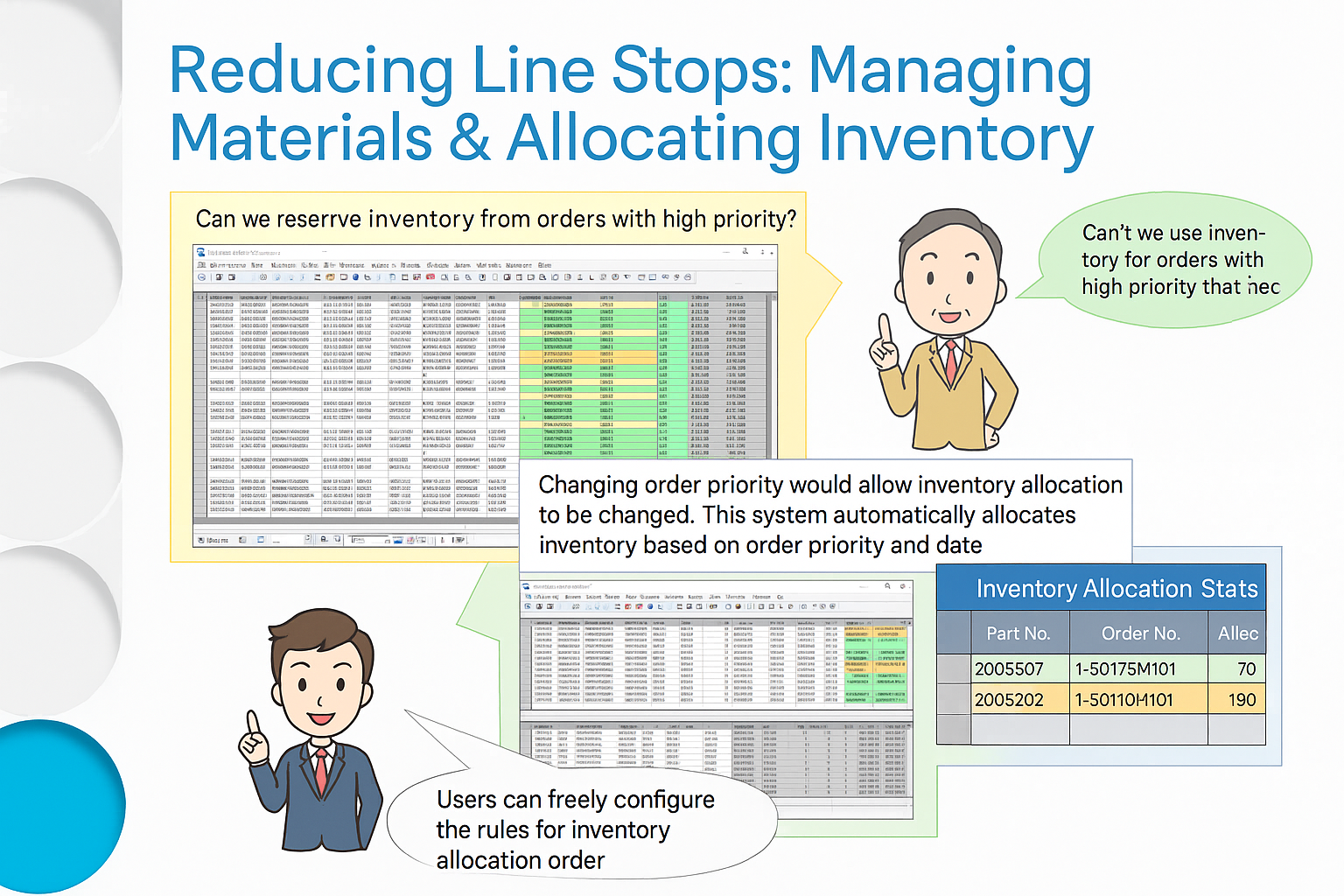
In production management, the importance of information sharing and collaboration during the pandemic is emphasized. In particular, objective indicators are needed to determine which tasks are affected by information. When materials are insufficient due to demand fluctuations, production cannot proceed even if kanban circulates. When delivery dates change due to demand fluctuations, material inventory allocation also needs adjustment.
Using inventory for urgent items affects other tasks, so it is necessary to timely determine which tasks are affected. Additionally, reflecting factory-specific rules, such as not reallocating materials for important customer orders to urgent items, is also necessary.
Appropriate Purchasing Plans, Delivery Date Changes, Demand, and Order Point Arrangements
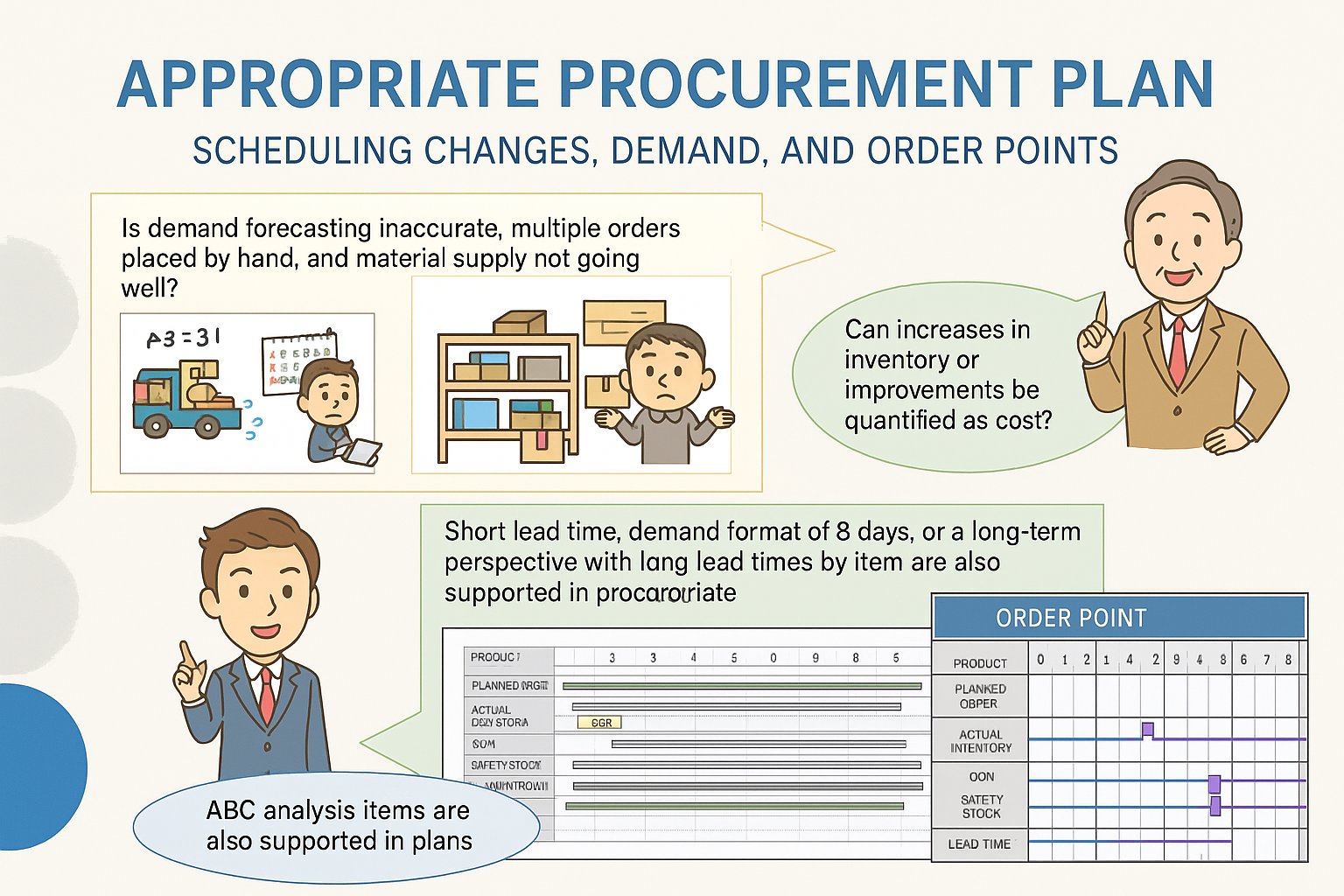
Regarding material inquiries, there are various conditions, and managing them with kanban alone is difficult. In production management MRP, planning is based on fixed lead times, making it difficult to allocate materials according to actual production timing, requiring a scheduler.
Due to demand fluctuations, not only material allocation but also purchasing changes daily. How can the scheduler respond to purchasing shortages, lead time differences, and order methods?
Purchasing shortages automatically generate purchasing orders with MRP, determining which items need ordering and when. For excessive purchasing, end-of-period inventory information is displayed on purchasing orders, allowing consideration of quantity changes. Additionally, an excessive purchasing list can be output, and by canceling flags on ordered purchases and recalculating with Asprova, excessive purchasing can be resolved.
Items with short purchasing lead times create purchasing plans with MRP based on demand using the scheduler. For materials with long lead times and stored in warehouses, purchasing plans are created at order points when inventory MIN is exceeded using the scheduler.
Frequently Asked Questions: Kanban and Production Scheduler
Key points on how to combine kanban and scheduler in situations with significant demand fluctuations.
When is kanban alone insufficient?
When demand fluctuates enough to disrupt monthly leveling. The pull-type kanban alone makes it difficult to flexibly instruct production volume per process, requiring a combination with push-type production instructions.
Why use Asprova for the previous process and kanban for the subsequent process?
Because molding and pressing in the previous process differ significantly in takt and lot size from assembly, requiring equipment allocation and setup minimization planning. Kanban alone cannot issue work instructions, so it is divided with MRP-based instructions.
What does the scheduler change when demand increases or decreases?
It automatically adjusts work instruction numbers according to shipping differences. If the load increases, the start is delayed, and tasks stopped at Max inventory become startable, centralizing information management on one instruction sheet.