
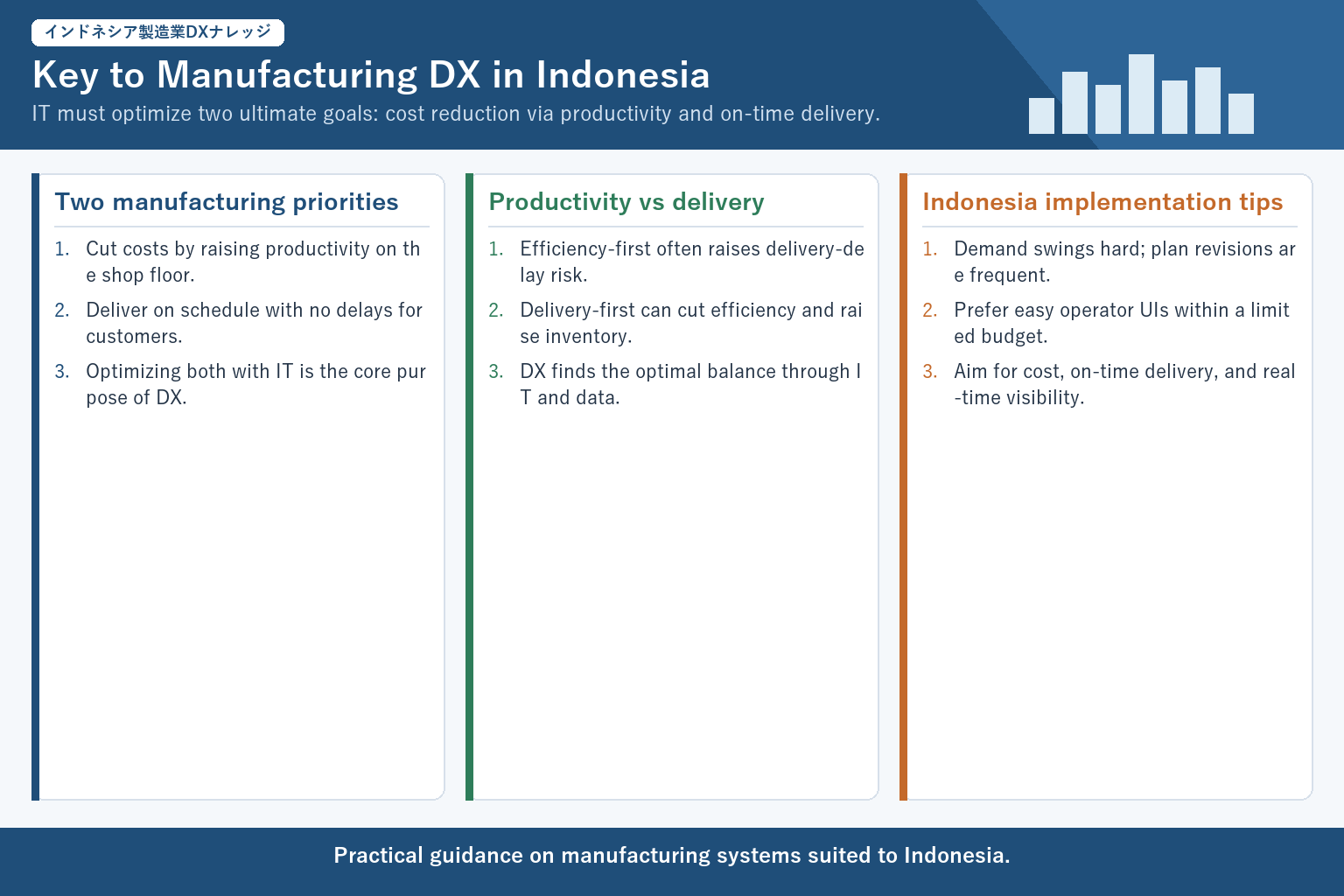
It is often said that the two paramount objectives in the manufacturing industry, not limited to Indonesia, are "cost reduction through productivity improvement" and "delivering on time without delays."
Management creates business plans to maximize business development based on market supply and demand adjustments. However, even if sales increase by selling at a price close to the manufacturing cost, unexpected selling and administrative expenses can lead to losses. Since it is not easy to raise the selling price due to market conditions, process management based on production plans aimed at cost reduction through productivity improvement from material purchase to product completion becomes important.
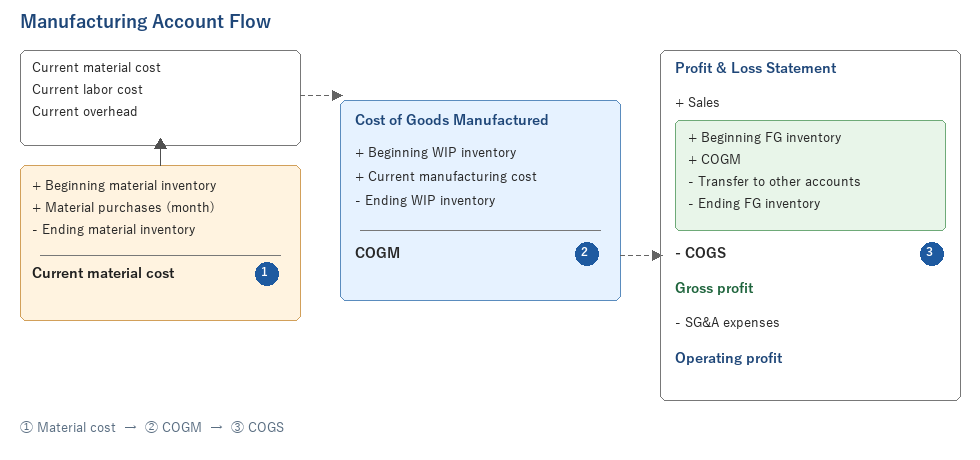
Manufacturing account relationship diagram
In manufacturing cost accounting, confusion often arises between manufacturing cost, cost of goods sold, and selling and administrative expenses. Manufacturing cost is the cost of products completed in the current month, cost of goods sold is the manufacturing cost of sold products (a mix of beginning inventory and current month completions), and selling and administrative expenses incurred when selling products are outside the cost of goods sold.
- Beginning material inventory + materials purchased during the month - ending material inventory = current month material cost
- Beginning work-in-progress inventory + current month material cost + current month processing cost - ending work-in-progress cost = manufacturing cost
- Beginning product inventory + manufacturing cost - ending product inventory = cost of goods sold
- Sales - cost of goods sold = gross profit
- Gross profit - selling and administrative expenses = operating profit
- Operating profit - non-operating expenses = ordinary profit
Japanese manufacturing companies in Indonesia are constantly in an environment with high demand fluctuations. Prioritizing efficiency for productivity improvement increases the risk of delivery delays, while focusing too much on delivery times can lead to more setups and decreased production efficiency.
I believe that finding the optimal value to achieve these two conflicting paramount objectives through IT is the main goal of digital transformation in manufacturing.
In production management system implementation projects in Japan, there is a tendency to add functions to fit the company's operations even at high costs. In Indonesia, however, there is a trend towards requests for screen modifications to ease input by shop floor workers, reduce work burden, and add external data import functions within a limited budget.
This blog aims to assist those in the Indonesian manufacturing industry who feel the need for systematization of production management operations but are unsure where to start, by providing articles about production management systems that help envision what a manufacturing system suitable for Indonesia might be.
What this article covers
- The ultimate goal in manufacturing is to improve productivity and meet delivery deadlines.
- Understanding the differences between manufacturing cost, cost of goods sold, and selling and administrative expenses is important.
- Account linkage diagrams are useful for cost calculation in manufacturing.
- The purpose of DX is to optimize the trade-off between productivity improvement and meeting delivery deadlines using IT.
- In Indonesia, system implementation is required within a limited budget.
Differences Between Manufacturing Orders and Kanban in Indonesian Manufacturing
Both the "number of manufacturing orders" and the "number of kanban cards" can be calculated by expanding the required quantity based on forecasts. However, manufacturing orders are the actual work units based on production plans (push system) and are production instructions from the production management department to the shop floor. On the other hand, kanban is the actual result of the subsequent process withdrawing from the previous process only what has been used (pull system), and it flows autonomously on the shop floor based on the relationship between demand and supply.
In a system compatible with the kanban method, the following three are possible through MRP (Material Requirements Planning).
- Manufacturing perspective: Issuance of manufacturing orders, calculation of the number of kanban cards in the process
- Purchasing perspective: Calculation of material requirements, calculation of the number of material kanban cards
- Equipment perspective: Load calculation for lines and machines
Kanban serves as a production instruction in units of BOX for the previous process, and the total number of manufacturing orders (total required quantity - current inventory + safety stock) is almost the same as the "number of kanban cards x box capacity" for the current month.
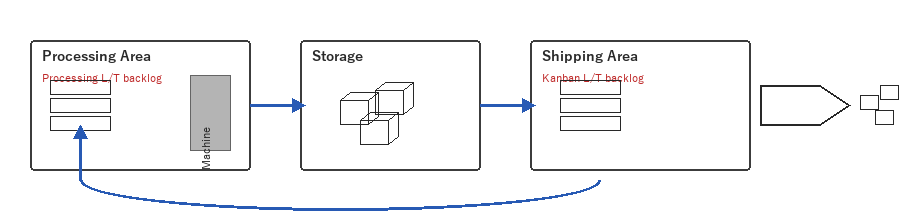
In the kanban method, when the number of BOXes in the parts storage is 0, covering the next withdrawal kanban card with one kanban card in the process (work-in-process kanban) at the processing site is considered the ultimate operation where inventory is 0 and only work-in-process inventory exists.
If the types and quantities required by the subsequent process change daily, the equipment investment on the shop floor becomes costly. Therefore, in kanban method operations, it is necessary to level the types and quantities daily.
In lot production, specialists produce the same items together to reduce setup times, but in leveled production, it is necessary to evenly distribute various types of products, requiring external setup (secondary resource setup) of internal setup (primary resource setup) and multi-skilled workers. Pursuing leveling leads to one-piece flow.
Since the kanban method cannot respond to sudden demand fluctuations, it is considered to use a production scheduler for appropriate production preparation, such as calculating the required quantity from forecast information to arrange raw materials and outsourcing, or making capacity plans based on forecast information for factory resources.
-

-
The Difference Between Planned Production Manufacturing Instructions and Kanban in Indonesian Manufacturing Industry
Whatisthedifferencebetweenmanufacturinginstructionsandkanbanquantities?。Whydoeskanbanrequireleveledproduction?。Whycom…
続きを見る
Factory-Driven Systems in Indonesia Using Schedulers
In the Indonesian automotive market, Toyota vehicles account for over 30%, and many Japanese manufacturers operate using the Toyota Production System's 'kanban'. However, since the COVID-19 pandemic in 2020, leveling the production process has become challenging, and production that responds to demand fluctuations is now required. As a result, measures to prevent stockouts and excess inventory have become important.
When demand fluctuations are significant, leveling production on a monthly basis becomes difficult, and the operation of the pull-type autonomous kanban system can be hindered. Therefore, push-type production instructions that respond to demand fluctuations are needed, and production plans that can flexibly instruct production volumes for each process are required. A hybrid method that combines production adjustments using 'kanban' to prevent overproduction on the shop floor is effective.
-

-
Site-Driven System Using a Production Scheduler in Indonesia
Wheniskanbanalonenotenough?。WhyuseAsprovaupstreamandkanbandownstream?。Whatdoestheschedulerchangewhendemandrisesorfalls?。
続きを見る
Calculation Methods for Time-Based Operating Rate and Stroke-Based Load Rate
Takt time (T/T) is a target value set by Toyota for parts manufacturers to fulfill orders, calculated as 'available operating time per day ÷ order quantity per day'. In contrast, cycle time (C/T) is devised by the production management department of parts manufacturers, calculated as 'planned operating time per day ÷ target production quantity' to determine the standard capacity of their production equipment.
In the Toyota Production System (TPS), single setup is recommended, and guidance is provided to bring cycle time closer to takt time. This shortens setup time and improves production efficiency.
In press processing manufacturing, the load rate is calculated as the ratio of the number of strokes required to fulfill orders to 'strokes per hour GSPH × operating hours per day'. For example, for paired items like car doors, orders are placed separately for left and right. Although the necessary quantities for left and right can be calculated by MRP (Material Requirements Planning), the load rate is calculated as double for each side with different item codes.
This is because MRP aims to calculate requirements without considering line production capacity, assuming infinite capacity to accumulate loads. Overload adjustments are manually leveled.
On the other hand, the production scheduler is based on the fundamental idea of deploying requirements according to order quantities so as not to exceed 100% of resource capacity, and assigning tasks to the line. Therefore, accurate load calculation is possible even for the production of paired items.
-

-
Calculation Methods for Time-Based Operating Rate and Stroke-Based Load Factor
Load factor is the ratio of demand to a machine's supply capacity. In press processing, it is the ratio of the number of strokes required to fulfill an order to the strokes per hour (GSPH). On the other hand, operating rate is the ratio of actual operating time to available operating time, or the ratio of operating time needed to fulfill an order to the total daily available operating time.
続きを見る
Minimizing Inventory and Opportunity Loss Costs with the Beer Game to Achieve Overall Optimization
Production management systems aim for partial optimization by separating management by department and process. However, barriers between departments and processes can hinder the flow of goods and information, leading to extended lead times and increased work-in-progress inventory.
Lessons from the Beer Game highlight the importance of recognizing inventory cost reduction and opportunity loss reduction during decision-making stages such as purchasing orders and manufacturing instructions within the supply chain. This understanding helps in connecting production processes seamlessly and realizing the benefits of implementing a production scheduler aimed at overall optimization of production sites.
-

-
Minimizing Inventory Costs and Opportunity Loss Costs in the Beer Game to Achieve Overall Optimization
The purpose of the Beer Game is to recognize the importance of reducing inventory costs and opportunity loss costs (backorders) when making decisions about ordering and issuing manufacturing instructions within a supply chain that has a purchasing lead time of 4 weeks and a manufacturing lead time of 4 weeks.
続きを見る
Optimal Inventory in the Supply Chain Considered in Indonesia
General trading companies handle a wide variety of products and have procurement and sales functions similar to a "general store." This allows them to fulfill logistics functions that adjust the supply chain from downstream to upstream, and they also have financial and development functions to nurture companies through investments and capital participation.
To avoid the risks of inventory costs from excess stock and opportunity losses from stockouts, forecast production maintains product inventory at shipping locations and product warehouses, while make-to-order production keeps material inventory at suppliers and material warehouses. These storage locations become decoupling points that achieve optimal inventory in the supply chain.
During the early days of the internet, it was said that the role of general trading companies would end as individual online shops were launched one after another. However, by fulfilling logistics and financial functions for the entire supply chain, they remain among the top popular employment destinations even 20 years later.
-
-
Optimal Inventory in the Supply Chain Considered in Indonesia
General trading companies have shifted from an agency business to a business model that generates profits in line with added value across the entire supply chain, from upstream to downstream. By formulating a logistics strategy that optimizes the entire supply chain, they contribute to consumer benefits through time reduction and price reductions driven by economies of scale.
続きを見る
Considering Partial Optimization and Overall Optimization from Everyday Life Examples in Indonesia
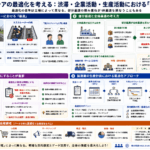
To minimize traffic congestion, it is ideal for all cars to refrain from changing lanes and to slow down without coming to a complete stop. However, in reality, due to the desire to reach the destination quickly and the suspicion that staying still is a disadvantage, drivers prioritize individual optimization and repeatedly change lanes. As a result, congestion worsens.
In groups with differing interests, partial optimization based on individual emotions prevails, worsening congestion. However, if all drivers can show consideration for others and limit their desires to respect others' benefits, overall optimization, such as the early resolution of congestion, can be achieved, allowing everyone to return home quickly.
Organizations like companies and the military differ significantly from society as a whole in everyday life because they can suppress individual selfishness for the common goal of maximizing profits.
-
-
Partial Optimization and Overall Optimization Considered from Examples in Everyday Life in Indonesia
The criteria for optimization vary depending on the context. In the case of traffic congestion, it is throughput (the total movement per unit of time). For corporate activities as players in a market economy, it is profit maximization. In manufacturing production activities, it is productivity improvement and cost reduction. The optimal criteria differ based on perspective and objectives.
続きを見る
Operation Management, Trend Management, and Predictive Maintenance through IoT Implementation in Manufacturing in Indonesia
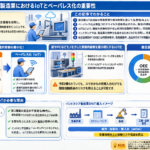
The implementation of IoT in manufacturing aims to collect information on production and capital goods to streamline the production process. Production goods include materials, work-in-progress, and products, while capital goods include machinery and people. Utilizing this information to efficiently flow production goods is crucial.
In Indonesian manufacturing, the importance of going paperless and adopting IoT is recognized. The goal is to integrate production processes such as production planning, manufacturing management, labor management, quality control, and operation management, advancing automation and unmanned production manufacturing operation management (MOM).
In machine operation management, operating and downtime are obtained from PLCs and signal towers, and overall equipment efficiency (OEE) is calculated from three aspects: time operation rate, performance operation rate, and quality rate. This enables the improvement of production efficiency.
Maintenance management aims to prevent failures through machine maintenance. Changes in equipment and failure trends are analyzed numerically, and equipment records and trouble cases are shared. Maintenance management is divided into preventive maintenance, which involves regular part replacement, and predictive maintenance, which forecasts machine issues.
-
-
Operational Management, Trend Management, and Predictive Maintenance through the Introduction of IoT in Manufacturing in Indonesia
Whyispaperlessoftenpostponed?。WhatinformationdoesmanufacturingIoTcollect?。HowisOEEbrokendown?。
続きを見る
Smart Factories in Indonesia Realizing Industry 4.0
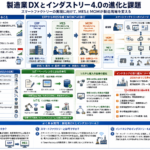
The manufacturing systems are shifting from Enterprise Resource Planning (ERP) systems to Manufacturing Execution Systems (MES) that focus on managing the factory/shop floor. In the future, it is expected to transition to Manufacturing Operations Management (MOM), which integrates production processes such as planning, scheduling, production management, labor management, and quality control, advancing automation and unmanned operations.
MES is positioned between ERP and PLC, issuing work instructions based on production schedules and monitoring the movement of raw materials and work-in-progress in real-time. MOM is a scheme that realizes smart factories by understanding the operational status and abnormalities of production equipment, digitizing MES, and promoting automation.
When transferring information to a digital network, transcription errors from paper and input errors into the system can occur, making paperless and IoT solutions effective immediate measures.
In Industry 4.0, IT technology is transferred to the hardware side, and by connecting hardware and networks, it aims to quickly and accurately collect and analyze data, improving productivity and quality.
-
-
Smart Factories in Indonesia Realizing Industry 4.0
The concept of a smart factory embodies the realization of Industry 4.0 through the digital transformation (DX) of manufacturing. Specifically, it involves collecting and managing shop-floor-level data with MES (Manufacturing Execution System) to improve production efficiency and reduce manufacturing costs, while further advancing automation through MOM (Manufacturing Operations Management).
続きを見る
Achievable on the Shop Floor! Operational Efficiency & Visualization for Indonesian Manufacturing
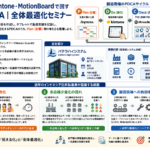
A joint seminar was held with the setup of creating production plans using the production scheduler Asprova, recording manufacturing results from tablets with Cybozu kintone, and visualizing planned and actual data with WingArc Motion Board to implement the PDCA cycle.
Japanese manufacturing companies in Indonesia face challenges such as shorter product lifecycles, high-mix low-volume production, demand fluctuations, rising labor costs, and competition with non-Japanese companies. To address these, improving production efficiency is crucial. It is necessary to optimize production resources across the factory and reduce inventory costs and the risk of opportunity loss.
The production scheduler visualizes the entire process from order receipt to production and purchasing, creating cycle time-based production plans that consider equipment capacity. This achieves improved productivity per unit time by shortening lead times and reduces inventory costs by cutting down on inventory.
-
-
Doable on the Shop Floor! Operational Efficiency and Visualization for Indonesian Manufacturing Factories
Today, I’ll be handling the initial "Plan" part of the PDCA cycle, which involves creating a production plan with a system, recording manufacturing performance on a tablet, and visualizing scheduled versus actual data using a BI tool.
続きを見る
Automated Customs and Excise Information System CEISA Provided by Indonesian Customs
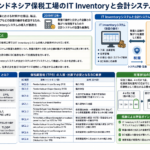
Indonesian customs emphasizes the relationship between the BC number assigned to the delivery note (Surat Jalan) when raw materials are received and the new BC number assigned to the shipping note when products are shipped. This is to ensure that duty-free raw materials are properly processed within bonded factories and correctly shipped.
The BC number is issued by the sender and can be obtained by registering the transaction in CEISA and obtaining customs approval. In transactions between bonded factories (KB), the sending KB obtains BC27. If the counterpart is a non-bonded factory (Non-KB), since CEISA is not implemented, the KB side obtains BC41 when sending and BC40 when receiving.
-
-
Functions of CEISA, the Customs and Excise Information Automation System Provided by Indonesian Customs
In 2013, customs mandated the introduction of an IT Inventory system for bonded factories to track the movement of quantities such as materials, work-in-progress, products, and scrap. However, starting in December 2019, it has also become mandatory to install an accounting system to report the connection between these quantity movements and their corresponding monetary values in accounting.
続きを見る
From Specification to Operation of Production Management Systems in Indonesia
In the requirement definition phase, where the operational flow of the production management system is determined, it is crucial to decide how the system will issue instructions to the shop floor and record achievements. For areas where the standard functions of the system are insufficient, add-on development is conducted. Through operation briefings and training sessions for the completed system, feedback from shop floor staff is incorporated, leading to specification changes or additional development. During operational rehearsals, data entry is performed by each department representative, and the methods of inter-departmental coordination are confirmed.
Unforeseen man-hours often arise during the implementation of production management systems. Focusing too much on man-hours can lead to opting for easier implementations, which may result in a sense of inferiority towards the customer. Once discussions on man-hours and compensation are settled, the primary focus is on customer convenience and improving operational efficiency. This is the pride of being an IT service provider.
In the implementation phase, where instructions are issued from the system in accordance with the movement of people and goods on the shop floor, and achievements are entered, one experiences the sensation of theory becoming reality. The fulfillment of introducing business systems is found in this moment.
From the perspective of inventory and cost, the factory is divided into material warehouses, manufacturing processes, and product warehouses, each managed by different departments. Manufacturing costs are calculated based on the production management's receipt and disbursement records, while sales costs are calculated based on the sales management's receipt and disbursement records. The material warehouse and manufacturing process are designated as production locations, while the product warehouse is designated as a sales location.
The business flow involves the movement of quantities and amounts, with inventory management responsible for managing the flow of quantities. The minimum necessary functions include a current inventory list, receipt and disbursement processing, and receipt and disbursement history management (stock card).
-

-
Until the specifications of a production control system are finalized in Indonesia and implemented on-site
Whatisthedifferencebetweentop-downandmusyawarahapproaches?。Whatisneededfirstatgo-live?。Mustpurchaseoverheadbeallocate…
続きを見る
Long (Buy) and Short (Sell) in Position Management
In Indonesia, there are many commodities with volatile prices, such as coffee and palm oil. Long contracts are made in anticipation of future demand and rising material prices, while short contracts are made in anticipation of a decline in selling prices, where borrowed stocks are sold and then bought back after the price drops. In a long position, losses occur if prices fall, and in a short position, losses occur if prices rise.
Selling borrowed stocks in a short position is known as short selling and can be considered a type of margin trading. During the 1997 Asian financial crisis, the hedge fund led by George Soros predicted that the Indonesian central bank did not have enough foreign reserves to prevent a currency collapse, and took a short position by short selling the rupiah. After the rupiah collapsed as expected, they bought it back and made huge profits.
-

-
The Difference Between Long (Buying) and Short (Selling) in Position Management
In the inventory business, purchase contracts are made in anticipation of future demand and rising material costs, while sales contracts are made in anticipation of falling selling prices. However, this creates the risk of market fluctuations moving in the opposite direction. To manage this position effectively, it is necessary to distinguish between inventory that is tied to sales contracts and inventory that is not.
続きを見る
Bill of Lading (B/L) Issued by the Shipping Company Based on Invoice and Packing List
When shipping furniture from Indonesia to Japan in containers, it is necessary to have a Bill of Lading issued by the Indonesian shipping company based on the Invoice, Packing List, and Certificate Of Origin (COO). For exports, the B/L date becomes the sales recording date.
From around 2000 to 2006, I operated a company that shipped furniture and miscellaneous goods from Bali. Customers from Japan who purchased furniture in Bali entrusted the forwarding operations to a company known as a cargo company.
The B/L issued by the shipping company is sent to the cargo company, which then sends it to the consignee in Japan. However, if there is a delay in the cargo company's follow-up for B/L issuance from the shipping company, even if the consignee receives an Arrival Notice from the Japanese shipping company, they cannot receive the cargo because the B/L from the cargo company has not arrived.
In such cases, I requested the cargo company to have the issued B/L surrendered (endorsed by the shipping company to confirm the cargo belongs to the consignee) and sent to the consignee in Japan via fax instead of mail, which is why it is also called a telex release.
-

-
A Bill of Lading (B/L) issued by the shipping company to certify the acceptance of cargo based on the Invoice and Packing List
The Bill of Lading (B/L) is issued by an Indonesian shipping company based on the Invoice, Packing List, and Certificate of Origin (COO) to certify the acceptance of cargo. In the case of exports, the B/L date becomes the sales recording date.
続きを見る
Implementation of Return Processing in Production Management Systems
In the Indonesian automotive parts industry, it is common for sales to be recorded simultaneously with shipment. The sales process is automatically completed upon shipment completion. During returns, a replacement shipment known as Tukar guling is often conducted.
System-wise, after the month-end closing, a Return Sales Order Entry and Return Shipping Entry are performed, and a negative invoice is issued. This process accounts for negative shipments (return receipts) and negative sales.
-

-
How Return Processing is Implemented in a Production Management System
In Indonesia, return processing commonly involves a method called Tukar Guling, where replacement goods are sent without revising the original Delivery Note or Invoice.
続きを見る
Introducing Smartphone-Based QR Code Management System in Indonesian Operations
The purpose of lot management is to maintain the accuracy of lot tracing and inventory management. To achieve this, it is important to attach a physical ticket issued by the system to the lot and input the actual results into the system using the lot number as a key every time the physical item flows. This ensures consistency between the physical item and the system.
When recording results by location (process) rather than by lot, it is possible to know "what is where and how many," but since the smallest unit of inventory quantity is "location," it is difficult to verify if the theoretical value is correct by counting the physical items.
When recording results by the flow unit of the physical item, which is the lot, it is possible to check "how many items are in this lot" for each destination. This is equivalent to constantly checking the theoretical value of the entire inventory by dividing roles, and the lot quantity is overwritten by the actual quantity of the subsequent process, converging to a more accurate quantity as it progresses to the subsequent process.
The role of a barcode reader is to scan barcodes and capture data, reducing the effort of manual input and preventing input errors. Handy terminals typically return the captured data to the PC business system in batches.
Distinguished from batch-type handy terminals, models equipped with OS such as Android or Windows CE are called wireless handy terminals, processing scanned barcode information wirelessly in real-time. There are cases where actual results are obtained with a handy terminal based on instructions issued by the production management system, checking if the physical item is scanned as instructed before linking it as actual results to the core system, and methods where actual results are recorded in the core system by scanning the physical item without instructions. ■ Reflecting actual results against instructions in the core system
- Receiving: From the uninspected area to the material warehouse, attach a physical ticket upon inspection approval
- Material Issue (Issue Instruction): From the material warehouse to the manufacturing shop floor
- Material Return: From the manufacturing shop floor to the material warehouse
- Product Receiving: From the manufacturing shop floor to the product warehouse, attach a physical ticket upon inspection approval
- Shipping (Picking List): From the product warehouse to the shipping area
- Disposal: From the warehouse to the disposal area
- Inventory (Inventory Sheet): Warehouse
■ Reflecting actual results without instructions in the core system
- Shelf Movement: Move from shelf to shelf
-

-
Introducing a QR Code Management System Using Smartphones for Business Operations in Indonesia
WhyrecommendsmartphoneQRoverdedicatedhandhelds?。Whatistheminimumbarcodecontent?。Howdoscannersdifferfrombatchhandhelds?。
続きを見る
Picking List for Verifying Item Lot Information on Labels at Shipment
During shipping operations, it is common to collectively retrieve products to be shipped that day from the warehouse and stack them in the shipping area. At this time, the picking list, which is consolidated into a single unit for shipping operations, is checked against the actual items.
In the shipping function of sales management, shipping instructions based on order information are entered, and the details of the shipping instructions bundled by sorting unit become the picking list. For example, for the details of multiple shipping instructions, a picking list number is assigned to the products to be loaded into a 40-foot container for export to Japan today, and the products placed in the shipping area are scanned and verified. If the verification result is OK, the shipping completion registration is executed.
The detail lines from order registration to shipping instructions and shipping performance accounting by picking are registered on an item (lot) basis. However, when actually loading onto trucks or containers, multiple items are consolidated into packaging units due to packaging work to prevent damage. This packing list needs to be submitted to the shipping company.
-

-
A picking list for verifying item lot information on physical labels at the time of shipment
In Indonesian manufacturing, a picking list is created by grouping the item lot detail lines from a list of registered shipping instructions into shipping units at the time of shipment. It is used to verify whether the physical goods match the item lots registered at the time of order entry. Comprising shipping instruction numbers (header) and item lot numbers (details), shipping performance is recorded accordingly.
続きを見る
Recommendations for Japanese Companies in Indonesia Struggling with Production Management Systems
The issues faced by Japanese manufacturing companies in Indonesia regarding production management can be summed up as 'invisible, incompatible, and disconnected.' Specifically, there is a lack of visibility into which shipments the flowing goods are linked to, forcing systems that do not fit the operations to be forcibly adapted, leading to an increase in Excel management, and a lack of connection in workflows between departments, resulting in more adjustments outside the system.
A company's business is determined by what it offers in response to market needs, and the relationships with customers and suppliers, as well as internal staff relationships, determine the way internal operations are conducted. These lead to sales and purchasing, forming the flow of added value in the supply chain, which shapes economic activities.
In Indonesia, internal decision-making is influenced by the political intentions of individuals or departments, and the constraints of the supply chain tend to complicate business practices. As a result, internal operations are often steeped in unique cultures and tend to become a collection of suboptimal solutions.
Excel is valued for connecting these suboptimal solutions, but it is necessary to implement important requirements in a system. It is important to consider the sentiments of Indonesian staff and ensure that the results from the system are visible in terms of the processes they have undergone.
In such a situation, the solution lies in diligently compiling requirements and implementing them in the system.
-

-
Recommendations for Japanese Companies in Indonesia Struggling with Production Management Systems
All internal business operations are ultimately connected to revenue, which is the source of a company's cash inflow, and purchasing, which is the source of cash outflow. When three key issues arise—lack of visibility into the current state, discrepancies in figures, and a disconnect in process flow—it not only reduces operational efficiency but also leads to a decline in employees' awareness of sales and cost management.
続きを見る
Potential for In-house IT System Development to Achieve Operational Improvement in Indonesia
When considering IT system development in Japanese manufacturing companies in Indonesia, outsourcing has the drawback of being less adaptable to environmental changes. Even when attempting in-house development, there is often a lack of personnel with IT skills within the company, and systems developed by skilled IT technicians tend to become personalized.
The ideal IT system can be flexibly modified in response to environmental changes, like Excel, and can be built by internal business personnel without requiring advanced IT skills. However, such tools have not existed until now, and outsourcing has been common. With the advent of Kintone and AppSheet, realistic proposals for in-house development are becoming possible.
These tools provide an environment where business personnel can build systems themselves and respond flexibly. This is expected to lead to operational improvements in the manufacturing industry in Indonesia.
-

-
"The Potential of In-House IT System Development for Achieving Business Improvements in Indonesia
As the features provided by Kintone and AppSheet become more advanced, Indonesia is also entering an era where in-house development of business systems is becoming possible. We believe that essential business transformation through IT is more advantageous when done in-house rather than outsourced.
続きを見る
Systems Usable and Easy to Use in Indonesia
In a project, the top priority is to reliably build a 'usable system.' Pursuing 'ease of use' during the project period has its limits, so it is important to decide on the types and number of functions and reports to some extent and have the customer agree that any additional 'ease of use' will be provided for a fee during the maintenance period. This is a major role for Japanese working in IT in Indonesia.
When introducing packaged business systems in Indonesia, gaps between the system and business processes tend to occur. Here are some examples:
- Night shift results are reported the next morning, and shipping documents (Surat Jalan) cannot be issued due to negative inventory.
- If the invoice has not arrived when goods arrive, purchase registration cannot be done, inventory is not recorded, and shipping cannot proceed.
- Shipping instructions are based on inventory deductions, and if there are no goods, shipping instructions cannot be issued the day before.
- Orders received but not yet shipped can be tracked as backorders, but orders received without shipping instructions cannot be tracked.
- Invoices for materials immediately used and costed upon arrival are not received, so they are not subject to cost calculation.
- If corrections to incoming and outgoing shipments are not completed before closing processes, physical inventory cannot be reflected.
- Irregular processing (material issuance/return processing, NG, separately managed items) input and actual ticket issuance cannot keep up.
- When wanting to correct actual mistakes discovered during physical inventory, if lots are already flowing to the customer, canceling DO (shipping documents) or invoices results in new invoice or DO numbers being assigned.
If a new business flow is designed theoretically first and applications are designed to match it, the shop floor may not be able to keep up after implementation.
To avoid such problems, system design that aligns with the actual conditions of the shop floor is required.
-

-
A System Usable in Indonesia and A User-Friendly System
Project success means completing the project on schedule and having the system operate according to requirements. As a result, this means a system usable in Indonesia has been created, but a user-friendly system is one with a gentle interface where the desired operations are immediately apparent.
続きを見る
DX Practice and Shop Floor Reform through Digitization of Manufacturing Daily Reports in Japanese Factories in Indonesia
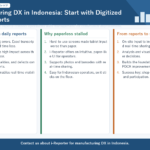
Many Japanese manufacturing companies have expanded into Indonesia, but DX on the shop floor is still in its developmental stages, with paper and Excel management being mainstream in small to medium-sized factories. In this situation, digitizing manufacturing daily reports for paperless operations is gaining attention as an effective first step in DX. This reduces entry errors, transcription omissions, and time loss, enabling important information to be shared and analyzed in real-time.
Using tools like i-Reporter allows shop floor staff to operate intuitively and input data with the same ease as using paper, making implementation on the shop floor smooth. The data accumulated through digitization can be utilized for process visualization and improvement activities, leading not only to operational efficiency but also to a transformation of shop floor culture.
To succeed in DX in Indonesia, understanding and participation of shop floor staff are essential, and starting with small operational improvements is the first step towards DX for the entire organization.
-
-
Digitalization of Daily Production Reports Using i-Reporter at Japanese Factories in Indonesia
Digital transformation (DX) in Indonesia’s manufacturing industry can be highly effective when started with paperless operations through the digitalization of daily production reports. It helps reduce on-site errors and transcription omissions, enables real-time information sharing, and promotes cultural transformation and continuous improvement through the introduction of intuitive tools such as i-Reporter.
続きを見る
FAQ | Production Management Systems in Indonesia
This hub article organizes the key questions that readers and AI should grasp first, following the map of this article.
What trade-offs should IT resolve in manufacturing DX?
Balancing cost reduction through productivity improvement and on-time delivery without delays. In Indonesia, where demand fluctuations are significant, leaning towards one side can easily lead to either stockouts or increased setups. The goal of DX is to find the optimal point using IT.
How do you differentiate between kanban and manufacturing orders?
Manufacturing orders are push instructions based on planning, while kanban is pull adjustment based on actual usage. In situations where leveling is disrupted, combining push instructions from a scheduler and kanban to prevent overproduction is effective.
In what order should related articles be read?
The basic approach is kanban and MRP, demand fluctuation response with scheduler combination, shop floor data with IoT/QR/digitalized daily reports, and implementation practice with implementation articles. Following the cards within the hub in this order makes it easier to grasp the overall picture.