


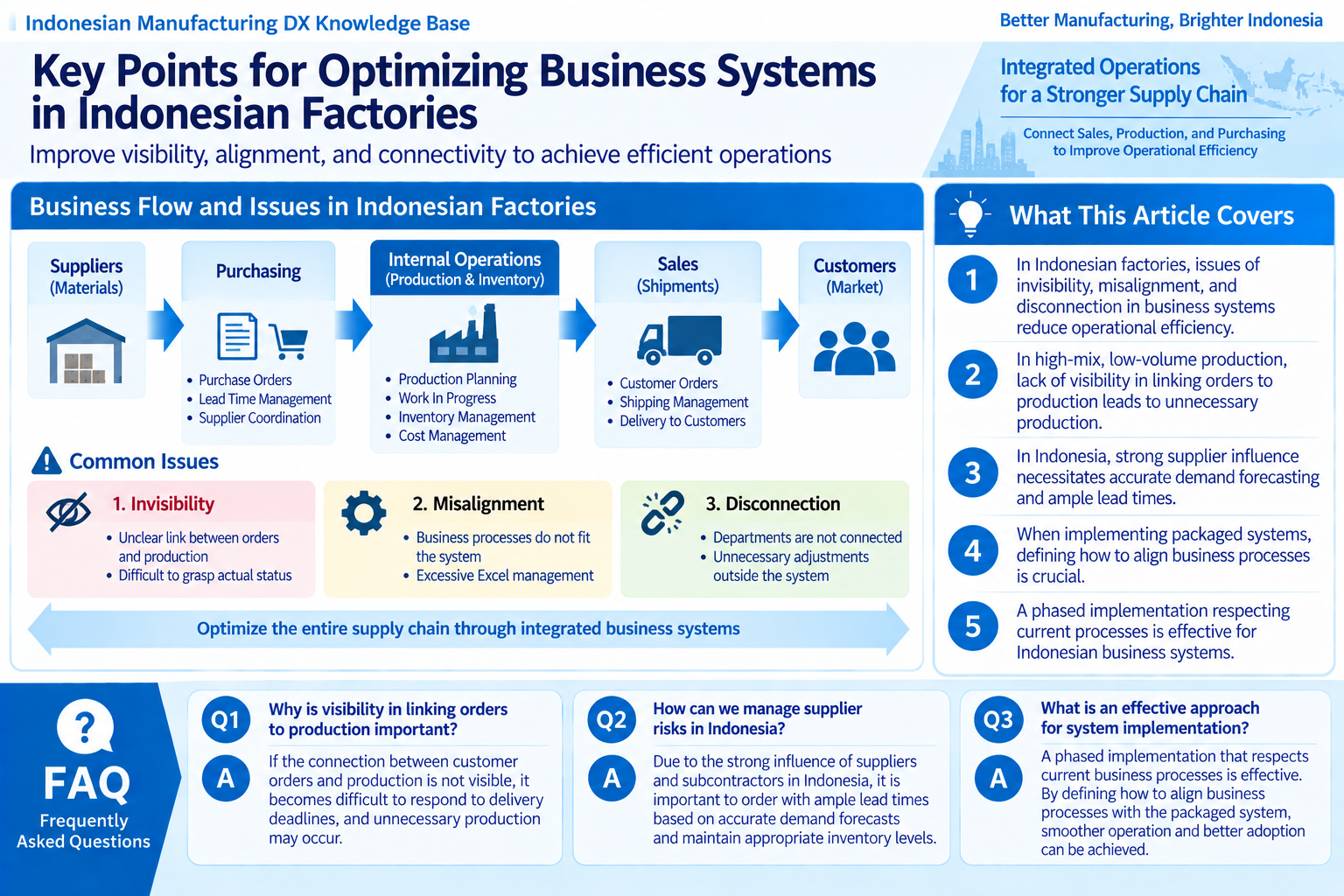
Internal operations are crucial elements linked to sales and purchasing. If there are issues with visibility, numerical alignment, and connectivity, operational efficiency declines, and employees' awareness of sales costs also diminishes.
-
-
Production Management Systems in Indonesia
The ultimate goal in manufacturing is to improve productivity and meet delivery deadlines. Understanding the differences between manufacturing cost, cost of…
続きを見る
What this article covers
- In Indonesian factories, issues of invisibility, misalignment, and disconnection in business systems reduce operational efficiency.
- In high-mix, low-volume production, lack of visibility in linking orders to production leads to unnecessary production.
- In Indonesia, strong supplier influence necessitates accurate demand forecasting and ample lead times.
- When implementing packaged systems, defining how to align business processes is crucial.
- A phased implementation respecting current processes is effective for Indonesian business systems.
Factors Affecting Internal Operations in Indonesian Factories
Having been involved with business systems in Indonesia for many years, the issues that emerge in conversations with Japanese companies primarily boil down to the following three:
- It is unclear which shipments the flowing items in the business process are connected to.
- Forcing business processes to fit incompatible systems leads to excessive Excel management.
- Business flows between departments are disconnected, resulting in unnecessary adjustments outside the system.
Internal operations connect to sales (shipments) and purchasing. This trio of invisibility, misalignment, and disconnection lowers operational efficiency and diminishes employees' awareness of sales costs. A company's business is determined by what it offers to market needs, and internal operations are shaped by how it interacts with customers, suppliers, and internal staff. Specific examples include:
- As the number of customers increases and order sizes decrease, it becomes unclear on the shop floor which orders are being produced, making it impossible to respond to delivery deadlines.
- With shorter product life cycles and difficult demand forecasting, only ordering and producing as needed prevents dead stock.
- Too little inventory can halt production lines, reducing productivity and causing delivery delays.
- In high-mix, low-volume production, if the link to orders is not visible, unnecessary production occurs to increase the utilization of shared lines.
- In Indonesia, strong supplier and subcontractor influence requires ordering with ample lead times based on accurate demand forecasts.
- Low local procurement rates in Indonesia mean shortages of imported materials can be critical.
Business systems should be defined by internal operations, and changing them to fit a predetermined system can lead to standardization but also to frequent changes.
Economic Activities Occur on the Supply Chain
In manufacturing, raw materials are procured, processed, and sold with added value. In services, value is created by providing services in response to customer requests. When procuring goods, suppliers are upstream, and when selling, customers and consumers are downstream. This flow is called the supply chain.
The flow of goods and services on the supply chain is the essence of economic activity, and merely extracting money without creating added value is not economic activity. Economic activity does not conclude within a company but is based on commitments and achievements with suppliers, customers, and consumers. These activities are evaluated by "reliability" in meeting deadlines, quality, and quantity, "flexibility" in responding to demand fluctuations, and "responsiveness" in shortening delivery times.
To strengthen relationships with business partners and customers, optimized business flows are called Standard Operation Procedures (SOP). ISO certification builds trust on the supply chain.
Case Study: Japanese factories in Indonesia are working to enhance reliability and flexibility by leveraging the local supply chain.
Key Point: Enhancing reliability, flexibility, and responsiveness on the supply chain leads to successful economic activities.
Determining Business Methods in Relationships with Suppliers and Partners on the Supply Chain
Generally, there are two main methods for implementing business systems in companies conducting economic activities on the supply chain, both in Japan and Indonesia.
- Systematization based on aligning company operations with the business flow of packaged systems
- Systematization based on aligning with unique company business flows
As of 2019, the mainstream is to standardize company operations by aligning them with the business flow of packaged systems that aggregate the know-how of development manufacturers. However, this often results in situations where "the system is operational, but cost-effectiveness is not achieved."
- The system is operated only for master management and inventory management among the functions of the packaged system.
- Despite being introduced on the premise of aligning operations with the standard flow, incomplete customization occurs due to pressure from the shop floor.
Implementing packaged systems involves three phases: requirements definition, implementation (development), and deployment (training) to the shop floor. When aligning operations with packaged systems, minimizing implementation and focusing on "how to align operations with the package specifications" during the requirements definition phase is central. It can be aligned under conditions such as:
- Few transactions, such as a low number of production batches or P/O issuances per day.
- ⇒ Low system input load.
- ⇒ Ample time for training.
- ⇒ High accuracy of system inventory, reducing inventory adjustment effort.
- Clear operations for ordering and receiving from suppliers or shipping after receiving orders from customers.
- ⇒ The importance of order backlog management is recognized, preventing operations solely for inventory.
- Few suppliers and customers.
- ⇒ Few data format types, reducing import load.
This is because internal operations are determined by relationships with suppliers and partners on the supply chain, making it difficult for companies that do not meet such conditions to align internal operations with the system. If aligning internal operations with the package is difficult, system development and implementation based on requirements definition are necessary, with adjustments during deployment to incorporate requirements not fully captured in the definition.
Systematizing Internal Operations in Indonesia's Excel Culture
Standard business flows implemented in major packaged software like SAP or Microsoft Dynamics are accumulations of the package vendors' years of know-how. It is considered odd to have operations that do not fit this, and aligning operations with the system flow is seen as the shortest path to improving operational efficiency when considering business system implementation in Japan.
This is a valid option in environments where goods flow smoothly between customers and suppliers on the supply chain, all transaction-related information is reflected in the system, and company decision-making is realized by analyzing accumulated system information.
However, in environments like Indonesia, where internal decision-making is often overridden by political intentions of individuals or departments, and supply chain constraints complicate business customs with customers, suppliers, and subcontractors, internal operations become steeped in unique culture. As each stakeholder seeks the most convenient method, it tends to become a collection of partial optimizations.
Excel is valued as a patching agent to connect these partial optimizations, and although Excel patchwork is prominent in overall internal operations, it ultimately aims for overall optimization.
When attempting to systematize the business methods of Japanese companies in Indonesia, it is more rational to gather truly necessary requirements from the Excel-patched and interconnected business methods and implement the system to fit the operations.
In environments where goods flow smoothly on the supply chain and all transaction-related information is reflected in the system, implementing major packaged software may be the best practice. However, in environments like Indonesia, where this is not the case, diligently gathering requirements and implementing them in the system tends to yield visible improvement results.
- Using customized systems for internal operations that generic packaged software could not address improved operational efficiency.
- Quickly adapting to changes in order deadlines and quantities allowed for maintaining high planning accuracy.
- Process performance management became visible on large monitors on the shop floor.
- Managing warehouse entries and exits with handheld terminals enabled easy automatic integration with inventory management systems.
- Attaching order-numbered tags to lots flowing on the shop floor made the connection between physical items and system inventory visible.
- Monthly production planning, which took a week, now completes in three hours.
- Linking orders and purchasing clarified the raw materials needed for the month, eliminating line stoppages due to stockouts.
- Complex production planning, such as color, specification, and day grouping, which was not possible with Excel, can now be done quickly.
- Improved demand forecasting accuracy eliminated excess production and reduced in-process inventory.
Thus, in Indonesia, there is significant room for improving internal operational efficiency by developing and implementing systems that align with operations.
Reasons for Considering Production Management System Implementation in Indonesia
The importance of Indonesian factories has increased, and accurate and prompt information management and its effective utilization are now required. This has led to considerations for system investment, driven by requests from Japanese headquarters and the needs of Indonesian subsidiaries.
- Desire to reduce operational load by unifying operations company-wide.
- Enable data monitoring from Japan.
- Integrate data with Japanese systems.
- Align with Japanese rules (inventory valuation methods, report display items, etc.).
- Low data accuracy.
- Slow data entry.
- High data entry load.
- Insufficient necessary data (reports).
- Entered data is not effectively utilized.
Issues with Japan-Led and Indonesia-Led System Implementations
Japan-led system implementation is often pursued in relatively large companies at the request of Japanese headquarters. The same system as the Japanese factory is introduced with the support of the headquarters' information systems department, but issues such as inability to utilize expensive systems, systems becoming unused after the Japanese implementer returns home, inability to ensure information accuracy, and inability to maintain masters often arise.
On the other hand, Indonesia-led system implementation is common in small to medium-sized companies, where the Indonesian factory independently selects systems. It often does not unify the entire operation under one system, leaving some Excel management. In this case, issues such as frequent double entry, lack of connectivity in system operations, and systems dependent on individuals often arise.
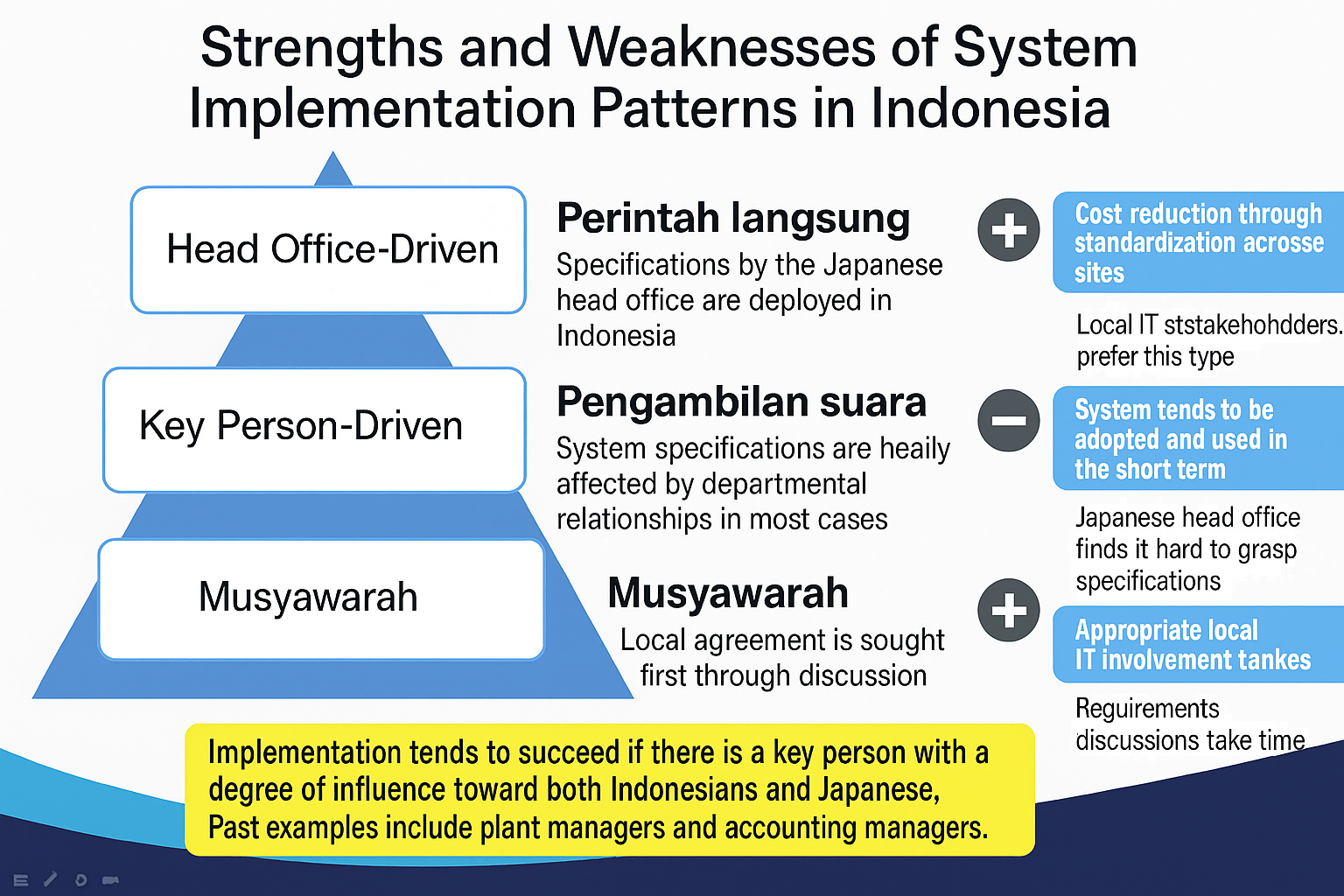
The initial phase of system implementation involves reviewing current operations and deciding how to translate them into the system, known as the requirements definition phase. In Indonesia, it is divided into three main patterns. The complete headquarters-led model is Perintah langsung (direct order from the top), where specifications from Japanese headquarters are deployed in Indonesia.
The local majority model is Pengambilan suara (majority vote), where the power dynamics between departments influence system specifications, making a key person for local coordination important. The musyawarah model is a consensus-based approach where discussions aim for unanimous agreement.
Considerations for Indonesian National Characteristics When Implementing Production Management Systems
The three sacred treasures of Japanese management, lifetime employment, seniority-based promotion, and company-specific unions, which were renowned worldwide in the 1990s, now seem a thing of the past in the harsh business environment with the rise of China and Asian countries.
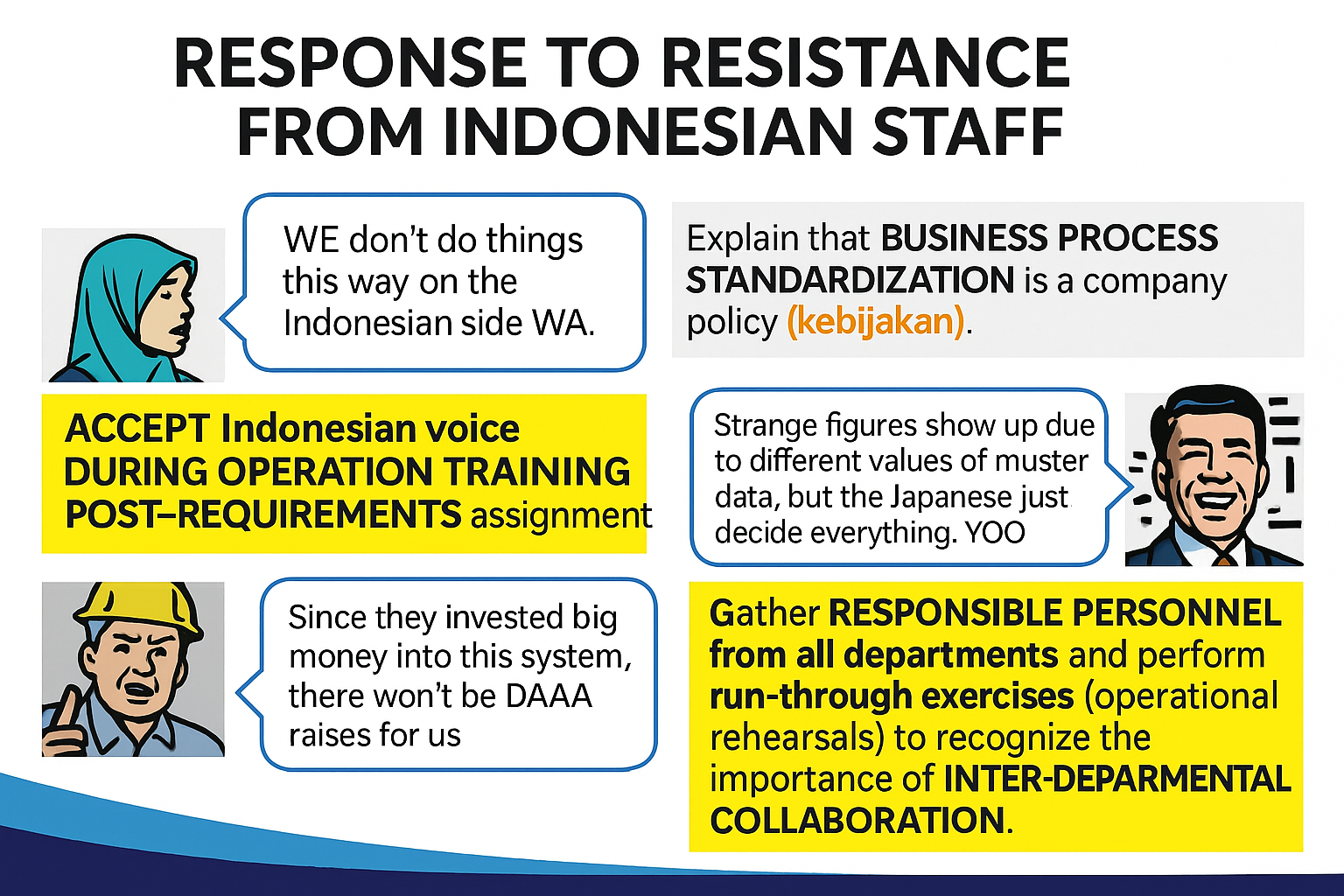
However, the "aun no kokyu" (unspoken understanding) that remains in Japanese companies, where decisions are deliberately left unclear, poses communication challenges with Indonesian office workers accustomed to clear instructions based on job descriptions in the American style.
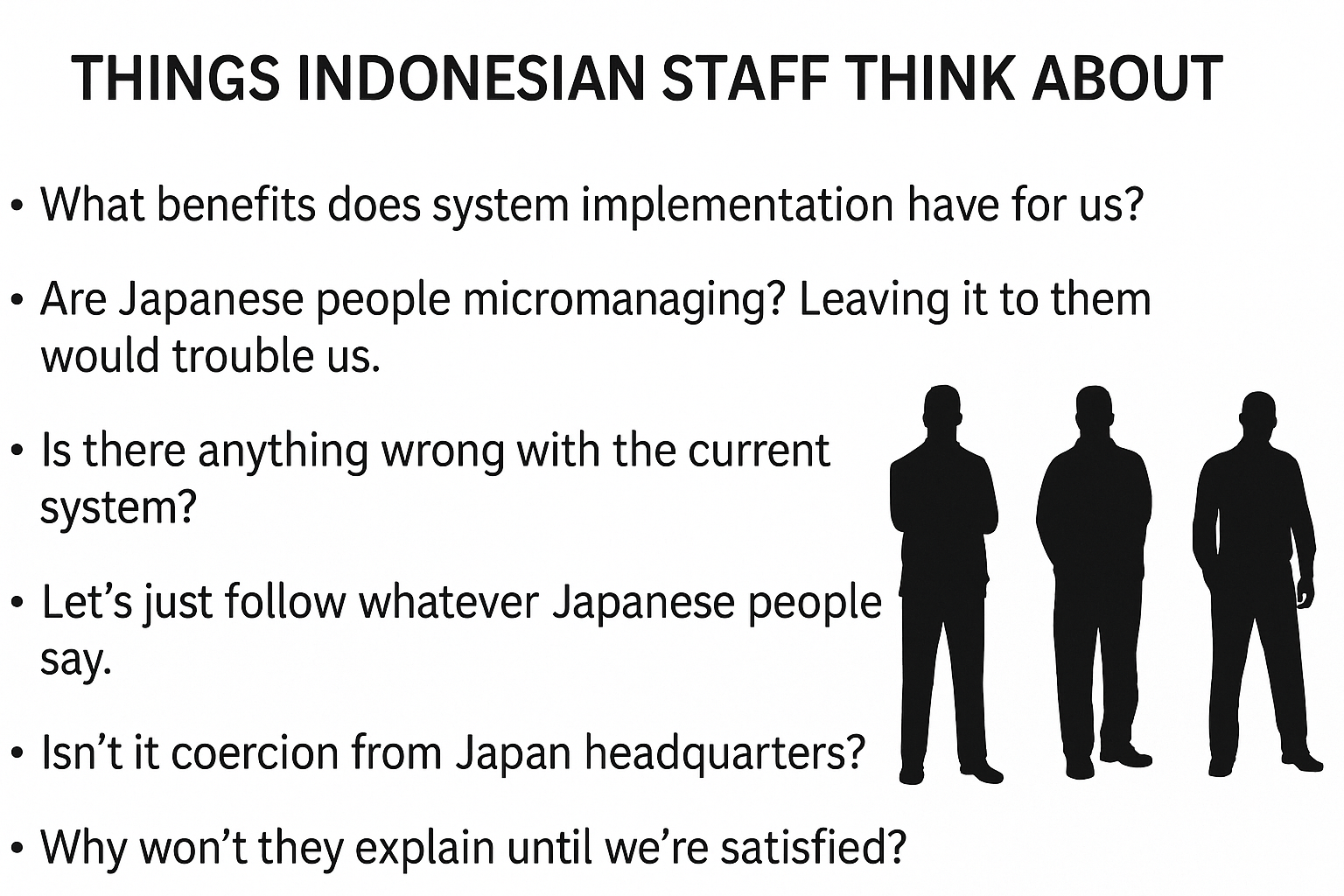
Case Study: In the field of system implementation in Indonesia, local staff of Japanese companies often express frustration, asking why explanations are not provided until they are satisfied.
Key Point: It is important to provide clear instructions and explanations to Indonesian staff.
Optimal Phased System Implementation Method for Indonesia
For many years, I believed that introducing package software as a standard business flow without customization was the most effective method for system implementation in Indonesia. However, I realized that even if the system is accepted as a standard, if the gap between the new business flow and the current one is large, Indonesian staff become skeptical of the results and emotionally unable to accept them.
For example, to achieve a result of 100, the current operations go through a process of confirming a result of 50 before proceeding to the next 50. However, if the new system immediately produces a result of 100 and the result is slightly different, even if it is more accurate, staff become skeptical.
Therefore, even if the new system can immediately produce 100, we deliberately execute the same process as the current operations from 0 to 50 with an external add-on, have them confirm the result, and then implement the remaining 51 to 100 with the new system's functions.
The purpose of systematization is to improve current operations. Simply replacing current operations with a system flow yields little improvement effect, but prioritizing "making the process visible" through which system results are derived considers users' emotions. We emphasize implementing user support functions through add-ons rather than customizing the package.
Case Study: In Japanese factories in Indonesia, by respecting current processes and gradually introducing new systems, staff understanding and trust were gained.
Key Point: A phased system implementation reduces the gap with current operations and considers user emotions, enabling smooth transitions.
Business Systems Suitable for Indonesia
To address the invisibility, misalignment, and disconnection issues in Indonesia, it is necessary to gather important requirements from business methods formed by unique internal culture and systematically implement them. Rather than developing from scratch, it is possible to standardize common functions of business systems, such as user authority management, master data management, export or import from Excel or CSV formats, transaction management, and closing processes.
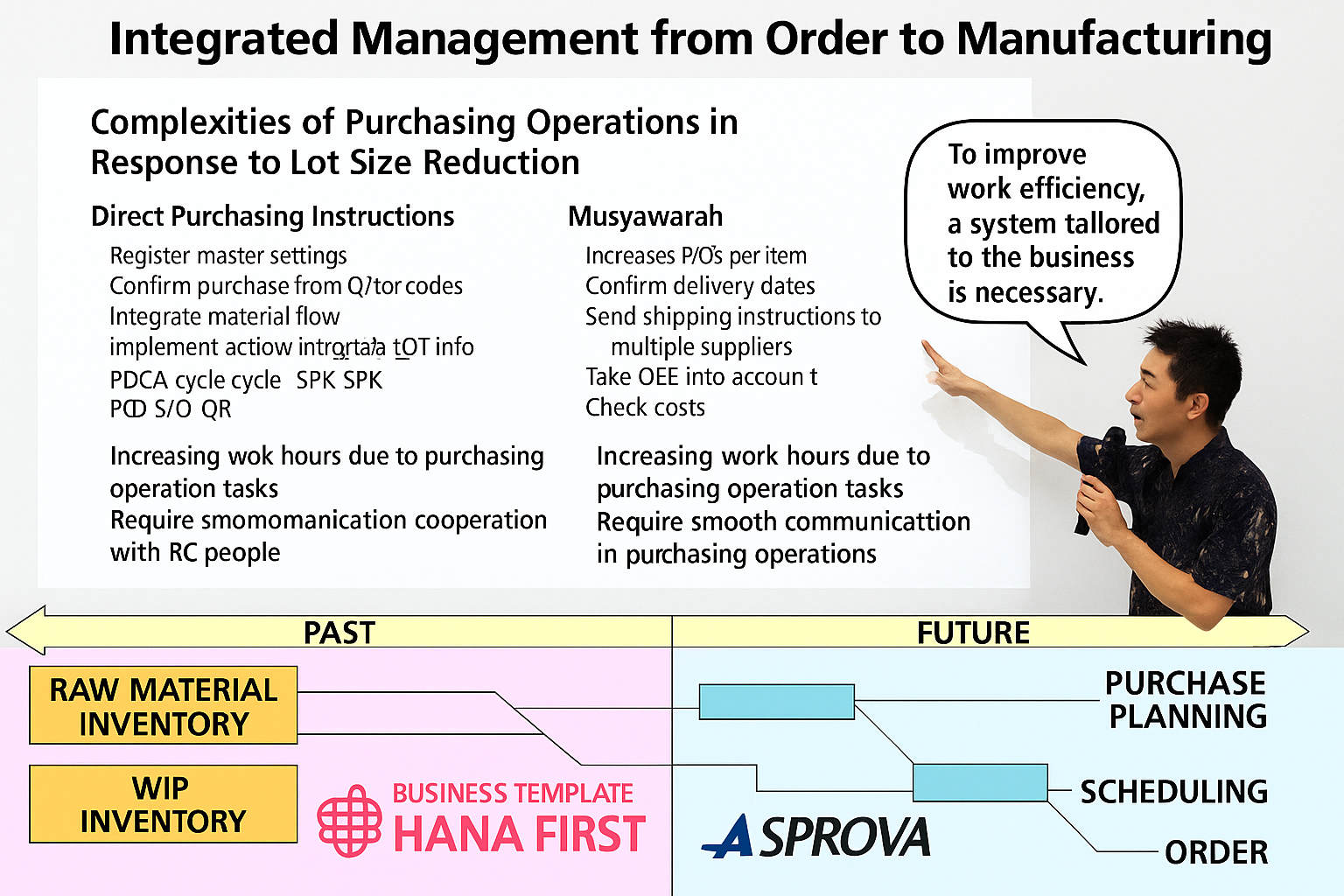
Our company implements management functions with the business template HanaFirst and planning with the scheduler Asprova, which I, with over 20 years of experience in the system industry, propose as the best practice for Japanese companies in Indonesia. The system is one means to achieve the goal of business improvement, and if systematization realizes efficient and accurate data entry, visualization, sharing, and systematization for effective information utilization, information from the shop floor will generate company competitiveness.
To produce visible effects from system implementation, we propose systems that focus on how much current operations have improved and what new results have been achieved after thoroughly hearing customer requirements.
Frequently Asked Questions | Optimizing Business Systems in Indonesian Factories
We summarize frequently asked questions in line with the content of this article.
What are the issues with business systems in Indonesian factories?
In Indonesian factories, issues include invisibility of which shipments the flowing items in the business process are connected to, excessive Excel management when forcing operations to fit incompatible systems, and disconnected business flows between departments, leading to unnecessary adjustments. These issues reduce operational efficiency and diminish employees' awareness of sales costs.
What should be considered when implementing systems in Indonesia?
When implementing systems in Indonesia, it is important to respect current business processes and gradually introduce new systems. By considering user emotions and making the process visible through which system results are derived, staff understanding and trust can be gained.
What are the effects of optimizing business systems in Indonesian factories?
Optimizing business systems in Indonesian factories enables quick adaptation to changes in order deadlines and quantities, maintaining high planning accuracy. Additionally, managing warehouse entries and exits with handheld terminals allows easy automatic integration with inventory management systems, improving operational efficiency.