


In Indonesian manufacturing, shipping is not just 'completed when the order is fulfilled,' but a comprehensive execution process involving retrieving items from the warehouse, matching lots, and recording shipping results in the system. The central document is the picking list, and the shipping request slip is key for governance in material issuance.
-
-
Production Management Systems in Indonesia
The ultimate goal in manufacturing is to improve productivity and meet delivery deadlines. Understanding the differences between manufacturing cost, cost of…
続きを見る
Positioning of this article: It is the authoritative source for 'shipping execution' under the production management hub. It does not cover general trade packing lists/B/L, but focuses on lot matching within the factory and delineation of shipping responsibility. For post-return corrections, refer to shipping returns, products to Hanafirst ERP, and trade documents to Bill of Lading and Invoice (business hub).
What this article covers
- This article is the authoritative source for shipping execution (picking/shipping requests) in production management systems.
- The picking list is a field verification document that bundles item lot details from shipping instructions into truck or container units.
- The shipping request slip separates the 'user' and the 'shipper,' serving as governance to prevent material removal and inventory discrepancies.
- Handheld verification improves sorting accuracy, but the basic design is to record shipping results in the system per shipping instruction.
- Packing lists and B/L are export documents, differing in role from factory picking (trade documents are covered in a separate article).
- Lot consistency during returns is covered in the shipping return article, and the overall ERP is traceable to the production management hub/Hanafirst.
Positioning of Shipping Execution in Production Management Systems
In the flow of sales, inventory, and production, the following are distinct:
- Shipping Instruction — An instruction registered in the system based on orders indicating 'what to ship'
- Picking List — A field verification list bundling instruction details into work units like trucks/containers
- Shipping Results — Completion data recorded in the system after verification (with lots)
- Packing List/B/L — Trade documents for export/shipping companies (different role from factory verification)
The main focus of this article is the top three. The trade documents below are traced to the business hub as needed.
Shipping Request Slip: Separating Users and Shippers
Previously, a manufacturing client requested 'only an inventory management system.' Simply having receipt and issue functions does not differ much from current Excel management, so it is important to input shipping requests from the system and issue slips.
In Indonesia, steel plates and bars are easily resold, increasing theft risk if manufacturing staff can freely remove materials. Therefore, separating the responsibility of users and shippers with slips helps reduce month-end inventory discrepancies.
Warehouse staff are not present during night shifts, so manufacturing staff must submit shipping request slips by evening to have materials issued for night shift use. This prevents unauthorized removal.
Additionally, registering the reason for shipping during request input allows for versatile use across manufacturing issuance, subcontracting issuance, shipping, inter-warehouse transfers, and disposal. This is not just an 'inventory module alone,' but shipping governance as part of the production management system.
Picking List: Matching Items and Lots by Shipping Unit
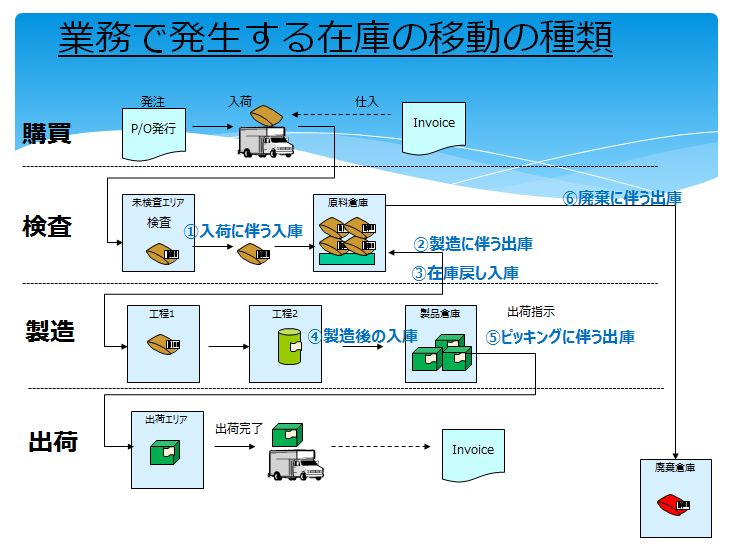
Shipping-related issuance work is particularly important. Typically, products to be shipped are retrieved from the warehouse and stacked in the shipping area. At this time, it is confirmed whether the picking list created for the shipping work unit matches the actual items.
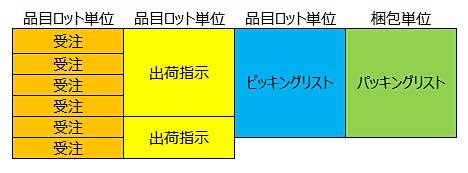
In the sales management system's shipping function, shipping instructions are input based on order information, and the details of the shipping instructions are compiled into sorting units, forming the picking list. For example, for export to Japan, a picking list NO is assigned to products loaded into a 40-foot container, and products in the shipping area are scanned for verification. If the verification result is OK, shipping completion registration is performed.
The detail lines of the picking list include uncompleted parts of issued shipping instructions. The keys are as follows:
- Shipping Instruction NO ← Obtained from the system
- Item Code ← Obtained from the system
- Lot NO ← Obtained from the system
- Picking List NO ← Newly assigned to instruction details to be registered as completed
The status of shipping instructions includes incomplete, partial shipment, and completed. Since details of different shipping instruction NOs are re-bundled with picking list NO, picking list NO is needed on the instruction detail side.
Design Points for Handheld Verification and Shipping Results Recording
When developing a shipping system using handheld terminals, the picking list is a tool for sorting accuracy, but the shipping results themselves should be recorded in the system per shipping instruction. Mixing work units (picking) with the authoritative units of accounting/inventory (shipping instructions) makes partial shipments and returns difficult to correct.
Shipping results with verified lots become the starting point for Trace Back (shipping → process → raw materials) during future claims. When Tukar Guling occurs during returns, whether the original shipping lot remains as the authoritative source is crucial.
Differences from Packing List and B/L (Common Confusions)
Details from order to shipping instruction to picking-based shipping results are at the item (lot) level, but when loading onto trucks or containers, they are consolidated into packing units, and a packing list may be submitted to the shipping company. The shipping company receives the Invoice, packing list, and Certificate of Origin (COO) and issues a Bill of Lading (B/L).
These are document processes for export/logistics and differ in layer from factory picking (actual lot verification). For details on trade documents, refer to Bill of Lading and Invoice Method, and this article refocuses on the factory's production management system side.
Frequently Asked Questions: Shipping and Picking in Indonesian Factories
Based on the positioning and field operations of this article, we organize frequently recurring questions.
What is the difference between a picking list and a packing list?
The picking list is a shipping work document for verifying actual item lots within the factory. The packing list is an export/logistics document at the packing unit level. Although the names are similar, their roles and users differ.
Why is a shipping request slip necessary?
To separate the responsibility of users and shippers, preventing unauthorized removal and inventory discrepancies. Simply having receipt and issue functions does not differ much from Excel and does not serve as governance in a production management system.
Is a shipping instruction unnecessary if verified by handheld?
No. Verification is for sorting accuracy, and the authoritative records for inventory and sales remain at the shipping instruction/shipping results level. This makes partial shipment and return corrections easier.
How does it relate to lot tracking?
Correctly recording item lots at the time of shipping is the premise for subsequent Trace Back and alternative linkage during returns.
Where should I read about returns?
For post-shipping Tukar Guling and corrected Invoices, the shipping return article is the authoritative source.
Related Links
- Production Management Hub — Entry point for production management systems in Indonesian factories
- Hanafirst ERP — Authoritative source for lot tracking and shipping results
- ERP Selection — Role sharing with selection perspectives and planning
- Shipping and Picking List — Shipping execution and lot verification
- Shipping Returns (Tukar Guling) — Inventory, sales, and lot design during returns
- Bill of Lading and Invoice — Trade document side (business hub)