


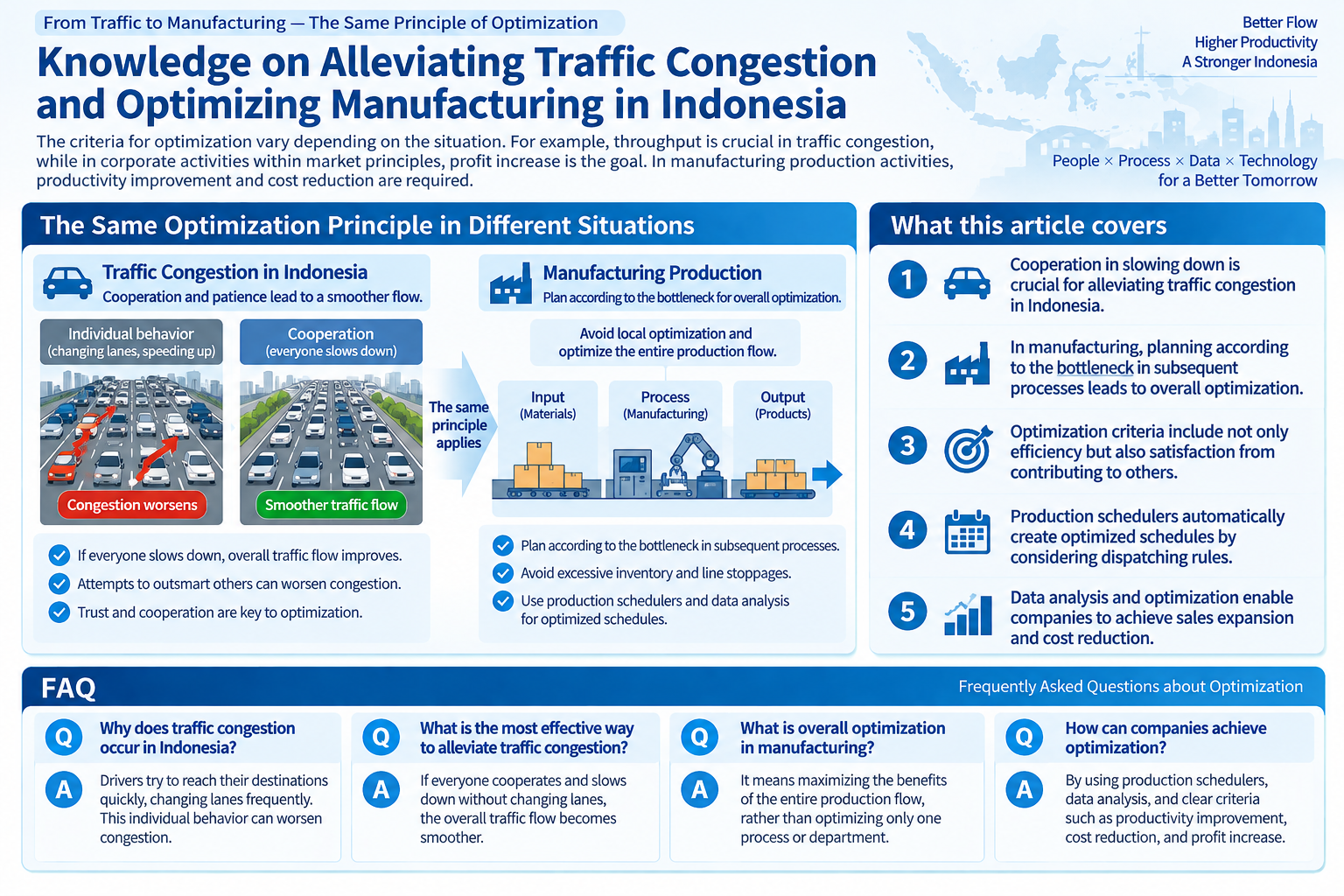
The criteria for optimization vary depending on the situation. For example, throughput is crucial in traffic congestion, while in corporate activities within market principles, profit increase is the goal. In manufacturing production activities, productivity improvement and cost reduction are required.
-
-
Production Management Systems in Indonesia
The ultimate goal in manufacturing is to improve productivity and meet delivery deadlines. Understanding the differences between manufacturing cost, cost of…
続きを見る
What this article covers
- Cooperation in slowing down is crucial for alleviating traffic congestion in Indonesia.
- In manufacturing, planning according to the bottleneck in subsequent processes leads to overall optimization.
- Optimization criteria include not only efficiency but also satisfaction from contributing to others.
- Production schedulers automatically create optimized schedules by considering dispatching rules.
- Data analysis and optimization enable companies to achieve sales expansion and cost reduction.
The 'Optimal' Method to Alleviate Traffic in Indonesia
I commute to the MM2100 service office in Cibitung, Indonesia, 2-3 days a week. When returning home at 5 PM, I often get caught in traffic near the TOL (toll road) gate, where drivers are eager to reach their destinations quickly. This results in tense competition with narrow gaps between vehicles.
When completely stopped in the overtaking lane, seeing the left lane suddenly flow smoothly can cause anxiety. However, if a slow-moving large trailer is ahead after changing lanes, one might regret not staying in the original lane. If one had unlimited stamina and accident-free driving skills, repeatedly changing lanes might be the fastest way to arrive.
In Japan, it is an unspoken rule to stand on the left and leave the right side open on escalators, but the most efficient method is to stand on both sides. Despite calls from railway companies, people in a hurry choose to stand on one side, making it hard to implement.
Case Study: Like the 'Prisoner's Dilemma,' the best solution to alleviate congestion is for everyone to slow down without changing lanes. However, in an environment where trust is lacking, attempts to outsmart others worsen congestion.
Key Point: To alleviate congestion, it is important for everyone to cooperate and slow down. However, in an environment where trust is lacking, individual actions can worsen congestion.
Concepts of Partial and Overall Optimization
Overall optimization occurs when organizations sharing interests, such as factories aiming to 'increase productivity,' 'ship without delays,' and 'reduce manufacturing costs,' achieve maximum benefits. However, it is difficult to achieve in groups with differing interests, like highway congestion or rush hour escalators.
Within organizations, fear of line stoppages due to material shortages can lead to excessive ordering, and fear of stopping parts supply to subsequent processes can result in increased inventory costs. Conversely, inventory shortages can cause opportunity losses, and these partial optimizations can undermine overall optimization.
In Indonesian two-wheeler and four-wheeler parts factories, the pattern often involves molding or pressing in the initial process and ASSY or welding in the subsequent process. The cycle times differ between automated initial processes and manual subsequent processes. In this case, planning based on the bottleneck in the subsequent process leads to overall optimization, as opposed to forward planning from the initial process, which accumulates inventory.
In capitalist economies like Japan and Indonesia, business players aim for partial optimization based on competition principles. However, in areas where public welfare is prioritized, such as congestion or escalators, contributions to others are necessary, approaching a socialist mindset.
Like a centipede race or three-legged race aiming for team victory, organizations operate with an internal focus on overall optimization and a market focus on partial optimization. While organizations are composed of individuals pursuing personal interests, humans are superior to animals in aligning with the organization's pace.
Clarifying Optimization Criteria
Measuring optimization criteria solely by throughput, or total movement per unit time, is unrealistic. For example, in congestion or on escalators, not everyone wants to move quickly; those with time may yield to those in a hurry, gaining satisfaction from contributing to others. Thus, optimization criteria cannot be measured by efficiency alone.
In optimization discussions, it is often mentioned that 'overall optimization does not necessarily lead to the optimization of human happiness.' This is due to unclear criteria for measuring the degree of optimization. Our company's basic axis in discussing manufacturing optimization is 'inventory reduction through shortening purchasing and manufacturing lead times,' considering constraints on production resources like equipment and personnel.
In comedy or skits, intentionally changing the subject to elicit laughter is common, but in discussions, changing the subject to lead to a favorable conclusion can occur. If done unconsciously, it can lead to circular discussions, wasting time without benefiting anyone.
In discussions on equipment optimization for improving factory productivity, there may be counterarguments that 'optimizing production resources may not maximize customer satisfaction.' This stems from unclear optimization criteria.
Our company's work involves business improvement through IT. Clients often request 'automatic optimization,' akin to asking 'what is the world's most delicious dish.' Without knowing what is optimal for the individual, we cannot take action.
Optimization Approaches for Manufacturing Production Planning
In manufacturing, a standard production plan is created based on customer orders received by the sales department, considering shipments. Using a parts structure table, the net requirements of parts to be manufactured and raw materials to be used are calculated for each process, and manufacturing lots are staggered by manufacturing lead time days, allocating work to production resources. If overload work occurs, it is brought forward or allocated to alternative resources for leveling.
In the process of leveling overload work within the capacity of daily production resources, moving overflow work causes a domino effect, recursively pushing out already allocated work. This adjustment work is automatically performed by considering pre-set dispatching rules and resource evaluations, creating an optimized schedule, which is the function of a production scheduler.
Simply setting parameters in a production scheduler to derive an optimal solution that meets constraints such as leveling production resources, minimizing setup time, minimizing delivery delays, and batch consolidation has its limits. To obtain a more optimal schedule, repeated simulations are necessary, selecting the one closest to the optimal value of the objective function used as an evaluation index.
In the era of big data, analyzing and optimizing data to predict delivery delays, raw material shortages, productivity declines due to frequent setups, and excessive inventory due to batch consolidation is important for speeding up decision-making and improving operational efficiency.
This optimization approach is utilized not only in manufacturing but also in retail for effective use of floor space, in marketing for offering products aligned with trends, in transportation for securing safe and low-cost delivery routes, and in finance for determining asset management portfolios. Many companies achieve sales expansion and cost reduction through this.
Frequently Asked Questions | Indonesian Traffic and Optimization
Based on the content of this article, frequently asked questions are briefly organized.
What is the optimal method to alleviate traffic in Indonesia?
To alleviate traffic in Indonesia, it is important for everyone to cooperate and slow down. However, in an environment where trust is lacking, individual actions can worsen congestion.
What is overall optimization in manufacturing?
Overall optimization in manufacturing refers to increasing productivity, preventing delivery delays, and reducing manufacturing costs, allowing the entire organization to reap maximum benefits. Since partial optimization can undermine overall optimization, planning from an overall perspective is crucial.
How is the optimization approach conducted in manufacturing production planning?
In manufacturing production planning, a standard production plan is created based on order receipts, leveling overload work. A production scheduler is used to automatically optimize the schedule, and repeated simulations are conducted to select the optimal schedule.