


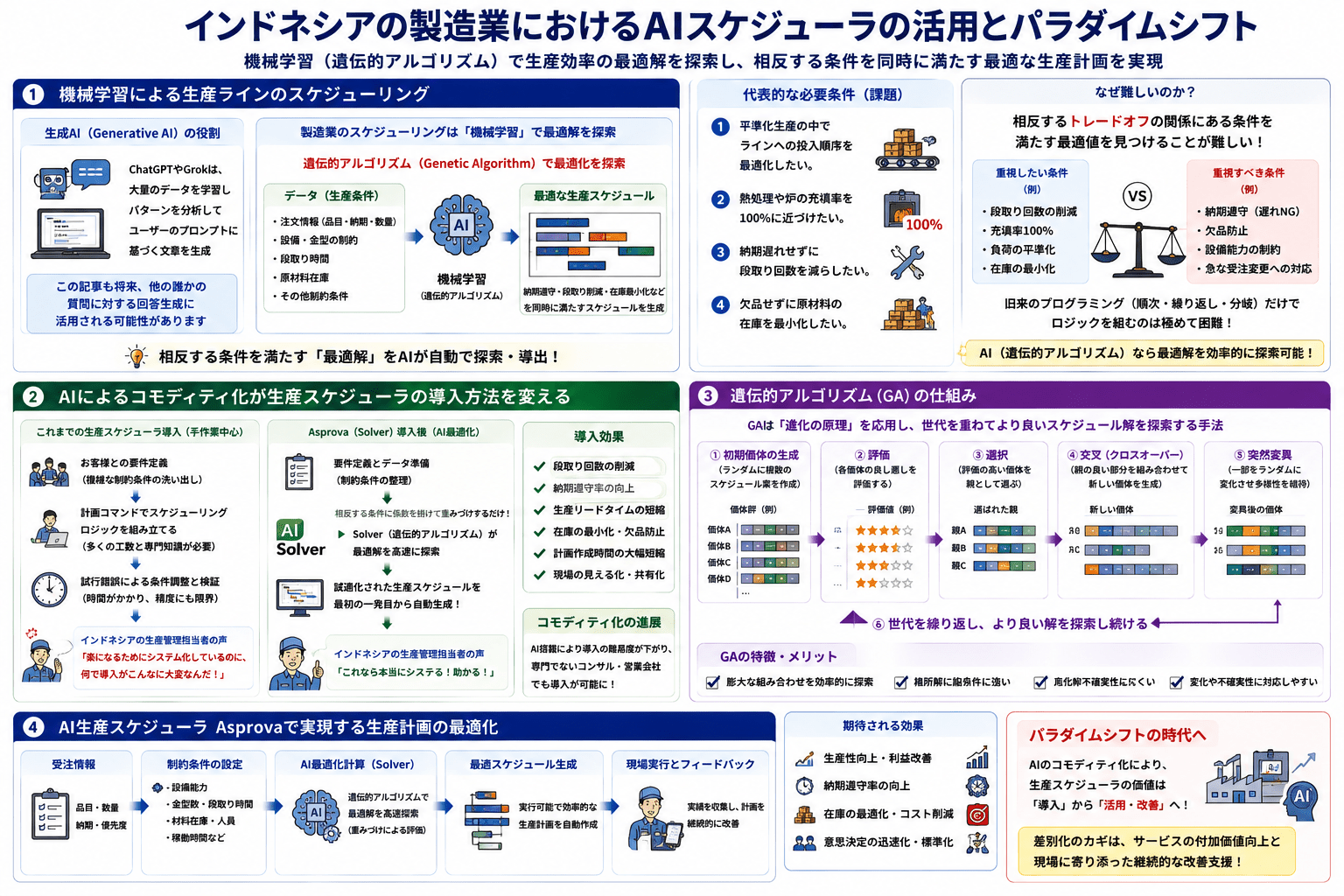
In the scheduling of production lines in manufacturing, machine learning techniques such as genetic algorithms have made it possible to search for optimal solutions to improve production efficiency. In Indonesia, the commoditization of AI is causing a paradigm shift in the field of manufacturing systems. Production Scheduler in Indonesia In Indonesia's Japanese manufacturing industry, the adoption of production management systems has been increasing. However, when it comes to one of the key challenges in production management—creating feasible production plans that take machine and equipment loads into account—manual work using Excel remains the standard practice. As a result, the demand for production schedulers is expected to grow in the future. 続きを見る

What this article covers
- What can AI decide automatically?
- How does this differ from dispatching rules?
- What data is needed first on the floor?
Production Line Scheduling with Machine Learning
Even among Japanese residents in Indonesia, it is becoming increasingly evident through social media posts and other channels that tools like ChatGPT and Grok are becoming indispensable both at work and in daily life. ChatGPT is classified as a type of generative AI within the broader category of artificial intelligence (AI).
It learns from vast amounts of data on the internet, analyzes patterns, and generates subsequent text based on the prompts entered by users.
Even this article I am writing now could, in the future, contribute to content generation as part of the data already learned and patterned by generative AI when someone inputs a prompt like “Teach me how to use AI for production scheduling tasks in Indonesia.” However, in the context of production scheduling in manufacturing, optimization is explored using genetic algorithms from machine learning.
For example, the following are typical requirements that come to mind when creating production schedules for Japanese manufacturing companies in Indonesia:
- Optimizing the input sequence to the line within leveled production.
- Increasing the fill rate of heat treatment or furnaces to near 100%.
- Reducing the number of setups without delaying delivery deadlines.
- Minimizing raw material inventory without causing shortages.
The difficulty lies in finding the optimal value that satisfies conditions with conflicting trade-offs. Specifically, it involves achieving load leveling, a 100% fill rate, and fewer setups while meeting the condition of no delivery delays, or preventing line stoppages due to shortages while minimizing material inventory—conditions that work in opposite directions but must be satisfied simultaneously to achieve optimal scheduling.
The high level of difficulty in building logic using basic processing such as “sequential,” “repetitive,” and “branching” operations within the framework of traditional manufacturing system development with programming languages is easy to imagine. However, in the latest production line scheduling, genetic algorithms enable the search for optimal solutions, leading to a paradigm shift in the field of manufacturing systems driven by the advent of AI.
AI-Driven Commoditization Changes How Production Schedulers Are Implemented
In the implementation of production schedulers in Indonesia, a significant amount of effort was traditionally spent on building scheduling logic using planning commands based on requirement definitions with customers. Now, however, the logic for searching optimal production scheduling solutions with genetic algorithms has been embedded in an optional command called Solver within the production scheduler software Asprova. By simply applying coefficients to weigh conflicting conditions, highly accurate and optimized production schedules can be automatically generated at high speed.
During a production scheduler implementation project in Indonesia, I repeatedly heard complaints from Indonesian production management staff: “We’re systemizing this to make work easier, so why is the implementation so tough?” Each time, I could only respond, suppressing my emotions while inwardly frustrated, with, “We’re struggling now so you can relax in the future.”
However, with AI implemented in production scheduling logic, optimized schedules that meet their expectations are now automatically generated from the very first attempt, reducing interpersonal stress in my projects. On the flip side, this also means that the implementation of production schedulers, which was once highly challenging, has become so simplified that even consulting firms or sales companies without IT expertise can handle it.
In Indonesia, technological innovations driven by the latest AI clearly point to a future where production schedulers become commoditized. For a manufacturing system development company like ours, the need to enhance the added value of our services to differentiate ourselves is becoming increasingly critical.
FAQ | AI and Schedule Building
Questions on optimization and solvers.
What can AI decide automatically?
When objectives and constraints are clear, it can speed search over candidate schedules. Without clear criteria, “optimal” is undefined.
How does this differ from dispatching rules?
Rules are fast and explainable but limited for multi-objectives. Combine with simulation/search and pick solutions closest to the metric.
What data is needed first on the floor?
Basic masters for process, resources, setups, and orders, plus an actuals feedback path. Build a refresh loop before chasing precision.