


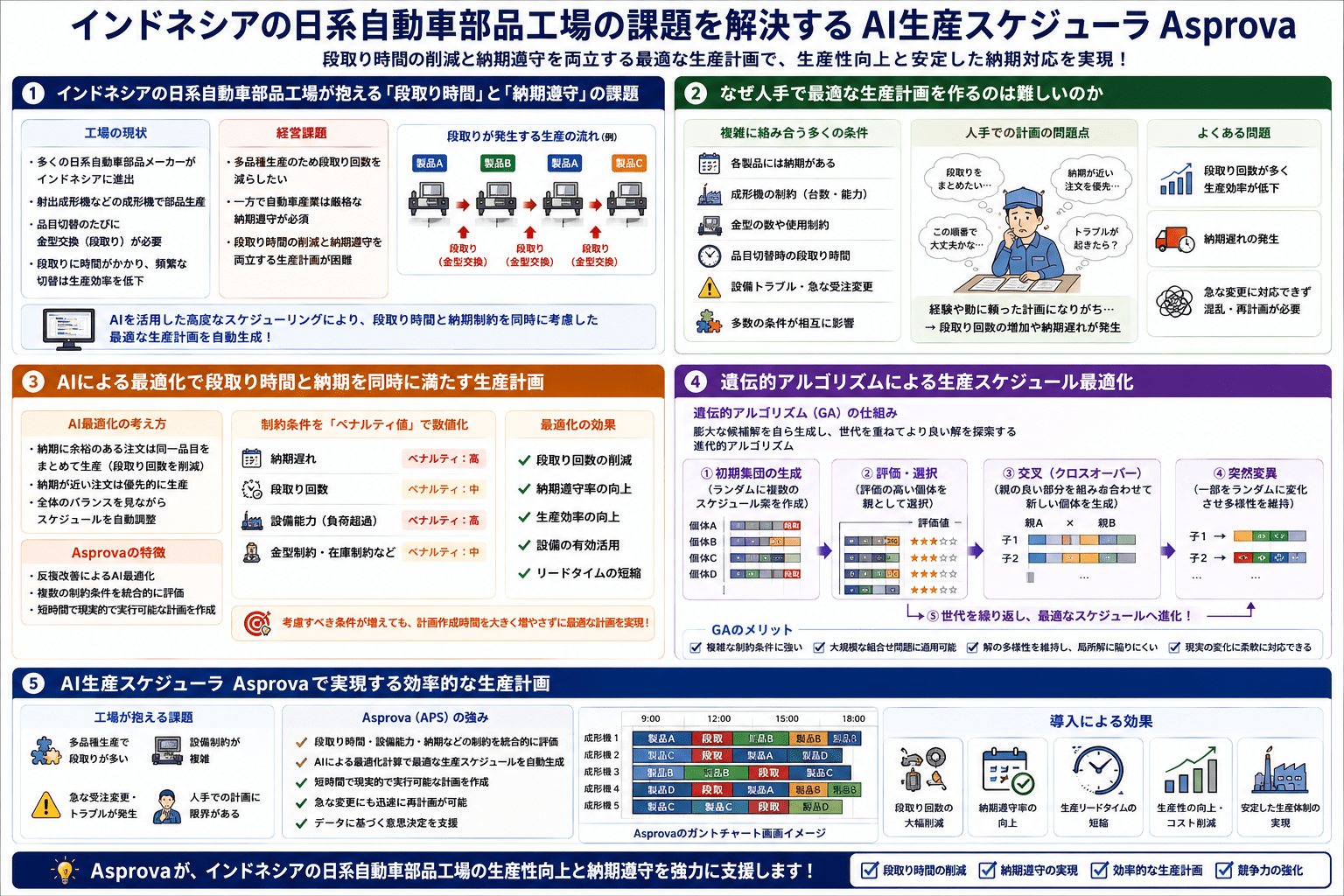
In Japanese automotive parts factories in Indonesia, balancing the reduction of setup time and adherence to delivery deadlines is a crucial management challenge. The AI scheduler Asprova utilizes genetic algorithms to automatically create efficient production schedules even under complex constraints. This supports both productivity improvement and adherence to delivery deadlines.
-
-
Production Scheduler in Indonesia
Production planning and load planning are closely related and require verification based on quantities. It is important to compare production quantities,…
続きを見る
What this article covers
- In Indonesian Japanese automotive parts factories, reducing setup time and adhering to delivery deadlines are critical challenges.
- The AI scheduler Asprova uses genetic algorithms to automatically create efficient production schedules.
- Asprova evaluates delivery delays and setup frequency as penalty values to explore optimal plans.
- Genetic algorithms are evolutionary algorithms that generate numerous candidate solutions while searching for the optimal solution.
- Asprova considers multi-variety production and equipment constraints to create executable production schedules in a short time.
Challenges of "Setup Time" and "Delivery Adherence" Faced by Japanese Automotive Parts Factories in Indonesia
Many Japanese automotive parts manufacturers have expanded into Indonesia, where parts production using molding machines, including injection molding machines, is routinely conducted. In these factories, to efficiently produce a wide variety of parts, mold changes (setup) are necessary each time the item is switched. However, since setup takes time, frequent item changes can be a factor in reducing production efficiency.
On the other hand, strict adherence to delivery deadlines is required in the automotive industry, and creating production plans that reduce setup frequency without causing delivery delays is a major challenge. Optimizing these complex conditions manually is not easy.
An effective means to solve these challenges is the production scheduler Asprova. With advanced scheduling functions utilizing AI, it is possible to automatically generate optimal production plans that simultaneously consider setup time and delivery constraints.
Why Is It Difficult to Create Optimal Production Plans Manually?
In the production planning of molding factories, simply arranging production in order of receipt does not result in an optimal schedule. Each product has a delivery deadline, and constraints on the molding machines and the number of molds, as well as the setup time that occurs when switching items, must be considered. To reduce setup time, it is desirable to produce the same mold together, but sometimes orders with earlier deadlines must be prioritized. Furthermore, if equipment troubles or sudden order changes occur, the plan needs to be reviewed.
As such, production planning involves many conditions that influence each other, making it very difficult to determine the optimal sequence manually. As a result, plans often rely on experience and intuition, leading to increased setup frequency and delivery delays.
Production Planning That Simultaneously Meets Setup Time and Delivery with AI Optimization
The production scheduler Asprova creates production plans that simultaneously achieve setup time reduction and delivery adherence using AI optimization. Specifically, orders with leeway in delivery are produced together to reduce setup frequency, while orders with imminent deadlines are prioritized, automatically adjusting the schedule while considering the overall balance.
The feature of this mechanism is that various constraint conditions can be quantified as "penalty values" and calculated as a single evaluation index. By integrating and evaluating conditions such as delivery delays, setup frequency, and equipment constraints, AI repeatedly improves the schedule to explore better plans. This allows for the creation of realistic and executable production schedules in a short time without significantly increasing the time required for planning, even if the number of constraint conditions to be considered increases.
Production Schedule Optimization with Genetic Algorithms
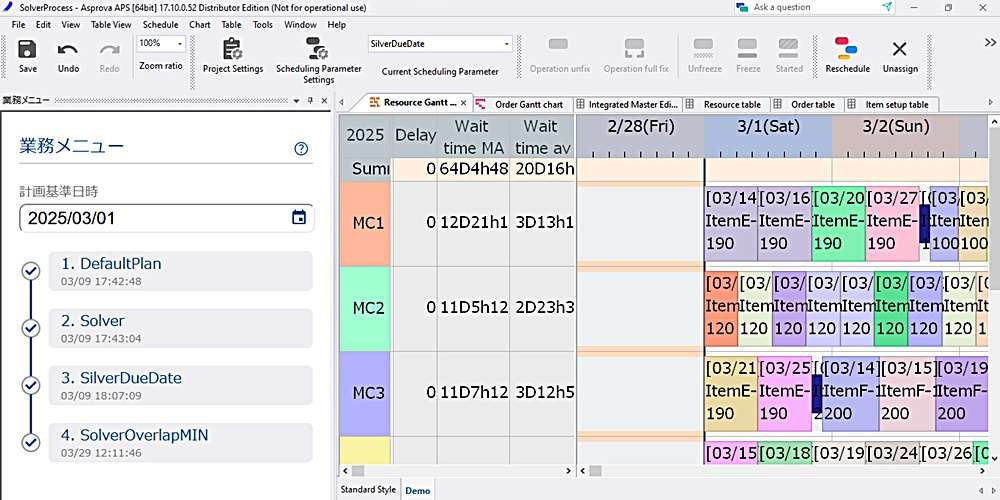
There are various types of optimization algorithms used in detailed scheduling (APS). For example, deep learning requires a large amount of training data, and preparing to learn the feasibility of plans in advance is challenging. It can also be difficult to respond to demand patterns that did not exist in the past.
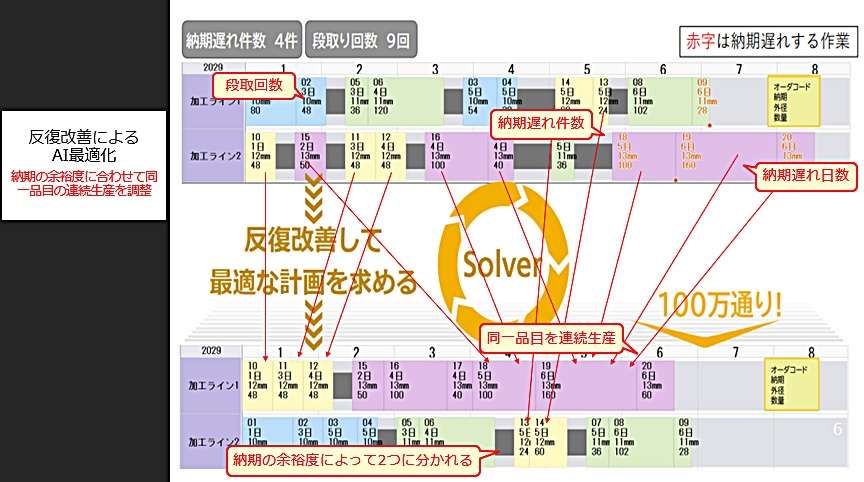
In contrast, the Genetic Algorithm (GA) is an evolutionary algorithm that generates a vast number of candidate solutions while exploring the optimal solution, making it suitable for complex optimization problems like production scheduling. First, multiple schedule proposals (individuals) are randomly generated and evaluated, and those with high evaluations are selected as parents.
Then, new schedules are generated through crossover, and some are randomly changed through mutation while generations are repeated. By maintaining the diversity of solutions and repeating exploration, the production plan is gradually improved, considering setup time and delivery constraints.
Efficient Production Planning Achieved with AI Production Scheduler Asprova
In automotive parts molding factories, production plans that balance setup time reduction and delivery adherence are required. However, due to the involvement of many conditions such as multi-variety production, equipment constraints, and sudden order changes, there are limits to manual planning. The production scheduler Asprova is an APS (Advanced Planning and Scheduling) system that automatically generates optimal production schedules while considering these complex conditions simultaneously.
By integrally evaluating constraints such as setup time, equipment capacity, and delivery deadlines, and using AI optimization calculations, realistic and executable plans can be created in a short time. This is expected to result in effects such as reduced setup frequency, shortened production lead time, and improved delivery adherence rate. It is being utilized as a powerful solution to achieve efficient and stable production systems in Japanese manufacturing in Indonesia.
Frequently Asked Questions|Utilizing AI Scheduler Asprova
We summarize frequently asked questions in line with the content of this article.
How does the AI Scheduler Asprova optimize setup time and delivery?
The AI Scheduler Asprova utilizes genetic algorithms to automatically generate production plans that simultaneously consider setup time reduction and delivery adherence. Orders with leeway in delivery are produced together to reduce setup frequency, while orders with imminent deadlines are prioritized, automatically adjusting the schedule while considering the overall balance.
Why is it difficult to create optimal production plans manually?
Production planning involves many conditions such as delivery deadlines, molding machine constraints, the number of molds, and setup time. These conditions influence each other, making it very difficult to determine the optimal sequence manually. As a result, plans often rely on experience and intuition, leading to increased setup frequency and delivery delays.
How does the Genetic Algorithm optimize production schedules?
The Genetic Algorithm is an evolutionary algorithm that generates a vast number of candidate solutions while exploring the optimal solution. First, multiple schedule proposals are randomly generated and evaluated, and those with high evaluations are selected as parents. Through crossover and mutation, generations are repeated, gradually improving the production plan considering setup time and delivery constraints.