


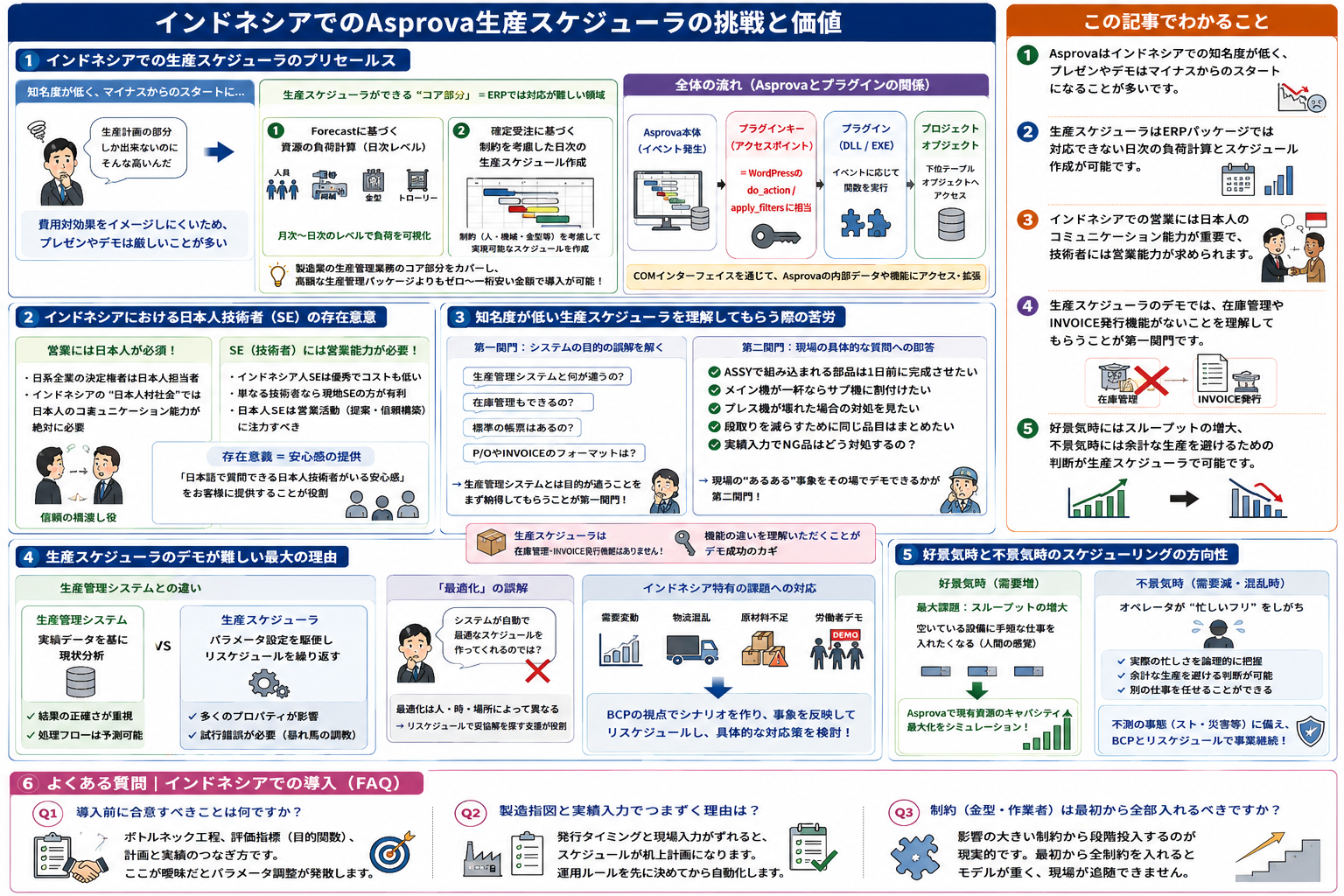
The recognition of production schedulers in Indonesia is still low, but they support daily load calculations for secondary resources such as molds and personnel, and create production schedules for primary resources like machinery under these constraints. These are core aspects of production management tasks that even expensive ERP packages cannot handle.
-
-
Production Scheduler in Indonesia
Production planning and load planning are closely related and require verification based on quantities. It is important to compare production quantities,…
続きを見る
What this article covers
- Asprova has low recognition in Indonesia, often starting presentations and demos from a negative position.
- Production schedulers can perform daily load calculations and schedule creation, which ERP packages cannot handle.
- Japanese communication skills are crucial in Indonesian sales, and engineers need sales abilities.
- In demos, it's crucial to convey that production schedulers lack inventory management and INVOICE issuing functions.
- Production schedulers enable decisions to increase throughput during booms and avoid unnecessary production during recessions.
Pre-sales of Production Schedulers in Indonesia
We are conducting technical sales for the Asprova production scheduler in Indonesia. Although this software is an application for the manufacturing industry, its recognition is still low in Indonesia, making it difficult to visualize cost-effectiveness, often resulting in presentations and demos starting from a negative position.
Such comments are common, and sales talks tend to become self-deprecating. However, production schedulers can do two things that even expensive production management package systems cannot.
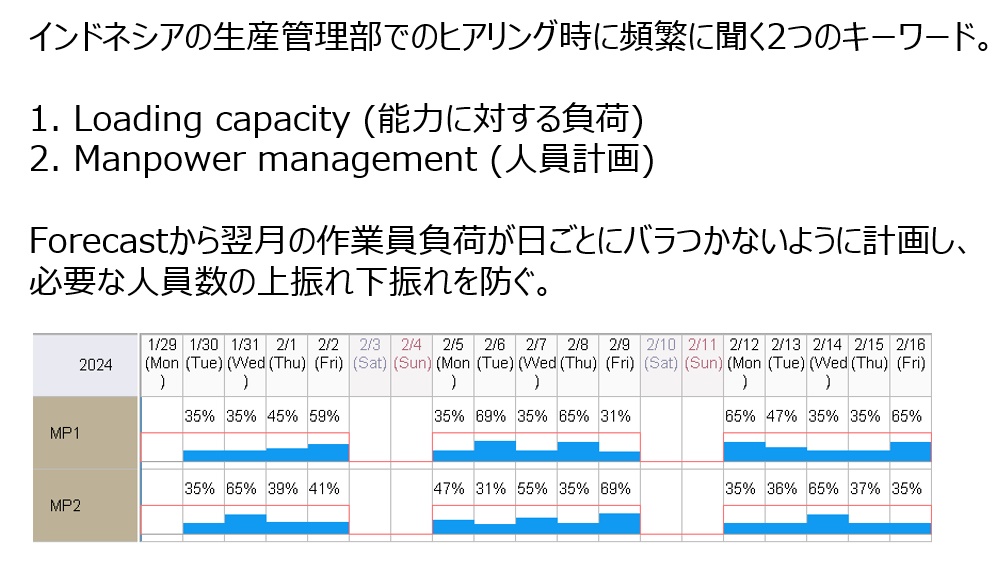
- Perform load calculations for production resources such as personnel, machinery, molds, and trolleys from monthly to daily levels based on forecasts.
- Create daily production schedules considering the constraints from confirmed orders.
These two aspects are core parts of production management tasks in the manufacturing industry, and they can be introduced at a price one digit lower than production management packages, making them highly regarded. However, I believe the success of introducing production management packages depends on the accuracy of the master and inventory, and if this information is incorrect, introducing a production scheduler will also be difficult.
In China, there is a saying, "Beat the chicken to scare the monkey," but in the case of production schedulers, we conduct sales with a bit of sarcasm, or in a more positive light, pull sales.
The Significance of Japanese Engineers (SE) in Indonesia
When conducting system sales at factories in Indonesia, it is common for a Japanese manager and an Indonesian representative to be present. It is typical to explain to the Indonesian representative in Indonesian while appealing to the Japanese representative in Japanese at key points. Preparing for questions that are likely to arise from the Indonesian representative by incorporating them into the demo is important to respond immediately when questions arise.
Here, the necessity of Japanese SEs in Indonesia is questioned. Japanese are essential for sales, and when dealing with Japanese companies, it is difficult to conduct sales to Japanese decision-makers without Japanese personnel. Communication skills of Japanese are absolutely necessary for sales in the Japanese community in Indonesia.
What about SEs? There are many highly skilled Indonesians, and it is easier to find capable Indonesian SEs than excellent Japanese SEs. Japanese SEs in Indonesia are required to have sales skills.
Since Indonesian engineers are more competent and cost-effective, I personally believe Japanese SEs are not necessary. Japanese sales conduct marketing activities to win orders, and if they bring Indonesian engineers to demos, they can gain customer trust. While some technical knowledge is necessary for sales, focusing on list marketing and hospitality golf is more efficient than spending time studying technology.
Considering this situation, if there is a significance for Japanese SEs in Indonesia, it is to provide customers with the reassurance that "there is a Japanese person knowledgeable in technology, so they can ask questions in Japanese if something happens." To emphasize this reassurance, it might be effective for Japanese to conduct demos.
I also conduct demos for Indonesian representatives in Indonesian, but even if the demo is considered well-done, I am asked, "Is there no Indonesian engineer?" Indonesians want to ask questions in Indonesian, and Japanese in Japanese. Even in Indonesia, where English is widely used and globalization is more advanced than in Japan, "home language remains important."
Challenges in Understanding Low-Profile Production Schedulers in Indonesia
In the case of production management systems, the processing flow is predictable, and customers understand the system's functions and constraints well. Therefore, the main challenge is to appeal the post-implementation business flow, the information obtained, and the content that can be analyzed. Even if unexpected questions arise, it can be explained that they can be resolved with customization or additional subsystems, so demos rarely become chaotic.
However, in demos of low-profile production schedulers in Indonesia, it is necessary to start by explaining "what is a production scheduler." Questions such as "How is it different from a production management system?", "Can it also manage inventory?", and "Are there standard reports?" fly around, but these are based on the misconception that production schedulers are similar to production management systems.
Even when asked, "Can it also manage inventory?" or "I want to see the standard P/O and INVOICE format," production schedulers do not have such functions, so it must be explained that "it cannot" or "the system's purpose is different." This makes demos prone to becoming chaotic, but the first hurdle is to have customers understand that "production schedulers do not have inventory management or INVOICE issuing functions like production management systems."
Production management systems analyze the current situation based on past performance data, while production schedulers are systems that repeatedly reschedule using parameter settings. When customers ask, "Can you do this?", even if it is possible, if it cannot be demonstrated on the spot, it is the same as "cannot do it."
Requests such as "I want the parts assembled in ASSY to be completed one day in advance," "I want to assign to a sub-molding machine when the main molding machine is full," "I want a demo of how to handle when the press machine breaks down," "I want to manufacture the same items together to reduce setup," and "How do you handle NG items when entering results?" are made, requiring demonstrations of specific situations on the shop floor. This is the second hurdle.
These two hurdles always stand in the way of production scheduler demos, making them difficult.
The Biggest Reason Production Scheduler Demos Are Difficult
The biggest reason production scheduler demos are difficult lies in the nature of the system. Production management systems analyze the current situation based on performance data, so accurate processing results are required. However, production schedulers are systems that repeatedly reschedule to approach the desired schedule results using parameter settings. There are many properties such as planning parameters, masters, and orders that affect the schedule results, making the elements very complex.
The process of calculating evaluation values involves many elements, and even if the weights of properties are set correctly, optimized schedule results are not always obtained. It only gives a certain tendency to the schedule results, requiring trial and error. This is similar to taming a wild horse.
A common misconception in production scheduler demos is that "the system automatically creates the optimal schedule." However, the AI engine cannot derive the optimal schedule by looking at the pre-set production resource parameters and orders.
If expressing the optimization of production planning, it might be said, "A production plan that does not exceed capacity, has no delivery delays, and levels the operating rate." However, in countries like Indonesia, where there are demand fluctuations and disruptions in logistics networks, line stoppages due to raw material shortages are a problem. It is important to issue manufacturing instructions in an order that does not cause line stoppages while looking at raw material inventory and purchase order backlogs against orders.
Case: The question "What is optimization?" is similar to the question "What is the most delicious food in the world?" The answer varies from person to person. What is optimal varies depending on the person, time, and place, and there are few cases where the optimal schedule can be envisioned during rescheduling. The role of the production scheduler is to help find "what is optimal" for the shop floor.
Takeaway: It is important to utilize production schedulers as tools to find the optimal schedule according to the shop floor's situation.
Scheduling Directions in Booming and Recession Times
In production management systems, it is common to separate management by process. However, the physical distance and barriers between processes cause stagnation in the flow of goods and information, limiting lead time reduction and work-in-progress inventory reduction. On the other hand, using production schedulers allows for visualizing the flow of processes within the factory and optimizing the overall production flow.
This clarifies the required amount of materials and the timing of input into processes, reducing inventory between processes. In booming times like Indonesia's economic growth, the biggest challenge is increasing throughput rather than reducing inventory or shortening lead times.
Human intuition tends to want to insert short orders into available equipment, but by utilizing production schedulers, it is possible to simulate capacity maximization with existing resources. On the other hand, when the demand for Indonesian domestic manufacturing declined due to the Lehman Shock or the slowdown in China's economy, operators pretended to be busy more often.
By using production schedulers, it is possible to logically grasp the actual busyness and make decisions to avoid unnecessary production when idle and assign other tasks. Furthermore, in Indonesia, labor strikes due to labor-management negotiation breakdowns can intensify, stopping production.
To prepare for such unforeseen circumstances, it is possible to prepare a BCP (Business Continuity Plan) from a business continuity perspective and reflect the events that occurred in the scheduler to reschedule and consider specific countermeasures.
Frequently Asked Questions | Implementation in Indonesia
Points that are repeatedly confirmed in the field of sales and implementation.
What should be agreed upon before implementation?
Bottleneck processes, evaluation indicators (objective functions), and how to connect plans and actuals. If this is ambiguous, parameter adjustments will diverge.
Why do manufacturing instructions and actual input stumble?
If the issuance timing and shop floor input are misaligned, the schedule becomes a desk plan. Decide on operational rules first before automating.
Should all constraints (molds, operators) be included from the start?
It is realistic to introduce constraints with a large impact in stages. Including all constraints from the start makes the model heavy, and the shop floor cannot keep up.