


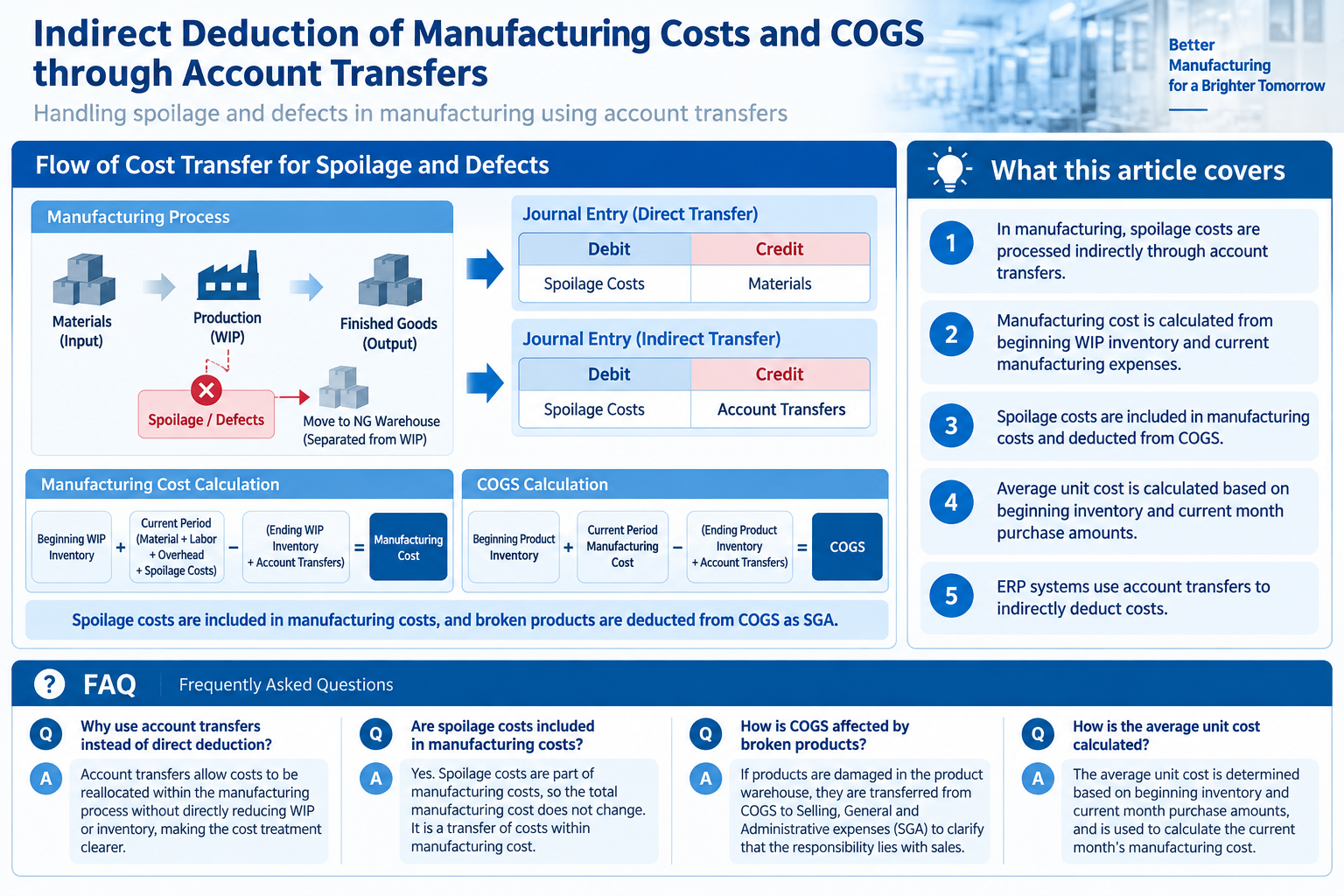
When material defects or spoilage occur, there is a method to indirectly transfer these costs to other accounts through account transfers, rather than directly reducing WIP or manufacturing expenses. This is similar to the treatment of depreciation expenses or allowance for doubtful accounts.
-
-
Accounting Systems in Indonesia
The adoption rate of SaaS-based accounting systems in Indonesia is less than 8%, despite the advancement of SaaS technology. The continuous launch of new…
続きを見る
What this article covers
- In manufacturing, spoilage costs are processed indirectly through account transfers.
- Manufacturing cost is calculated from beginning WIP inventory and current manufacturing expenses.
- Spoilage costs are included in manufacturing costs and deducted from COGS.
- Average unit cost is calculated based on beginning inventory and current month purchase amounts.
- ERP systems use account transfers to indirectly deduct costs.
What is Manufacturing Cost Transfer?
In manufacturing, the costs incurred to produce products are called manufacturing costs (Cost Of Goods Manufactured). The cost of goods sold (Cost Of Goods Sold) is derived from the beginning inventory and the manufacturing costs of the period, but no new cost items are added.
For example, if spoilage occurs during the manufacturing process, the factory moves the spoiled portion to an NG warehouse, separating it from normal WIP.
- Beginning WIP Inventory + Current Period (Material Cost + Labor Cost + Manufacturing Overhead) - Ending WIP Inventory = Manufacturing Cost
Since the ending WIP inventory is reduced by the amount separated to the NG warehouse, it is included in the manufacturing cost. To clarify the amount of spoilage, a separate journal entry is created. There are cases where materials are directly transferred to spoilage costs and cases where they are indirectly transferred through account transfers.
- Direct transfer of materials to spoilage costs
(Debit) Spoilage Costs (Credit) Materials - Indirect transfer of materials
(Debit) Spoilage Costs (Credit) Account Transfers
In this case, the formula for calculating manufacturing costs is revised as follows:
- Beginning WIP Inventory + Current Period (Material Cost + Labor Cost + Manufacturing Overhead + Spoilage Costs) - (Ending WIP Inventory + Account Transfers) = Manufacturing Cost
Since spoilage costs are also part of the manufacturing cost, the total amount of manufacturing costs does not change. It is merely a 'transfer of costs within the manufacturing cost'.
Next, if a product is dropped and broken in the product warehouse, it is transferred from COGS to SGA to clarify that the responsibility lies with the sales department, not the manufacturing department.
- Direct transfer of products to inventory shrinkage
(Debit) Inventory Shrinkage (Credit) Products - Indirect transfer of products
(Debit) Inventory Shrinkage (Credit) Account Transfers
In this case, the formula for calculating COGS is as follows:
- Beginning Product Inventory + Current Period Manufacturing Cost - (Ending Product Inventory + Account Transfers) = COGS
As a result, the broken products included in COGS are deducted as SGA.
Average Unit Cost and Manufacturing Cost
The manufacturing cost for the current month is determined by the cumulative amount based on the average unit cost of input WIP and the total processing cost of the process. The average unit cost of input WIP is calculated by dividing (Beginning WIP Inventory Amount + Current Month WIP Manufacturing Cost) by (Beginning WIP Quantity + Current Month WIP Manufacturing Quantity). Additionally, the current month manufacturing cost of WIP is the cumulative amount based on the average unit cost of input materials and the total processing cost of the process. The average unit cost of input materials is calculated by dividing (Beginning Material Inventory Amount + Current Month Material Purchase Amount) by (Beginning Material Quantity + Current Month Material Purchase Quantity).
In other words, when a certain item is placed at the top level (Level 0), "(Average Unit Cost of Input Items x Actual Input Quantity) + Total Processing Cost of the Process" becomes the manufacturing cost. The input amount for the next item, when it becomes an input item, is calculated based on the average unit cost calculated from the previous manufacturing cost and the beginning inventory amount.
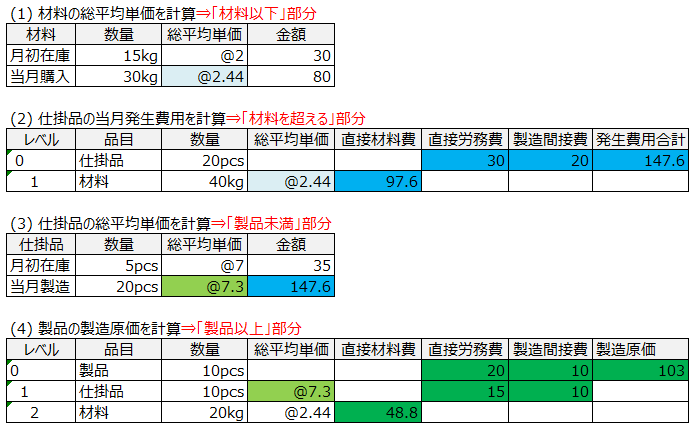
Cost Item Management by Portion
Manufacturing costs flow as follows based on the account connection diagram:
- Beginning Material Amount + Current Month Purchased Material - Ending Material Amount = Current Month Direct Material Cost
- Beginning WIP Amount + (Current Month Direct Material Cost + Current Month Processing Cost) - Ending WIP Amount = Current Month Product Manufacturing Cost
- Beginning Product Amount + Current Month Product Manufacturing Cost - Ending Product Amount = Current Month COGS
When managing by portion, direct material cost and labor cost portions are managed separately. The material cost portion starts from materials, flows through WIP, and into products.
- Beginning Material + Current Month Purchased Material - Ending Material = Current Month Direct Material Cost
- Beginning WIP + Current Month Direct Material Cost - Ending WIP = Current Month Product Manufacturing Cost (Direct Material Cost Portion)
- Beginning Product + Current Month Product Manufacturing Cost - Ending Product = Current Month COGS (Direct Material Cost Portion)
Processing costs start from WIP and flow into products.
- Beginning WIP Processing Cost + Current Month WIP Processing Cost - Ending WIP Processing Cost = Current Month Product Manufacturing Cost (Processing Cost Portion)
- Beginning Product Processing Cost + Current Month Product Manufacturing Cost (Processing Cost Portion) - Ending Product Processing Cost = Current Month COGS (Processing Cost Portion)
Types of Account Transfers
Deduction means "subtracting the excess amount recorded in manufacturing cost or COGS", and using account transfers (WIP) results in a deduction from manufacturing cost, while using account transfers (products) results in a deduction from COGS.
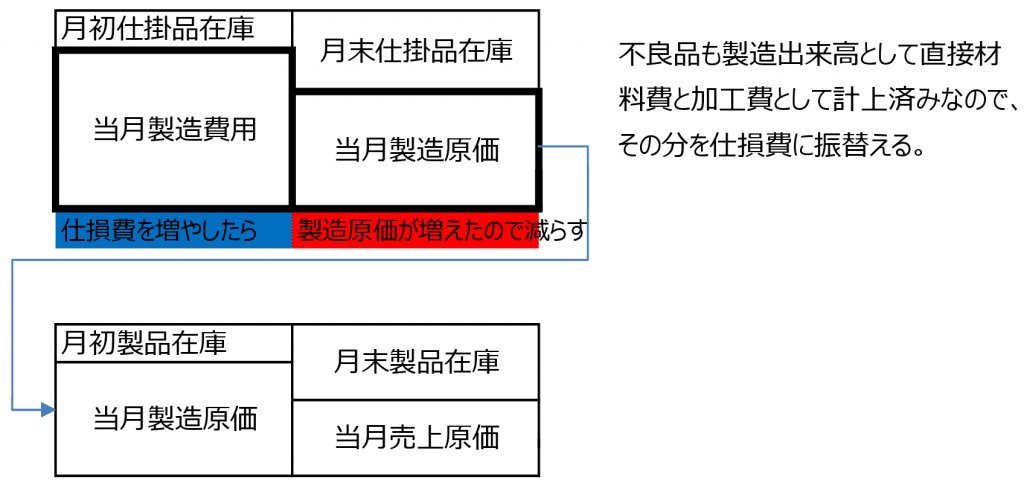
Record in Manufacturing Cost (Spoilage Costs) and Deduct from COGS
When material defects or spoilage occur, materials, WIP, or products are not directly reduced, but are indirectly transferred to another account, spoilage costs, through account transfers.
- Manufacturing Cost = Beginning WIP + (Current Month Manufacturing Expenses + Spoilage Costs) - Ending WIP
- COGS = Beginning Product + Current Month Manufacturing Cost - (Account Transfers + Ending Product) (Debit) Spoilage Costs 2 (Credit) Account Transfers (Products) 2
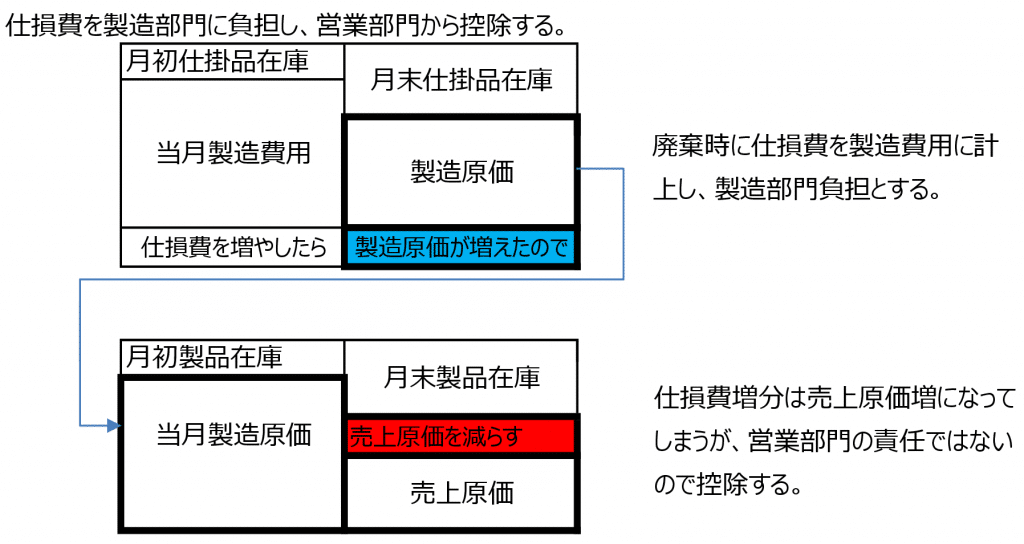
Record in Manufacturing Cost (Spoilage Costs) and Deduct from Manufacturing Cost (WIP)
The spoilage portion is transferred from direct material costs to spoilage costs within the manufacturing cost.
- Manufacturing Cost = Beginning WIP + (Current Month Manufacturing Expenses + Spoilage Costs) - (Account Transfers + Ending WIP) (Debit) Spoilage Costs 2 (Credit) Account Transfers (WIP) 2
Record in SGA and Deduct from Manufacturing Cost (WIP)
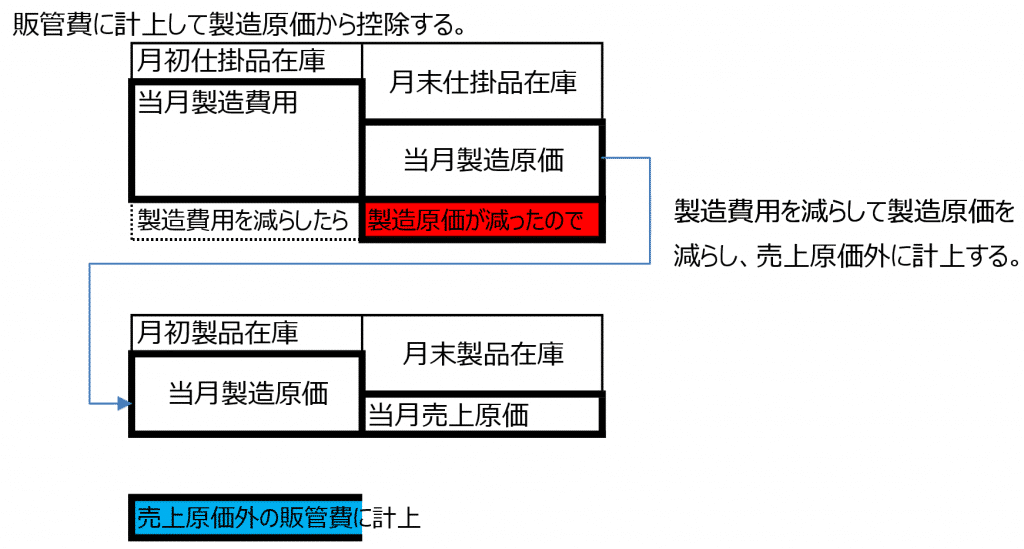
In cases where the amount is large due to customer returns, the portion of claims is removed from manufacturing cost and recorded as SGA or extraordinary loss.
- Manufacturing Cost = Beginning WIP + Current Month Manufacturing Expenses - (Account Transfers + Ending WIP) ⇒ Manufacturing Cost Down
- COGS = Beginning Product + Manufacturing Cost - Ending Product ⇒ COGS Down
- Gross Profit = Sales - COGS ⇒ Gross Profit Up
- Operating Profit = Gross Profit - SGA ⇒ Transferred to SGA and Operating Profit Down (Debit) SGA 2 (Credit) Account Transfers 2
Record as Asset and Deduct from COGS (Products)
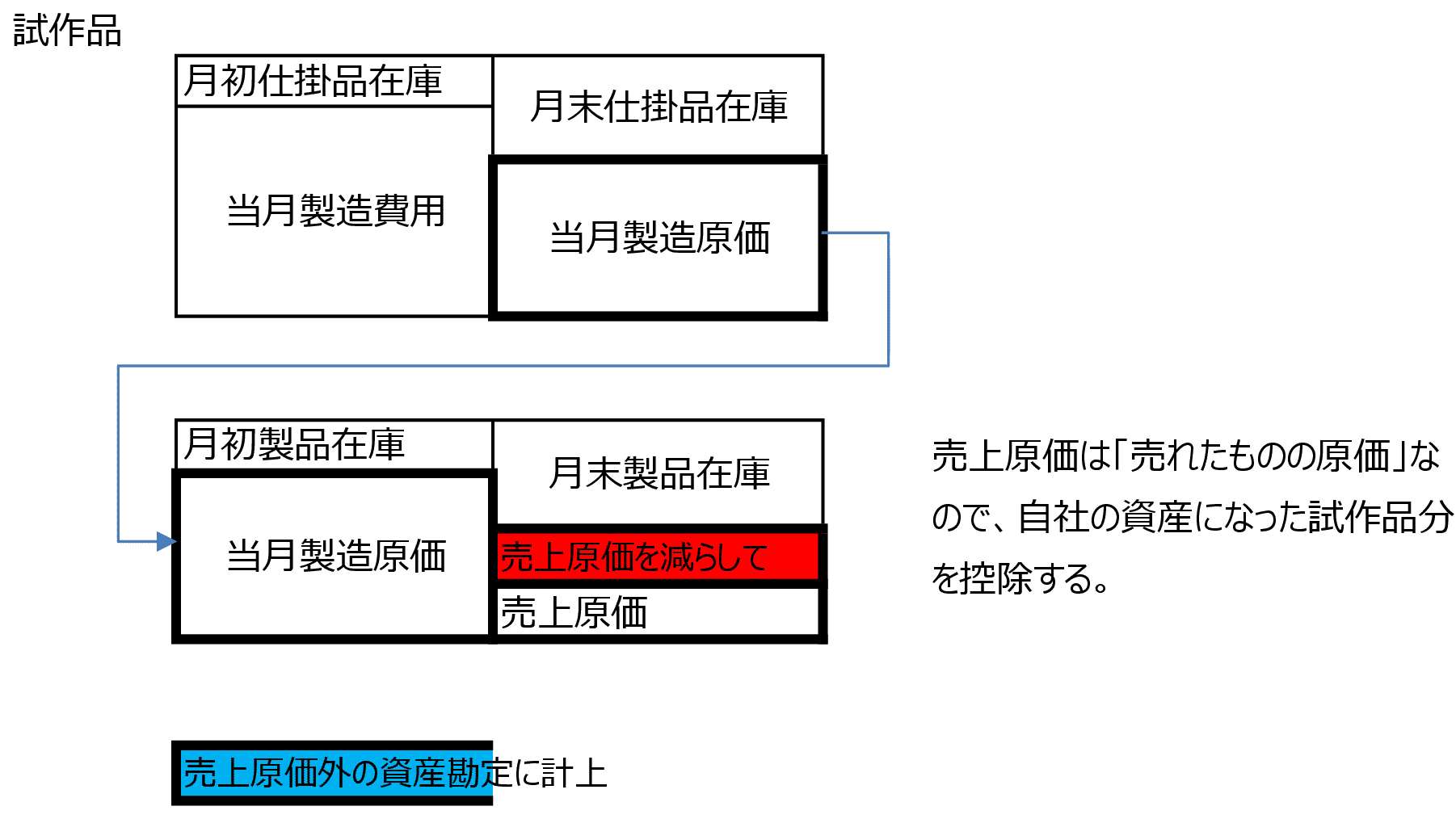
In cases where in-house product manufacturing is transferred to assets, the ending product inventory is reduced by the amount of prototypes, increasing COGS, so it is indirectly deducted from COGS through account transfers (products).
- COGS = Beginning Product + Current Month Manufacturing Cost - (Account Transfers + Ending Product) (Debit) Prototypes 2 (Credit) Account Transfers (Products) 2
Manufacturing Cost Calculation Process by Average Method
When production results are recorded as "10 good products, 2 defective products" in the production management system, the output of WIP or products is 12 units. Direct material costs and processing costs have already been incurred for the 2 defective units. Spoilage is confirmed by raising the disposal record at the time of disposal, and the inventory quantity is deducted, but until disposal, if it is WIP, it is included in the direct material cost portion of the current month manufacturing cost, and if it is a product, it is included in the WIP portion of the current month manufacturing cost, and is automatically included in COGS.
- Average Material Unit Cost = (Beginning Material Amount + Current Month Purchase Amount) / (Beginning Quantity + Purchase Quantity)
- Material Incurred Cost = Average Material Unit Cost x Usage Quantity
- WIP Manufacturing Cost = Material Incurred Cost + Total Processing Cost of the Process
- Average WIP Unit Cost = (Beginning Inventory + WIP Manufacturing Cost) / (Beginning Quantity + Current Month Production Quantity)
- Product Manufacturing Cost: (Average WIP Unit Cost x Usage Quantity) + Total Processing Cost of the Process
How to Indirectly Deduct Spoilage Costs on P/L
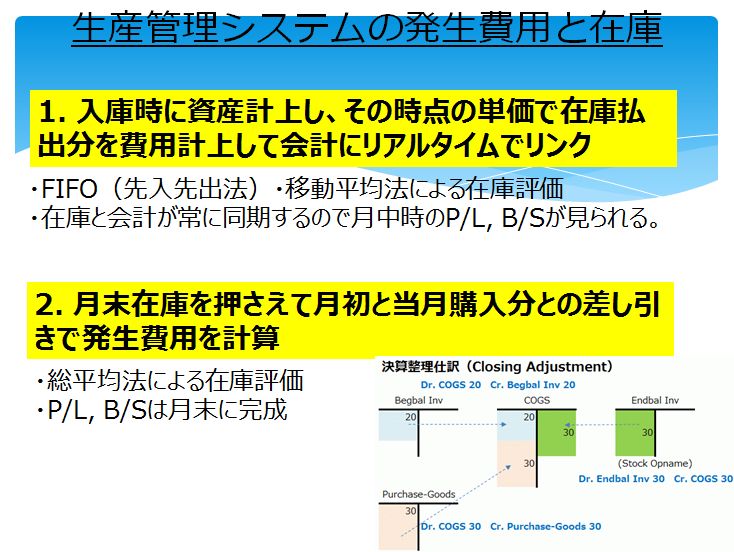
ERP systems have methods to continuously increase and decrease inventory accounts and expense the issued portion, or to process it in the purchase account during the month and transfer the beginning inventory to the ending inventory through the purchase account to expense it. When reflecting spoilage recorded in the output record in cost and accounting, in either system, it is common to indirectly deduct from cost using account transfers on the P/L.
Transfer Direct Material Costs Recorded in Manufacturing Cost to Spoilage Costs
Since it is only transferring what was recorded as direct material costs within manufacturing cost to spoilage costs, neither manufacturing cost nor COGS changes, and there is no change in gross profit.
- (Debit) Spoilage Costs 10 (Credit) WIP 10
- Manufacturing Cost (COGM) 80 = Beginning WIP 100 + (Current Month Manufacturing Expenses 40 - WIP 10 + Spoilage Costs 10) - Ending WIP 60
Or
- (Debit) Spoilage Costs 10 (Credit) WIP Account Transfers 10
- Manufacturing Cost (COGM) 80 = Beginning WIP 100 + (Current Month Manufacturing Expenses 40 + Spoilage Costs 10) - (WIP Account Transfers 10 + Ending WIP 60)
- COGS 170 = Beginning Product 200 + COGM 80 - Ending Product 110
- Sales Responsibility COGS - COGM = 90
Record Spoilage Costs in Manufacturing Cost and Deduct from COGS
If spoilage recorded by disposal is added to manufacturing cost, COGS increases and gross profit decreases, but since spoilage is not the responsibility of sales, it is deducted from COGS, resulting in no change in gross profit.
- (Debit) Spoilage Costs 10 (Credit) WIP 10
- Manufacturing Cost (COGM) 90 = Beginning WIP 100 + (Current Month Manufacturing Expenses 40 + Spoilage Costs 10) - Ending WIP 60
- COGS 170 = Beginning Product 200 + (COGM 90 - WIP 10) - Ending Product 110
Or
- (Debit) Spoilage Costs 10 (Credit) Product Account Transfers 10
- Manufacturing Cost (COGM) 90 = Beginning WIP 100 + (Current Month Manufacturing Expenses 40 + Spoilage Costs 10) - Ending WIP 60
- COGS 170 = Beginning Product 200 + COGM 90 - (Product Account Transfers 10 + Ending Product 110)
- Sales Responsibility = COGS - COGM = 80
Transfer Direct Material Costs Recorded in Manufacturing Cost to Extraordinary Loss
By deducting the portion included in manufacturing cost as direct material costs, COGS decreases, increasing gross profit and operating profit, but by recording it as extraordinary loss, net profit for the period decreases, balancing the accounts.
- (Debit) Extraordinary Loss 10 (Credit) WIP 10
- Manufacturing Cost (COGM) 70 = Beginning WIP 100 + (Current Month Manufacturing Expenses 40 - WIP 10) - Ending WIP 60
Or
- (Debit) Extraordinary Loss 10 (Credit) WIP Account Transfers 10
- Manufacturing Cost (COGM) 70 = Beginning WIP 100 + Current Month Manufacturing Expenses 40 - (WIP Account Transfers 10 + Ending WIP 60)
- COGS 160 = Beginning Product 200 + COGM 70 - Ending Product 110
- Sales Responsibility = COGM - COGM = 90
Frequently Asked Questions | Indirect Deduction of Manufacturing Costs and COGS
In line with the content of this article, we will briefly organize frequently asked questions.
What is Manufacturing Cost Transfer?
Manufacturing cost transfer is the method of recording the costs incurred to produce products as manufacturing costs and recording the cost of goods sold from that as COGS. No new cost items are added, and cost transfers are made within existing accounts.
Why Use Account Transfers?
The reason for using account transfers is to accurately record costs by indirectly transferring them to other accounts when material defects or spoilage occur, rather than directly reducing them. This ensures that the total amount of manufacturing costs or COGS does not change, and cost transfers are made.
How to Record Spoilage Costs in Manufacturing Cost?
The method of recording spoilage costs in manufacturing cost is to include spoilage costs within manufacturing cost and deduct them from COGS. This ensures no change in gross profit, as spoilage is not the responsibility of sales, and it is deducted from COGS.