


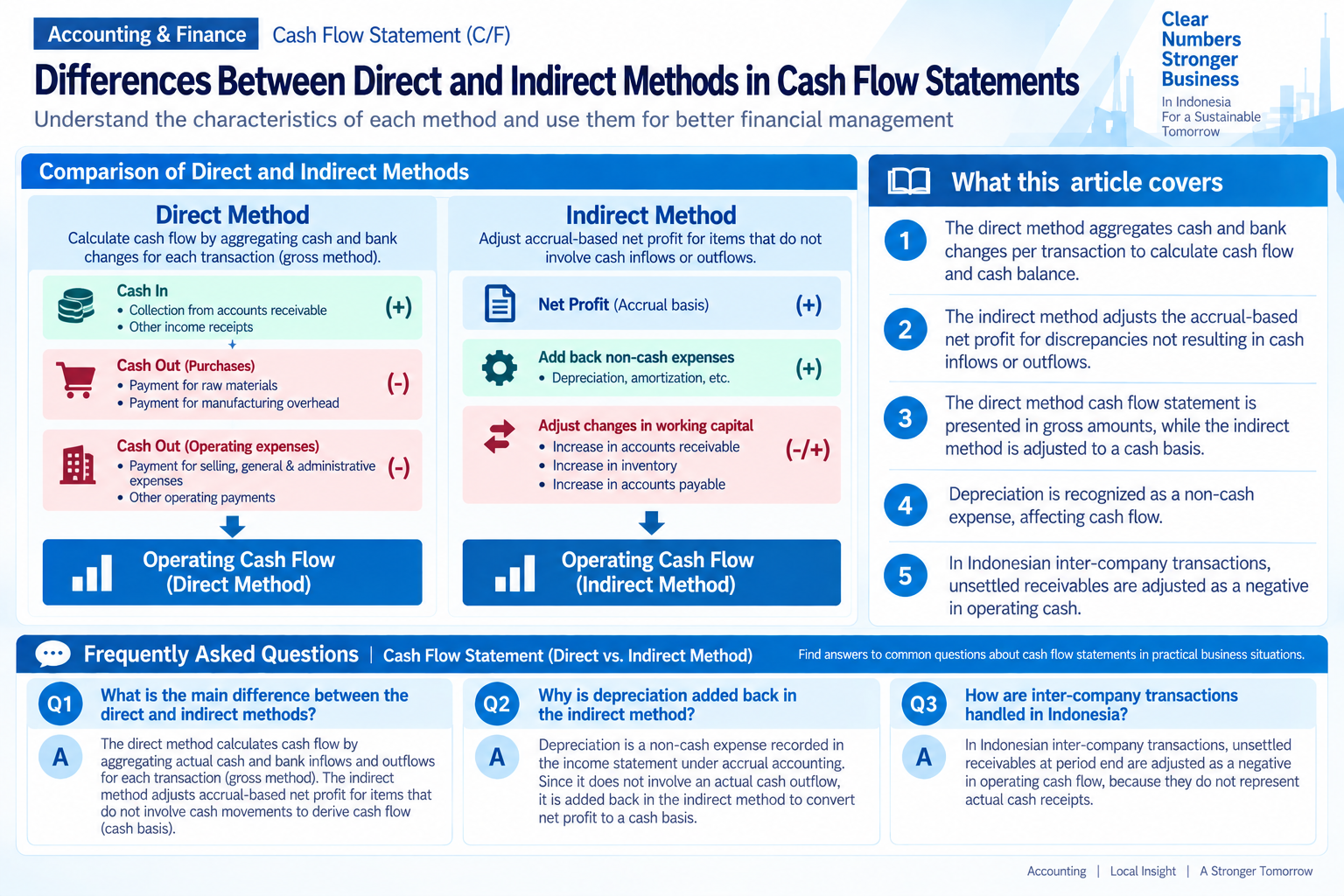
The direct method aggregates cash and bank changes per transaction to calculate cash flow and cash balance. Therefore, adjustments are necessary for unrealized foreign exchange gains and losses related to cash and bank accounts.
-
-
Accounting Systems in Indonesia
The adoption rate of SaaS-based accounting systems in Indonesia is less than 8%, despite the advancement of SaaS technology. The continuous launch of new…
続きを見る
What this article covers
- The direct method aggregates cash and bank changes per transaction to calculate cash flow and cash balance.
- The indirect method adjusts the accrual-based net profit for discrepancies not resulting in cash inflows or outflows.
- The direct method cash flow statement is presented in gross amounts, while the indirect method is adjusted to a cash basis.
- Depreciation is recognized as a non-cash expense, affecting cash flow.
- In Indonesian inter-company transactions, unsettled receivables are adjusted as a negative in operating cash.
Differences Between Direct and Indirect Methods from an Accounting System Perspective
In companies that use cash basis accounting, profits and losses are recognized when cash moves, regardless of when the transaction occurs, aligning P/L with cash flow. However, most companies use accrual basis accounting, recognizing profits and losses when transactions occur, regardless of cash movement.
This creates discrepancies between P/L profits and cash flow at month-end, necessitating a separate cash flow statement (C/F).
The "Cash Flow from Operating Activities" section of the cash flow statement differs between the direct and indirect methods. The direct method calculates cash flow and cash balance by aggregating cash and bank inflows and outflows per transaction, known as gross presentation. The indirect method adjusts the accrual-based net profit for discrepancies not resulting in cash inflows or outflows, converting it to a cash basis to calculate cash flow and cash balance.
Case: The direct method shows cash flow from operating activities by aggregating cash and bank inflows and outflows per transaction (gross presentation).
- (+) Income from A/R settlement ⇒ Add C/F code to A/R settlement journal entry
- (-) Outflow from direct material cost payment ⇒ Add C/F code to direct material cost payment journal entry
- (-) Outflow from manufacturing overhead ⇒ Add C/F code to indirect labor cost and expense payment journal entry
- (-) Outflow from SGA expenses ⇒ Add C/F code to SGA expense payment journal entry
Case: The indirect method shows cash flow from operating activities by calculating the net cash portion from Net Profit.
- (+) Net Profit ⇒ Accrual-based net profit
- (+) Depreciation ⇒ Amount deducted from Net Profit on an accrual basis P/L
- (-) Increase in A/R ⇒ Amount not received as cash/bank
- (+) Increase in A/P ⇒ Amount not paid out as cash/bank
In accounting systems, the direct method requires setting the relevant cash flow code during transaction input involving cash and bank movements, aggregating it in the relevant C/F section. The indirect method generates it from account balances without needing cash flow codes.
Realized and Unrealized Gains and Losses in Cash Flow Statements
When preparing a cash flow statement (C/F) in an accounting system, the direct method aggregates transactions by cash flow code per accounting month, while the indirect method aggregates the general ledger (G/L) per accounting month, calculating the beginning and ending balances. In both methods, adjustments for foreign exchange revaluation of cash and bank account balances at month-end are necessary to align C/F balances with actual cash and bank balances.
Foreign exchange gains and losses are broadly categorized into two types:
- Realized forex gains and losses at settlement (Forex Gain-Realized)
⇒ Gains and losses related to receivables (A/R) and payables (A/P) are not included in C/F (as they are not cash/bank). - Unrealized forex gains and losses from month-end revaluation (Forex Gain-Unrealized)
⇒ All gains and losses related to cash and bank are included in C/F (as they are cash/bank), but those related to A/R and A/P are not included (as they are not cash/bank).
In the indirect method, if A/R and A/P include both operating and non-operating investment activities, calculating the forex gain or loss amount to be included in C/F after adjusting for cash and bank movements from accrual-based P/L net profit becomes challenging.
Direct Method Cash Flow Statement
The direct method cash flow report (C/F) is created based on the G/L, categorizing cash and bank accounts into three sections vertically by counterpart account. During journal entry input, selecting the cash flow code indicating the desired C/F section is necessary.
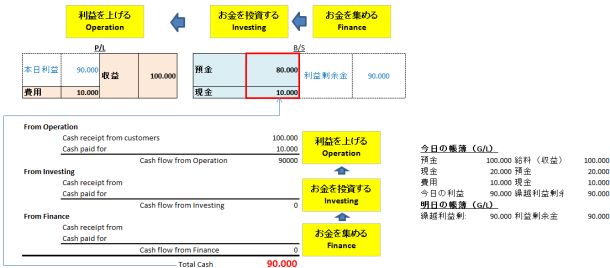
Generally, the direct method C/F is considered burdensome compared to the indirect method, but using an accounting system makes it easier to prepare. However, analyzing cash backing for net profit in P/L is more suitable with the indirect method C/F.
The three sections indicate cash inflows and outflows in company business activities: "raising money (credit side of B/S)", "investing (debit side of B/S)", and "generating profit (P/L)".
- Investment = Credit side of the balance sheet (right side = Creditor is honored in Europe)
- Investment = Debit side of the balance sheet (left side = Debtor is less honored in Europe)
- Profit = Income statement
Cash refers to cash and cash equivalents, including cash, regular deposits, and current deposits.
- How money is raised (Financial Activities = Finance)
- How money is invested (Investing Activities = Investing)
- How profit is generated (Operating Activities = Operation)
These explain how cash moved in each of the three company activities.

In the direct method, based on the cash flow code in the journal, the offset for cash and bank accounts is applied to the details of IN and OUT for operating, investing, and financial activities. In the indirect method, the operating activities section is prepared to show how much of the P/L profit and loss resulted in cash flow. For the investing and financial activities sections, the offset for liabilities, capital, and assets is primarily cash and bank, similar to the direct method cash flow statement.
Ways to Increase Cash
In transactions between Japanese companies in Indonesia, cash-only transactions are rare, and having zero receivables and payables balance is uncommon. In the indirect method cash flow statement, unsettled receivables balance is adjusted as a negative in operating cash, and unsettled payables balance as a positive, from the accrual-based net profit in P/L.
It is often said in corporate accounting that there are only three ways to actually increase cash:
- Increase deductible expenses to reduce taxable income (tax saving).
- Shorten the payment terms for receivables from sales and delay the payment terms for payables from COGS.
- Increase non-operating cash inflows and reduce non-operating cash outflows.
In Indonesian inter-company transactions, although there are no promissory note transactions, even when sales (revenue) are recognized on a shipment basis in P/L, until the invoice issued after inspection is received and the receivable is recorded, it is pooled as a provisional receivable. Therefore, provisional receivables not recorded as receivables also need to be adjusted as a negative in operating cash (the same applies to provisional payables not recorded as payables).
- Shipment Date (Debit) A/R Accrued 100 (Credit) Sales 100
- Invoice Arrival Date (Debit) A/R 110 (Credit) A/R Accrued 100 (Credit) VAT Out-payable 10
Tax Saving on Corporate Income Tax through Depreciation
Depreciation included in manufacturing costs and SGA expenses is recognized as a "non-cash expense" due to the absence of invoices. This affects cash flow, but if pre-tax net profit is negative and taxable income is zero, depreciation cannot be used to save on corporate income tax.
Recording depreciation on fixed assets does not directly increase cash. It may only bring joy knowing that actual cash is more than net profit in P/L by the amount of depreciation.
- January
- (Debit) Cash 1,200 (Credit) Sales 1,200
Profit of 12 million yen on P/L. Plus 12 million yen on C/F (operating section).
- February
- (Debit) Machine 1,200 (Credit) Cash 1,200
No impact on P/L. Minus 12 million yen on C/F (investing section).
- March
- (Debit) Depreciation 10 (Credit) Accumulated Depreciation 10
Loss of 100,000 yen on P/L. No impact on C/F (operating section).
Increasing non-deductible expenses does not result in tax savings. Investing in land (real estate) without depreciation does not save taxes, but it may generate rental income (income gain) or appreciate in value over several years, resulting in capital gains.
Frequently Asked Questions | Differences in Cash Flow Statements
Based on the content of this article, frequently asked questions are briefly organized.
What are the differences between direct and indirect method cash flow statements?
The direct method aggregates cash and bank changes per transaction to calculate cash flow and cash balance. The indirect method adjusts the accrual-based net profit for discrepancies not resulting in cash inflows or outflows, converting it to a cash basis.
How are foreign exchange gains and losses handled in cash flow statements?
Realized forex gains and losses at settlement are not included in C/F as they do not involve cash and bank. Unrealized gains and losses from month-end revaluation are included in C/F if they involve cash and bank, but not if they involve A/R and A/P.
How does depreciation affect cash flow?
Depreciation is recognized as a "non-cash expense," affecting cash flow. If pre-tax net profit is negative and taxable income is zero, depreciation cannot be used to save on corporate income tax.