


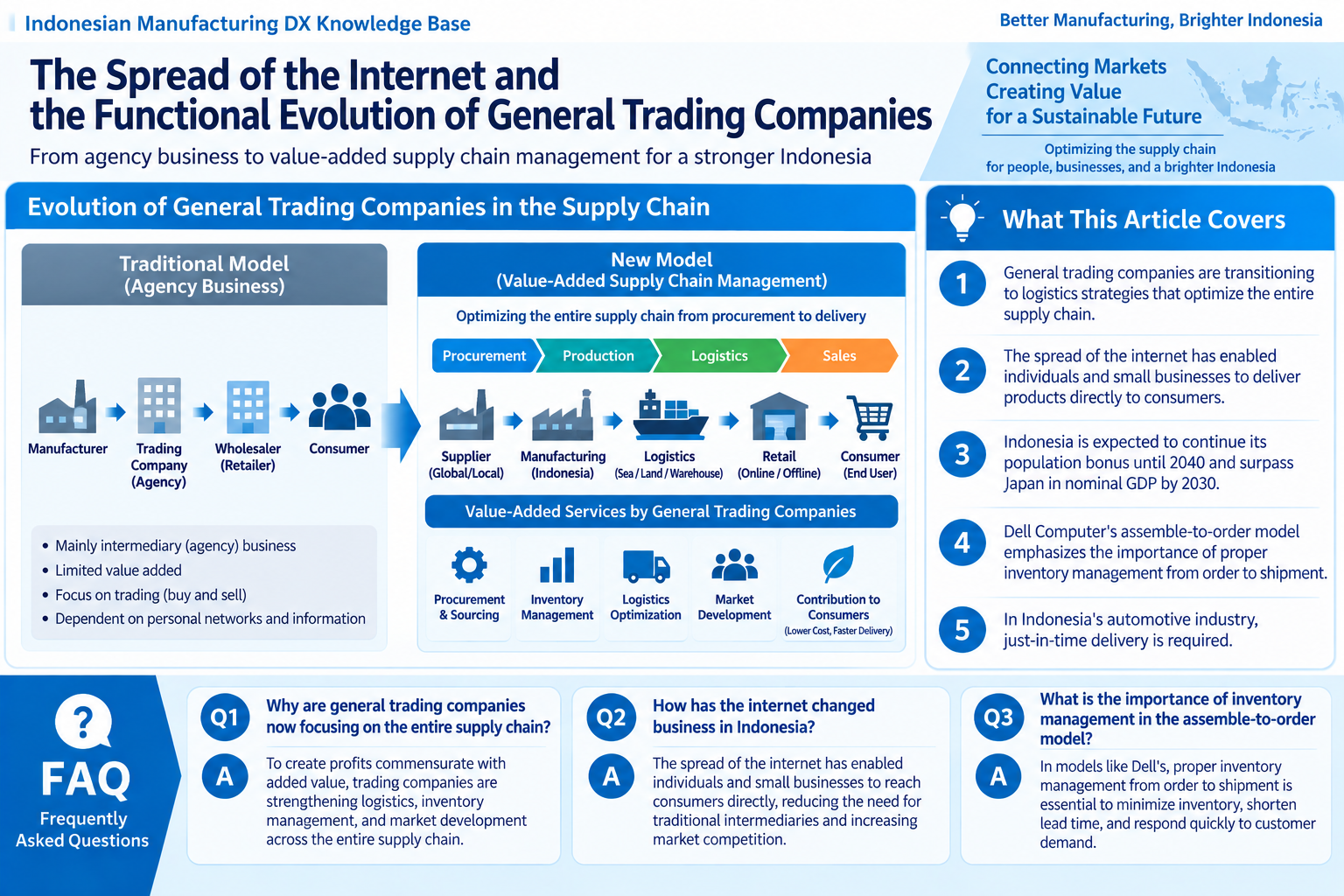
General trading companies are shifting from agency businesses to business models that generate profits commensurate with added value across the entire supply chain. This allows them to develop logistics strategies that optimize the entire supply chain, contributing to consumer benefits through time reduction and price cuts due to economies of scale.
-
-
Production Management Systems in Indonesia
The ultimate goal in manufacturing is to improve productivity and meet delivery deadlines. Understanding the differences between manufacturing cost, cost of…
続きを見る
What this article covers
- General trading companies are transitioning to logistics strategies that optimize the entire supply chain.
- The spread of the internet has enabled individuals and small businesses to deliver products directly to consumers.
- Indonesia is expected to continue its population bonus until 2040 and surpass Japan in nominal GDP by 2030.
- Dell Computer's assemble-to-order model emphasizes the importance of proper inventory management from order to shipment.
- In Indonesia's automotive industry, just-in-time delivery is required.
Changes in the Functions of General Trading Companies Due to the Spread of the Internet
I came to Indonesia in October 1997. At that time, Indonesians often asked me to "lend money" or "do business together," but these requests have significantly decreased recently. One major reason is the increase in income and wealth of Indonesians, and another is the spread of the internet, which has enabled individuals and small businesses without connections to reach end consumers.
Conversely, it can be said that expectations for Japanese people have decreased. However, in Indonesia, where the population bonus is expected to continue until 2040 and nominal GDP is predicted to surpass Japan by 2030, the position of Japanese people has shifted from "useful foreigners with money and connections" to "business rivals."
Around the year 2000, as individual online shops were being launched one after another, two major business transformations were often predicted during the transition from the dawn to the growth phase of the internet:
- An era where individuals can compete on equal footing with large corporations online will come.
- The role of trading companies and wholesalers will end as producers directly transact with consumers.
Looking at the situation in 2020, it has become possible to sell ornamental plants and juvenile arowanas directly from rural Java or near the jungles of Kalimantan via Tokopedia or Instagram. The agency business of small trading companies and wholesalers that only added middle margins has declined, and these predictions have largely come true.
However, the presence of Japanese general trading companies remains significant, continuing to rank high in student employment popularity rankings. Despite movements such as Marubeni Corporation posting a record loss of 197.4 billion yen due to impairment losses in the consolidated financial results for March 2020, and Itochu Corporation surpassing Mitsubishi Corporation in market capitalization in June, the significance of the five major trading companies remains large in terms of capital participation and intermediary functions in material procurement when establishing local subsidiaries of Japanese companies in Indonesia.
The image of general trading companies learned in junior high school civics classes emphasized the wide range of products handled, from "ramen to missiles," but since then, general trading companies have shifted to business models that generate profits commensurate with added value across the entire supply chain.
In February 2019, Mitsubishi Corporation's large investment in GoJek became a topic of discussion, highlighting their role in incubating businesses with a focus on continuity rather than exits through sales or IPOs, while considering collaboration with group companies.
- A "general store"-like procurement and sales function due to the wide range of products handled
- A logistics function that coordinates from downstream to upstream of the supply chain
- A financial and nurturing function that fosters companies through investment and capital participation
The spread of the internet has leveled the competitive environment for businesses, and when procurement and manufacturing of products can be completed within a specific business entity or region, direct sales businesses from producers to consumers have become viable. However, general trading companies, which can leverage "economies of scale" backed by their group networks and financial power, have redefined their core business as the organizer function of the entire supply chain, thereby enhancing their significance.
Decoupling Points in the Supply Chain
Manufacturing production forms are broadly classified into make-to-stock and make-to-order. Dell Computer's assemble-to-order model, which holds semi-finished product inventory and assembles products for shipment upon receiving orders, is known as the "Dell Model" and has increased sales. In the supply chain, appropriate inventory is necessary from order to shipment.
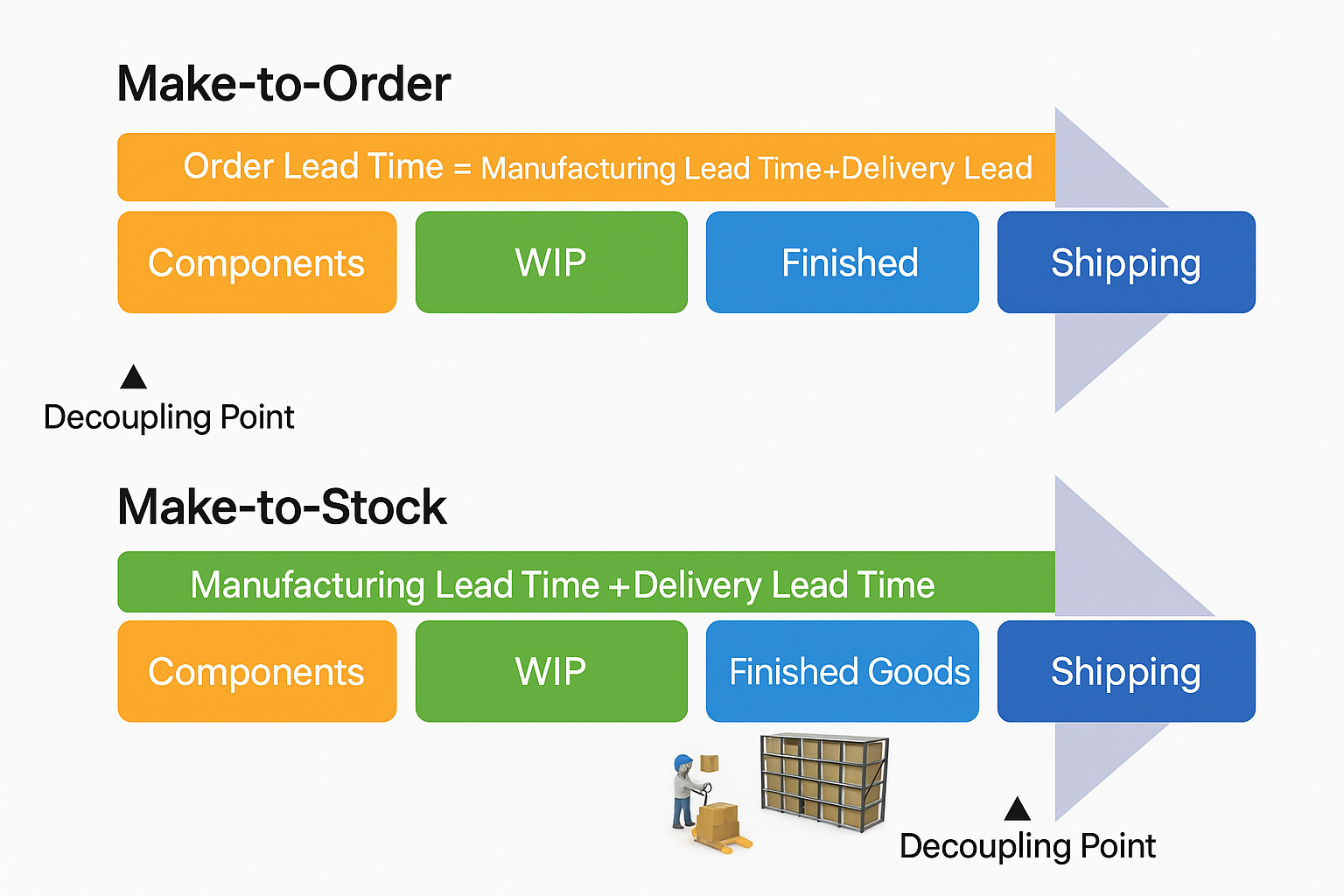
There are two reasons why inventory is necessary in the factory, which also applies to the entire supply chain. Ultimately, the "optimal" state is when replenishment and shipment occur simultaneously.
- Insurance to bridge the gap between manufacturing (supply) lead time and order (demand) lead time
- To prevent stopping the flow of the bottleneck process (main body) that determines the productivity (supply capacity) of the entire factory
The place where inventory is held in the supply chain is called the decoupling point. In make-to-order, the "procurement location" corresponds, and in make-to-stock, the "shipping location" corresponds. Inventory control considering different decoupling points for each business entity in the supply chain is very difficult.
Indonesia is affected by rising and unstable international logistics prices, leading to increased demand fluctuations. Like e-commerce and online marketplaces such as Amazon, Alibaba, and Indonesia's Tokopedia, Japanese general trading companies can draw logistics strategies that optimize the entire supply chain by grasping and adjusting logistics across the supply chain. This contributes to consumer benefits through time reduction from order to shipment and price cuts due to economies of scale.
Frequently Asked Questions | Impact of the Internet on General Trading Companies
Based on the content of this article, frequently asked questions are briefly organized.
How has the spread of the internet affected general trading companies?
The spread of the internet has enabled individuals and small businesses to deliver products directly to consumers, changing the roles of trading companies and wholesalers. This has necessitated the development of logistics strategies that optimize the entire supply chain.
How has the position of Japanese general trading companies in Indonesia changed?
In Indonesia, due to the spread of the internet and economic growth, the position of Japanese people has shifted from "foreigners with money and connections" to "business rivals." However, the significance of general trading companies remains large, playing important roles in capital participation and intermediary functions in material procurement.
How has the business model of general trading companies evolved?
General trading companies have shifted from agency businesses to business models that generate profits commensurate with added value across the entire supply chain. This allows them to develop logistics strategies that contribute to consumer benefits through time reduction and price cuts due to economies of scale.