


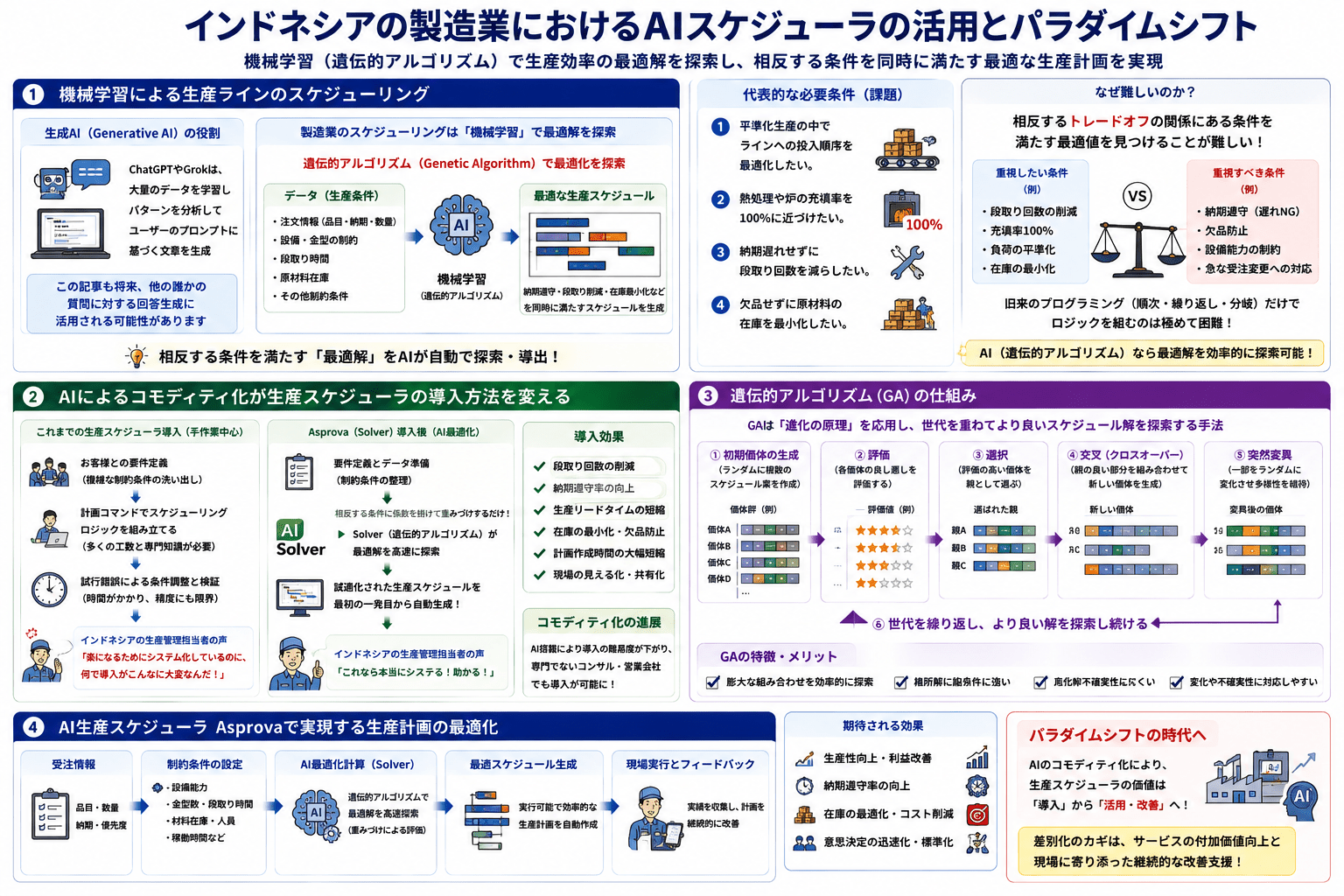
In Indonesian manufacturing sites, conflicting conditions such as "meeting delivery deadlines while reducing setups, controlling inventory, and increasing furnace fill rates" often arise simultaneously. Traditionally, dispatching rules and manual adjustments were relied upon, but using search methods like genetic algorithms allows for rapid exploration of candidate schedules based on weighted objectives.
-
-
Production Scheduler in Indonesia
Production planning and load planning are closely related and require verification based on quantities. It is important to compare production quantities,…
続きを見る
Positioning of this article: This is a definitive guide on "optimization search (Solver)" under the production scheduler hub. It is not a general discussion on generative AI but focuses on how to optimize the objective functions and constraints of production schedules. Refer to Solver8 for planning AI demos, mold/operator constraints for constraint placement, and Asprova for the product.
What this article covers
- This article is a definitive guide on optimization search (Solver/Genetic Algorithm) in production scheduling.
- Leveling, fill rate, setup reduction, stockout avoidance, and inventory minimization are trade-offs, often requiring more than a single rule.
- Asprova's Solver applies coefficients (weights) to conflicting conditions to rapidly explore high-precision schedules.
- Without clear objectives and constraints, 'optimal' cannot be defined; thus, KPI articulation is a prerequisite.
- The Solver8 article focuses on planning AI demos, while this article covers optimization concepts and implementation changes.
- Reading this alongside constraint modeling (mold/operator) clarifies the meaning of the search space.
Machine Learning (Genetic Algorithm) and Production Scheduling
Generative AI (like ChatGPT) focuses on text generation, but in production scheduling, machine learning-oriented search (e.g., genetic algorithms) is often more effective. It evaluates candidate allocations and steers them in a favorable direction.
Examples of necessary conditions frequently encountered in Japanese factories in Indonesia:
- Optimize line input order within leveled production
- Approach 100% fill rate for heat treatment and furnaces
- Reduce setup frequency without delaying delivery
- Minimize raw material inventory without stockouts
These are trade-offs. Prioritizing delivery can increase setups and inventory, while increasing fill rates can reduce input order flexibility. "Scoring everything 100" is not feasible, so it is necessary to declare what score to aim for using coefficients (weights).
How Asprova Solver Changed Implementation
In past implementations in Indonesia, significant effort was required to build logic with planning commands according to requirements, leading to feedback that "implementation is difficult despite being introduced to make things easier."
With the Solver option, the approach of applying coefficients to conflicting conditions makes it easier to automatically generate high-precision schedules quickly. This represents a shift from "writing all sequences and branches in a program" to "declaring objectives and constraints and letting the system explore."
As a result, even non-IT specialists can more easily engage in scheduler implementation, and the technology itself is moving towards commoditization. Differentiation shifts to local constraint modeling (mold, skills, bonded, multi-variety) and support for adoption.
Decisions to Make Before Field Application
- KPI Articulation — Prioritization of delivery compliance rate, setup frequency, inventory days, fill rate, etc.
- Definitive Constraints — Mold, operator, maintenance slots, etc. (auxiliary resource articles)
- Operational Master Updates — Responsibility for maintaining processes, resources, setups, orders
- Performance Feedback — Path to return the difference between plan and actual to the next weighting
Without an operational cycle that updates before discussing accuracy, Solver will "produce a clean result once and end."
Reading as Knowledge
- This Article (Solver) — Concepts of weighting conflicting objectives and optimization search
- Solver8 — Planning AI, demo/product surroundings
- Mold/Operator Constraints — Constraint modeling as a prerequisite for exploration
- asprova-cost — Connecting planned labor hours from optimization results to cost/budget
Frequently Asked Questions|AI and Schedule Optimization
As knowledge of production schedulers (APS), we organize frequently recurring questions.
What can AI automatically decide?
When objective functions and constraints are clear, it can accelerate the exploration of candidate schedules. Without clear criteria, optimal cannot be defined.
What is the difference from traditional dispatching rules?
Rules are fast and easy to explain, but have limitations with complex objectives. Combining them with search allows for selecting solutions closer to evaluation metrics.
What is the difference between Solver and Solver8?
This article covers optimization search concepts, while Solver8 focuses on planning AI demos. Also read the product LP's Solver explanation.
What initial data is needed?
Basic master data for processes, resources, setups, orders, and a feedback path for performance. Create an operational cycle that updates before accuracy.
Related Links
- Production Scheduler Hub — Entry point for planning, APS, Asprova
- Asprova — Product definitive (Data Bridge / Viewer / Solver)
- Solver8 — Planning AI, demo surroundings
- Scheduling Optimization
- Mold/Operator Constraints
- Standard Cost and Budget
- Solver (Optimization Search)
- Production Management Hub — ERP, performance side