


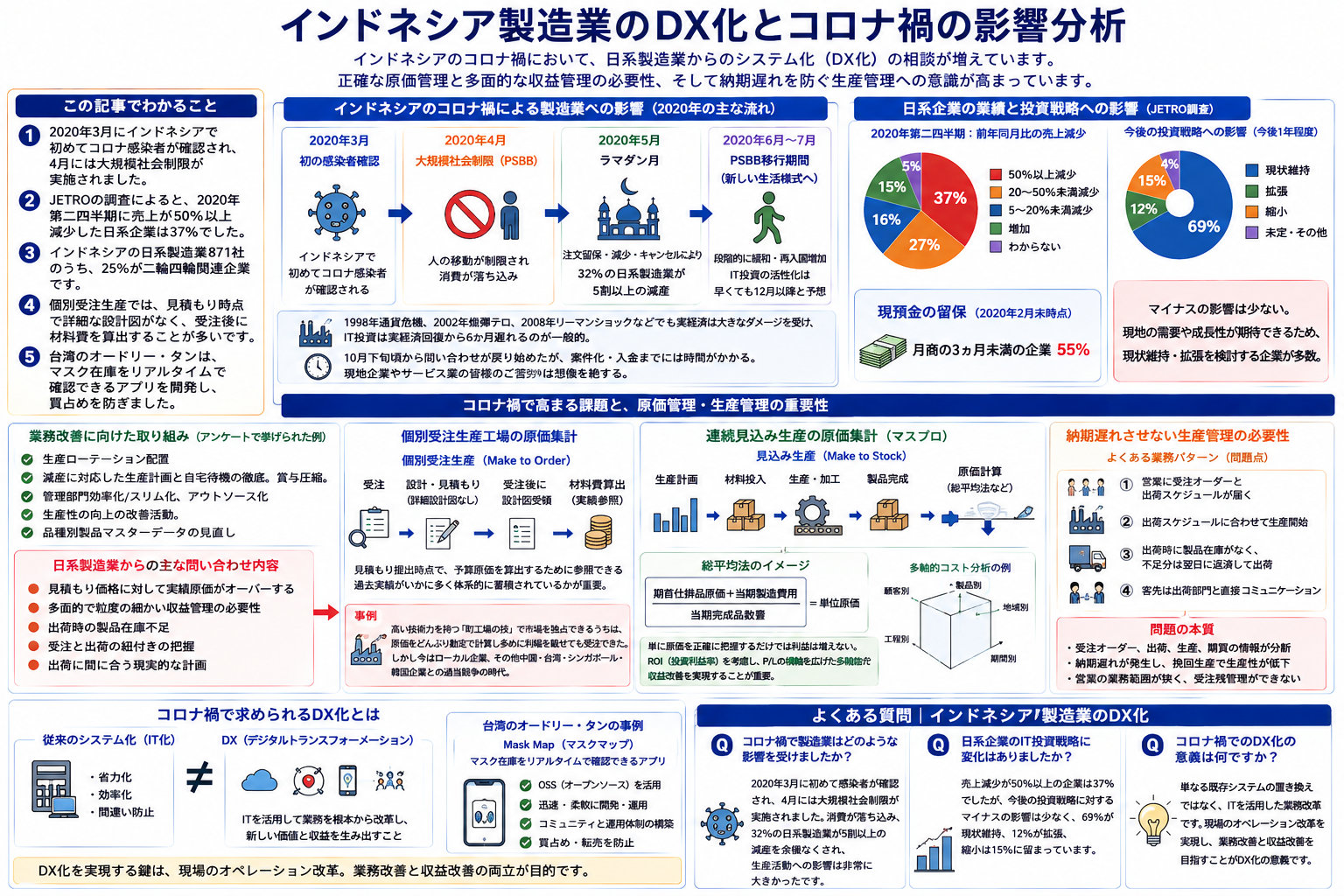
During the COVID-19 pandemic in Indonesia, there has been an increase in consultations from Japanese manufacturing companies regarding systemization (DX). In particular, there is a growing need for accurate cost management, multifaceted profit management, and heightened awareness of production management to prevent delivery delays.
-
-
Production Scheduler in Indonesia
Production planning and load planning are closely related and require verification based on quantities. It is important to compare production quantities,…
続きを見る
What this article covers
- In March 2020, the first COVID-19 case was confirmed in Indonesia, and large-scale social restrictions were implemented in April.
- According to a JETRO survey, 37% of Japanese companies experienced a sales decline of over 50% in the second quarter of 2020.
- Out of 871 Japanese manufacturing companies in Indonesia, 25% are related to two-wheel and four-wheel vehicles.
- In make-to-order production, detailed design drawings are often not available at the quotation stage, and material costs are calculated after receiving the order.
- Audrey Tang from Taiwan developed an app to check mask inventory in real-time, preventing hoarding.
Impact of the COVID-19 Pandemic on the Manufacturing Industry in Indonesia
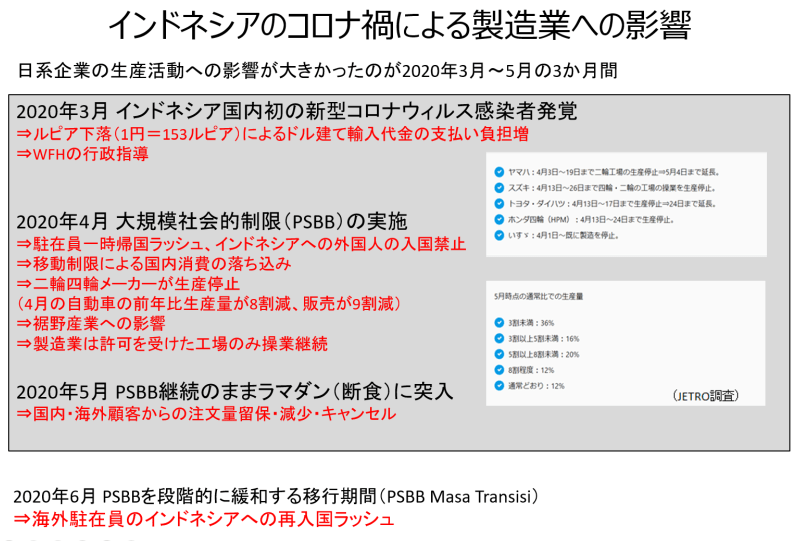
In March 2020, the first COVID-19 case was confirmed in Indonesia. In April, large-scale social restrictions (PSBB) were implemented, limiting people's movement and causing a decline in consumption. In May, during the continuation of PSBB and the onset of Ramadan, 32% of Japanese manufacturing companies were forced to reduce production by more than 50% due to order deferrals, reductions, and cancellations from both domestic and international sources. The impact on production activities from March to May was significant.
Indonesia has faced economic downturns multiple times, such as the 1998 currency crisis, frequent bombings around 2002, and the 2008 Lehman Shock. Each time, the real economy, including production, distribution, and consumption, suffered damage, and private sector IT investments typically lagged six months behind the recovery of the real economy.
In June, Indonesia entered a transition period (PSBB Masa Transisi) with a gradual easing of PSBB, marking the beginning of a new lifestyle (New Normal). From late June to July, the re-entry of expatriates into Indonesia increased, and it was anticipated that IT investments in the manufacturing industry would begin to revitalize as early as December.
From late October, inquiries and requests gradually started to return, but it took 1-2 months to issue an invoice for the down payment (DP) and an additional month for payment to be received. The challenges faced by service industries catering to local companies are unimaginable.
Impact on Japanese Companies' Performance and Investment Strategy
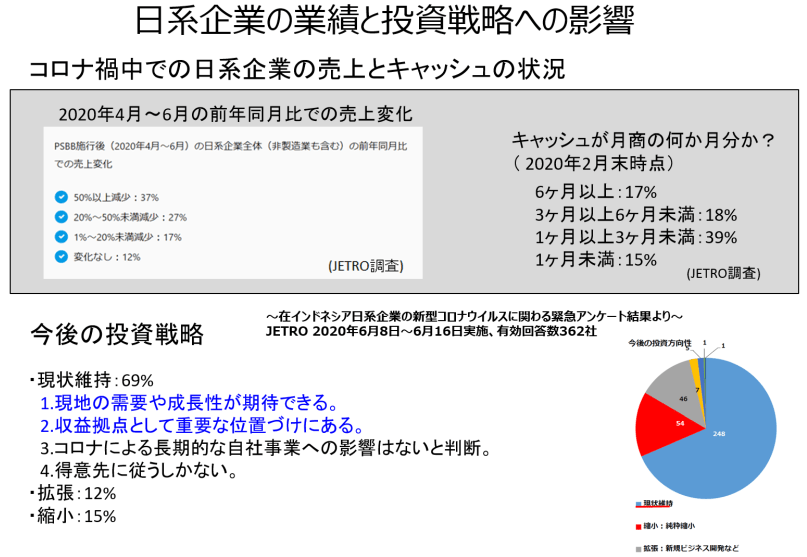 According to a JETRO survey, 37% of Japanese companies in Indonesia experienced a sales decline of over 50% year-on-year in the second quarter of 2020, while 27% saw a decrease between 20% and 50%. Additionally, as of the end of February 2020, 55% of companies had cash reserves of less than three months of monthly sales. This has significantly impacted IT investment strategies.
However, the negative impact on future investment strategies is minimal, with 69% of companies planning to maintain their current status, 12% considering expansion, and only 15% contemplating reduction, due to expected local demand and growth potential.
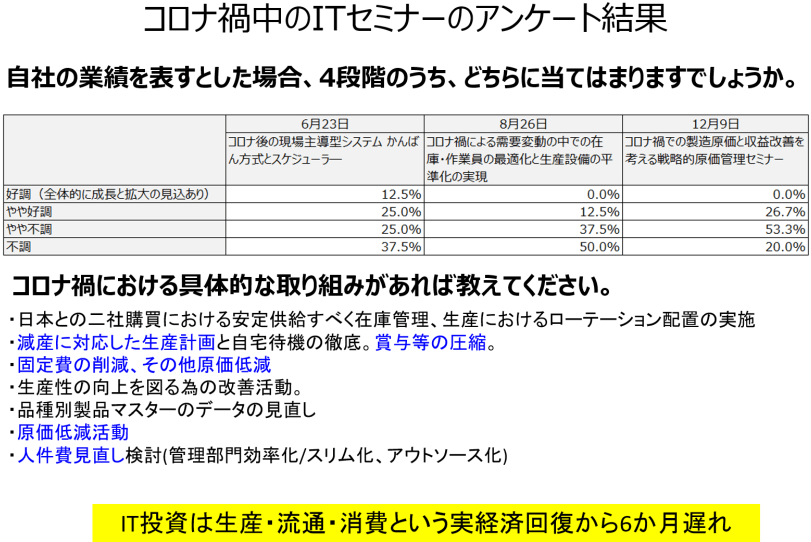
In the three seminars held during the COVID-19 pandemic, the following business improvement initiatives were highlighted in the surveys:
- Production rotation placement
- Production planning and thorough home standby to respond to reduced production. Bonus compression.
- Efficiency and streamlining of management departments, outsourcing
- Improvement activities for productivity enhancement.
- Review of product master data by product type
These indicate an increased awareness of cost management and production planning, which is reflected in inquiries to our company.
- Actual costs exceeding estimated prices
- Need for multifaceted and detailed profit management
- Product inventory shortages at the time of shipment
- Understanding the linkage between orders and shipments
- Realistic plans that meet shipping deadlines
Cost Aggregation in Custom Order Production Factories
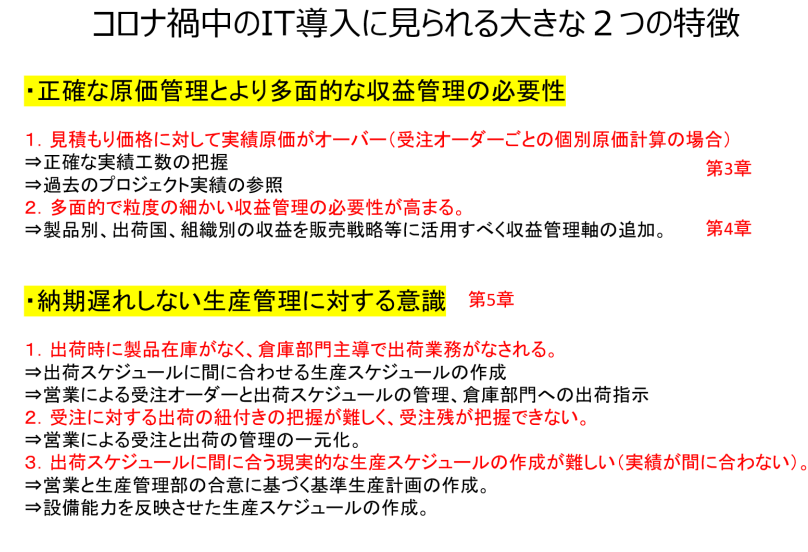
Among 1489 Japanese companies in Indonesia, 871 are in the manufacturing sector (as of November 2019), with 25% of them related to two-wheel and four-wheel vehicles. During the COVID-19 pandemic, customer inquiries focused on the following two points:
- The need for accurate cost management and more multifaceted profit management
- The need for production management that avoids delivery delays
Factory production methods are divided into two: custom order production, where different costs occur for each order number, and forecast production (mass production), where basically the same costs occur.
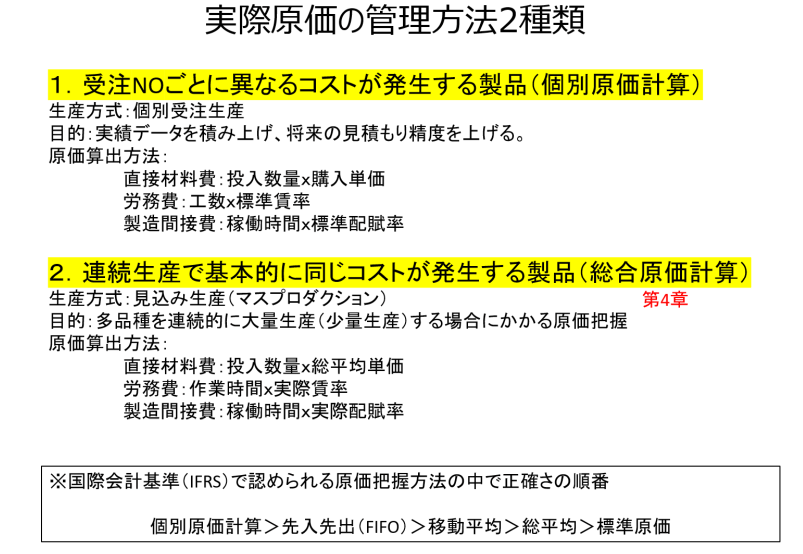
Custom order production is mainly conducted by small and medium-sized enterprises, aiming to improve future estimation accuracy by accumulating actual data. In custom order production factories, where each product is unique, it is often the case that detailed design drawings are not available at the estimation stage, and accurate material costs can only be calculated based on detailed designs received from the ordering side after the order is placed. In this case, the extent to which useful past performance data is systematically accumulated and can be referenced to calculate budget costs at the time of estimation submission becomes important.
Case: A Japanese SME conducting custom order production in Indonesia was able to secure orders by calculating costs roughly and adding a large profit margin as long as it could monopolize the market with the high technical skills of "town factory techniques." However, it is now an era of excessive competition.
Takeaway: In the midst of intensifying market competition, accurate cost management becomes a crucial factor that influences a company's competitiveness.
I do not necessarily believe that DX (Digital Transformation) is the correct solution for problem-solving. However, the COVID-19 pandemic has highlighted the delay in Japan's DX, and it is strongly felt at the shop floor level that vested interests and past entanglements are factors delaying DX. In Indonesia, the rapid spread of EC and mobile systems has occurred due to the absence of constraints from existing systems and vested interests.
As Japan progresses from the baby boomer generation to the next, the speed of decision-making for transformation will certainly increase. I believe we must move forward while clearly facing the realities we do not want to see.
Cost Aggregation in Continuous Forecast Production
Amid the COVID-19 pandemic, many Japanese manufacturers are considering implementing systems to review cost management. Compared to previous levels, the importance of Indonesia as a manufacturing and sales base has increased, and rising labor costs have made it easier for IT budgets to be approved for Indonesian subsidiaries.
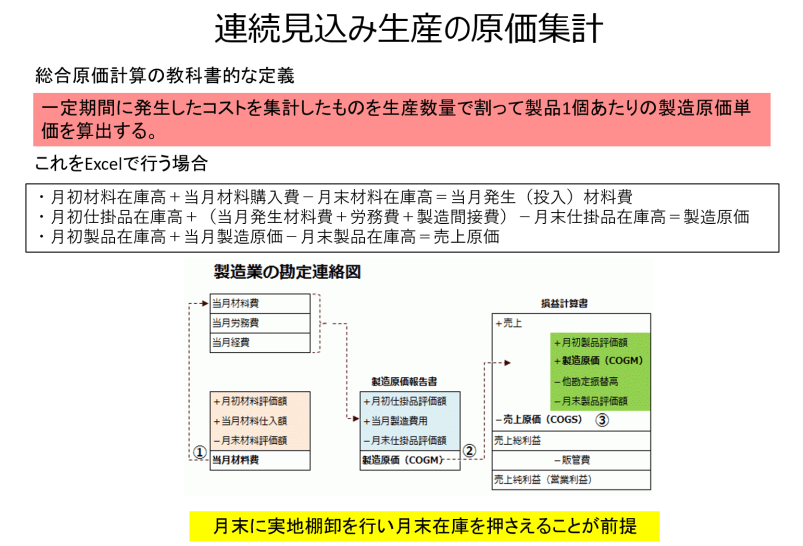
The core operations of Japanese companies in Indonesia are gradually being systematized, but one area where digital transformation is slow is cost management, particularly comprehensive cost accounting for mass production models. This is because accurate production results are necessary to adopt cost calculation methods recognized by international accounting standards (IFRS), such as the total average method and moving average method.
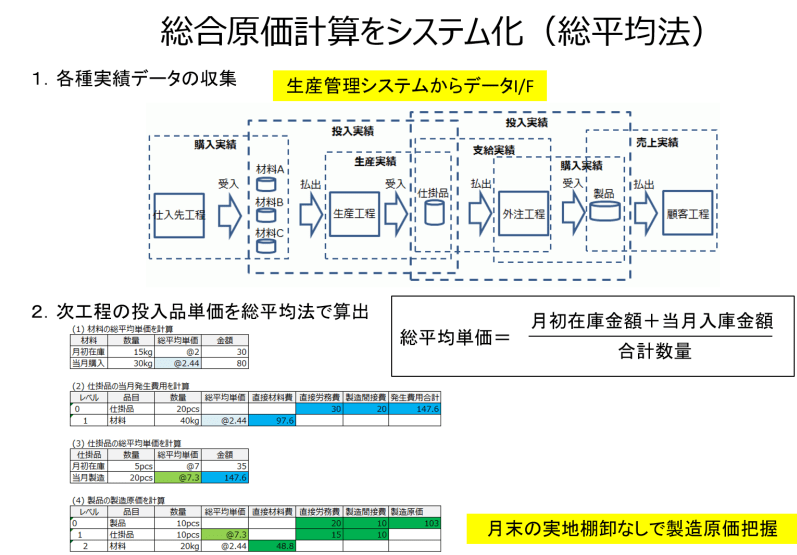
The details of comprehensive cost accounting are complex, but the basic question raised during the pandemic was "Why is it necessary to accurately grasp costs?" The purpose of corporate activities is to pursue profit, which is also a condition for survival. Profit is a condition for corporate survival, and securing cash and deposits is crucial. If a business is started with a capital of 100 million and incurs fixed costs of 25 million monthly, it will face financial difficulties if sales are not recorded within four months.
Simply accurately grasping costs does not increase profits. What is important is how much profit those costs generate. Considering ROI (Return on Investment), a shift in thinking from a cost center to a profit center is necessary.
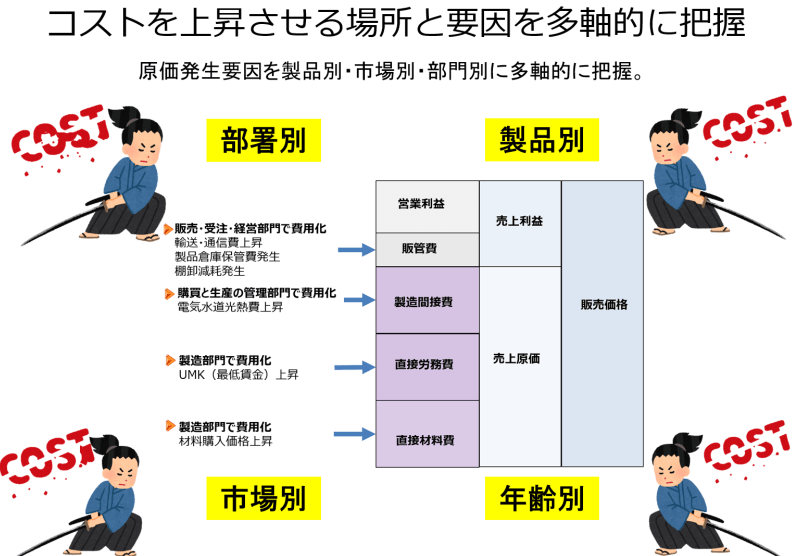
This shift in thinking involves deriving gross profit on the P/L based on manufacturing costs, subtracting selling and administrative expenses to calculate operating profit, and transitioning to a management accounting mindset that assesses the appropriateness of costs on the vertical axis of the P/L. Furthermore, improving profitability during the pandemic requires multidimensional analysis that expands the horizontal axis of the P/L.
Production Management to Prevent Delays
During the COVID-19 pandemic, one of the business improvement challenges we received from many Japanese manufacturing companies was "accurate and multifaceted cost management," and another was "the necessity of production management that prevents delays." In manufacturing, the process from procuring raw materials to producing finished products is called production management, while the process of receiving orders from customers and shipping products is called sales management. This is a common business pattern observed in Indonesian manufacturing.
- Sales receive order requests and shipping schedules from customers.
- Production begins according to the shipping schedule.
- On the shipping day, if there is no product inventory, the shipping department ships what is available, and the shortfall is shipped the next day.
- Customers communicate directly with the shipping department.
As a result, the scope of sales operations narrows, focusing mainly on order management. Ideally, sales should be involved with the production management department in creating a master production schedule (based on product completion dates), issue shipping instructions to the shipping department, and manage how much has been shipped against the order, known as backlog management.
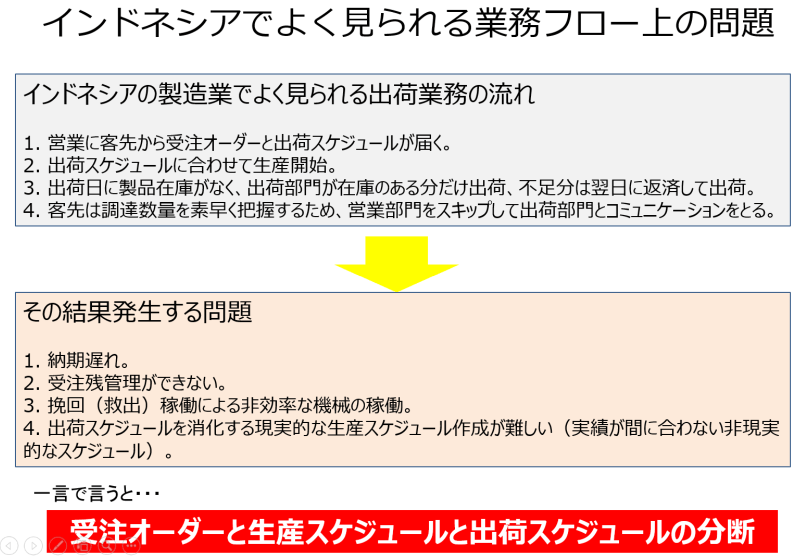
Ideally, sales should lead the issuance of invoices to customers and hand over sales slips to the accounting department to process sales and accounts receivable journal entries. However, due to the inability to manage backorders, they end up waiting for the shipping department to complete their tasks and for further communication. The root cause of this problem is the lack of product inventory at the time of shipping and the inability to produce according to delivery schedules.
Since products are not always completed at the time of shipping, many factories have the shipping personnel, rather than sales, as the point of contact with customers. As a result, order requests, shipping schedules, and production schedules (including purchasing schedules) become disconnected. This leads to delivery delays and reduced productivity due to recovery (rescue) production.
What is DX Transformation Required During the COVID-19 Pandemic?
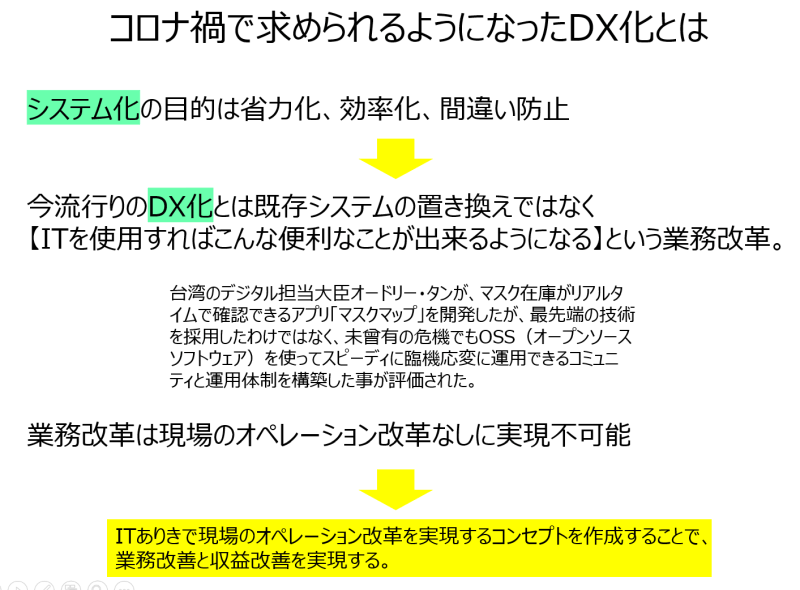
If the purpose of systemization is labor-saving, efficiency, and error prevention, then DX transformation is not merely a replacement of existing systems, but a business reform that enables such conveniences through the use of IT.
Taiwan's Digital Minister Audrey Tang developed the "Mask Map" app, which allowed real-time checking of mask inventories, preventing hoarding and resale due to mask shortages in the country. This was not a system utilizing cutting-edge technology, but rather one that leveraged OSS (open-source software) to build a community and operational framework that could be operated quickly and flexibly, which was highly praised.
To carry out business reform, reforming shop floor operations is essential. Creating a concept to realize shop floor operation reform based on IT and achieving business and profit improvement is considered the meaningful aspect of DX transformation.
Frequently Asked Questions | Digital Transformation in Indonesian Manufacturing
This section organizes frequently asked questions concisely in line with the content of this article.
How was the manufacturing industry in Indonesia affected by the COVID-19 pandemic?
The first cases were confirmed in March 2020, and large-scale social restrictions were implemented in April. This led to a decline in consumption, forcing 32% of Japanese manufacturing companies to reduce production by more than 50%. The impact on production activities was significant.
What changes have occurred in the IT investment strategies of Japanese companies?
According to a JETRO survey, 37% of companies experienced a sales decline of over 50%, but the negative impact on future investment strategies is minimal. 69% of companies are considering maintaining the status quo, 12% are considering expansion, and only 15% are considering downsizing.
What is the significance of digital transformation during the pandemic?
Digital transformation is not merely a replacement of existing systems but a business reform utilizing IT. Achieving operational reform on the shop floor and aiming for business and profit improvement is the profound significance of digital transformation.