


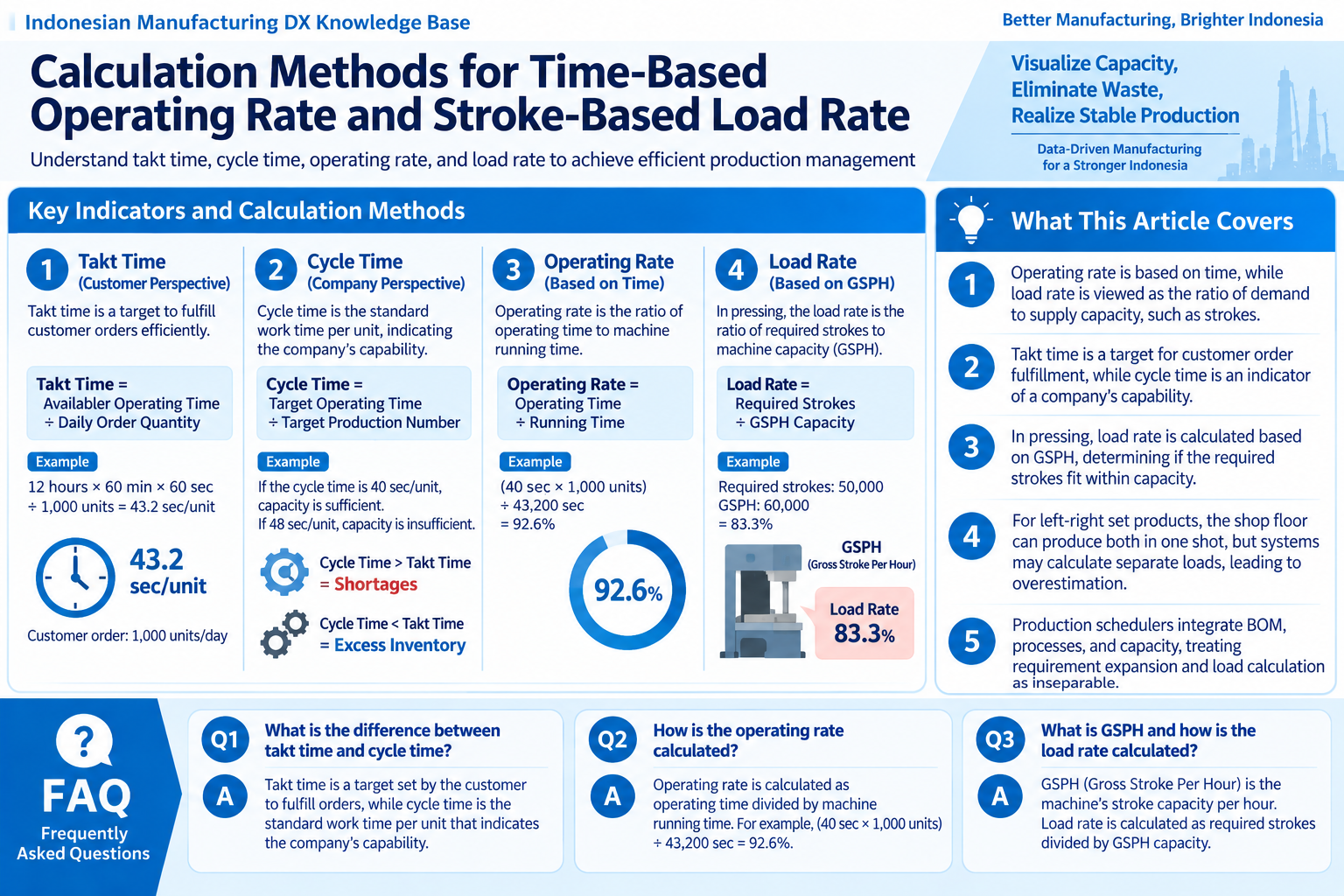
The load rate indicates the ratio of demand to the supply capacity of a machine. In pressing, it is the ratio of the number of strokes needed to fulfill orders against the GSPH (Gross Stroke Per Hour). The operating rate is the ratio of operating time to machine running time, representing the necessary operating time to fulfill daily orders.
-

-
Production Management Systems in Indonesia
The ultimate goal in manufacturing is to improve productivity and meet delivery deadlines. Understanding the differences between manufacturing cost, cost of…
続きを見る
What this article covers
- Operating rate is based on time, while load rate is viewed as the ratio of demand to supply capacity, such as strokes.
- Takt time is a target for customer order fulfillment, while cycle time is an indicator of a company's capability.
- In pressing, load rate is calculated based on GSPH, determining if the required strokes fit within capacity.
- For left-right set products, the shop floor can produce both in one shot, but systems may calculate separate loads, leading to overestimation.
- Production schedulers integrate BOM, processes, and capacity, treating requirement expansion and load calculation as inseparable.
Takt Time and Cycle Time in the Toyota Production System
Takt time (T/T) is a target set by Toyota for parts manufacturers to efficiently fulfill orders. For example, if Toyota places an order for 1,000 units per day and the manufacturer's operating time is 12 hours, the takt time is 43.2 seconds per unit.
- (12 hours x 60 minutes x 60 seconds) ÷ 1,000 units/day = 43,200 seconds/1,000 units = 43.2 seconds/unit
On the other hand, cycle time (C/T) refers to the standard work time per cycle. If a parts manufacturer processes at 40 seconds/unit, it results in excess capacity and inventory, requiring adjustments in operating time. Conversely, processing at 48 seconds/unit leads to insufficient capacity and shortages, necessitating efforts to reduce machine downtime through single setup (within 10 minutes).
- Cycle time > Takt time indicates insufficient capacity (shortages)
- Cycle time < Takt time indicates excess capacity (inventory)
Takt time is a customer-focused metric (Toyota), while cycle time is company-focused (parts manufacturer). In the Toyota Production System (TPS), eliminating waste and aligning cycle time with takt time is emphasized. Takt time is straightforward, but cycle time is calculated from planned operating hours and target production numbers by the production management department.
- Takt time = Available operating time ÷ Daily order quantity
- Cycle time = Target operating time ÷ Target production number
Whether setup time is included in operating time depends on the factory, but TPS promotes single setup to achieve 'Cycle time = Takt time'. Takt time and cycle time reflect the concept of 'how many seconds it takes to make one unit', and if the cycle time is 40 seconds/unit for 1,000 units, the operating rate is 92.6%.
- Operating rate = Operating time ÷ Running time = (40 seconds x 1,000 units) ÷ 43,200 seconds = 92.6%
Load Rate Based on Stroke Count in Pressing
In the production of pressed products, the load rate is calculated based on GSPH (Gross Stroke Per Hour) rather than takt or cycle time. This considers how many times the machine needs to operate to fulfill order quantities within its capacity, including setup and downtime.
- Load rate = Demand ÷ Supply capacity = Daily stroke count ÷ (GSPH x Operating time)
The load rate shows the 'ratio of demand to machine supply capacity', similar to the operating rate but without converting to units or time. If demand exceeds capacity, overtime or weekend operations are needed.
Load Rate Calculation for Left-Right Set Products in Indonesian Four-Wheel Parts Factories
In Japanese factories in Indonesia, many parts can be taken as left-right sets in one shot during pressing or molding processes, known as left-right set products or common products. Locally, they are called RL (Right-Left or Kanan-Kiri) products. In the production management system's BOM (Bill of Materials), when setting two-piece products, it is set as 0.5 child items per 1 parent item, meaning 1 child item is needed for 2 parent items.
Examples include car door parts, which have different item codes immediately after being separated into left and right, and orders from customers come separately for each. If the shop floor can manufacture according to the required quantities for left and right, the production management system's MRP (Material Requirements Planning) function will output the correct manufacturing instructions. However, load rate calculations may calculate loads separately for left and right, leading to overestimation.
- If there is an order for 100 right only: Process 100 right molds (100 shots)
- If there is an order for 100 left only: Process 100 left molds (100 shots)
- If there are equal orders for 100 right and left: Process 100 right and left molds (100 shots)
- If there are 60 right and 100 left orders: Process 60 right and left molds (60 shots), then 40 left molds (40 shots)
The production management system recognizes a load of 200 shots for a manufacturing instruction of 200 total units (100 right and 100 left), but in reality, the shop floor can fulfill the order with 100 shots.
Differences in Load Rate Calculation Between Production Management Systems and Production Schedulers
For two-piece products, setting the BOM in both production management systems and production schedulers as 0.5 child items per 1 parent item or 1 child item per 2 parent items ensures correct load rate calculation.
The production management system's master sets the required quantities for BOM parent-child relationships for requirement expansion (quantity), and sets standard load (cycle time) in the item line master for load calculation, managing the master separately for requirement expansion and load calculation.
This approach is based on the idea that the production management system's MRP assumes infinite capacity, stacking loads without considering order quantities, and manually leveling overloads, focusing on requirement expansion.
Conversely, production schedulers integrate BOM, process information, and capacity (cycle time) into a single view, showing capacity set in the BOM or item process master, treating requirement expansion and load calculation as inseparable.
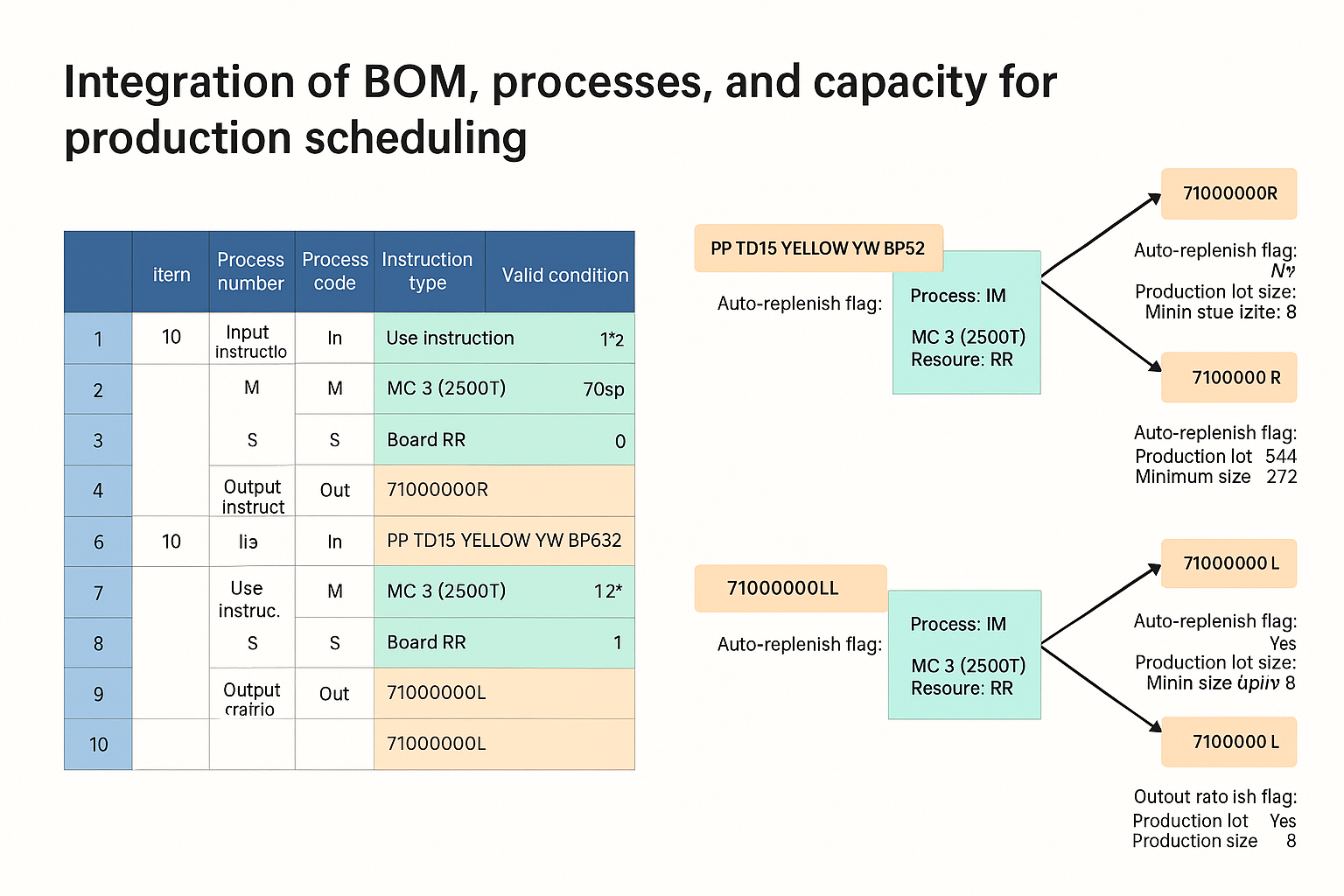
By setting the default output instruction for the right BOM and the optional output instruction for the left, unless specified otherwise at order time, the system automatically increases inventory by manufacturing the same number for the left as the right.
This is based on the fundamental idea of production schedulers to expand requirements according to order quantities without exceeding 100% of resource capacity based on cycle time.
Frequently Asked Questions | Calculation Methods for Operating Rate and Load Rate
Based on the content of this article, frequently asked questions are briefly organized.
What is the difference between takt time and cycle time?
Takt time is a target set by Toyota for parts manufacturers to efficiently fulfill orders. In contrast, cycle time refers to the standard work time per cycle, representing the actual processing time of the parts manufacturer. Takt time is customer-focused, while cycle time is company-focused.
How is the load rate for pressing calculated?
The load rate for pressing is calculated based on GSPH (strokes per hour). The load rate is the value obtained by dividing demand by supply capacity, calculated by dividing the daily stroke count by the product of GSPH and operating time. This indicates the ratio of demand to machine supply capacity.
What should be noted in the load rate calculation for left-right set products?
For left-right set products, the actual manufacturing shop floor can process both sides in one shot, but production management systems may calculate loads separately for each side. This can lead to overestimation of load, so it is necessary to align actual shot numbers with system load calculations.