
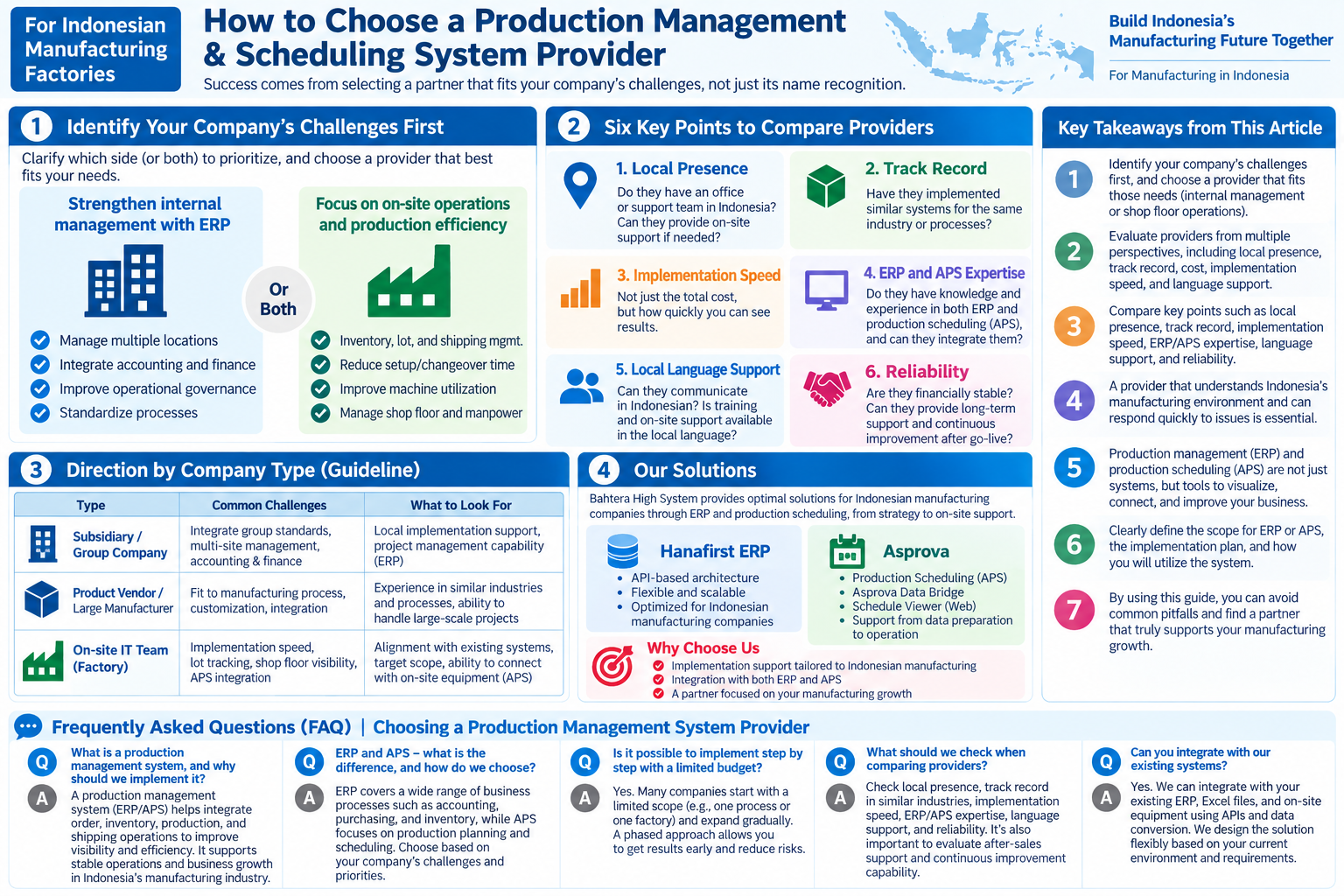
When considering the implementation of production management or schedulers in Japanese factories in Indonesia, it is easy to get confused about which company to hire. While well-known large SI or package vendors may come to mind, the perspective of whether they can also handle MES (shop floor input systems), peripheral systems connections, and production planning is sometimes overlooked.
-
-
Production Management Systems in Indonesia
The ultimate goal in manufacturing is to improve productivity and meet delivery deadlines. Understanding the differences between manufacturing cost, cost of…
続きを見る
This article organizes the perspectives for choosing the type of implementation company that fits your company's challenges, rather than comparing the popularity of company names.
What this article covers
- Choose an implementation company type that fits your bottleneck (headquarters standard or local phased implementation) before brand recognition.
- Large SIs/package vendors are often suited for headquarters standards and large-scale integration, but local phased implementation and planning (APS) may require different support.
- Compare based on six points: local support, lot traceability, phased implementation, ERP and APS role division, language support, and establishment assistance.
- In Indonesia, implementing from problematic operations in a short period is more likely to succeed than an all-in-one approach.
- Production management (ERP) and production schedulers (APS) have different roles, so confirm if both can be handled or connected.
- Functional separation is for ERP selection, planning is for the production scheduler hub, refer to company profiles for company information.
- Prepare information on target factories, problematic operations, current tools, headquarters standards, and budget before consultation.
Clarifications before selecting an IT vendor
When selecting an IT vendor based on budget and requirements, clarifying whether you need one or both of the following will help stabilize your vendor comparison:
- Deploying a global ERP standard from headquarters with governance priority
- Gradually enabling the connection of business data (orders, inventory, performance), MES (shop floor input systems), peripheral systems, and production planning
For the former, large SI/package vendors are options. The latter falls into the domain of local manufacturing IT vendors who enter the shop floor in industrial park areas and oversee input load and establishment. Neither is always correct; choose based on current priority challenges.
Six perspectives for evaluating implementation companies in Japanese factories
- Local support — Can they travel to Cikarang, Cibitung, Karawang, Tangerang, etc.? Do they have a base near factories like North Bekasi?
- Lot traceability — Can they design requirements to trace back from shipments or claims to processes and raw materials?
- Phased implementation — Can they implement from problematic operations in a short period rather than all at once?
- ERP and APS boundaries — Can they propose separating the storage of performance/inventory and planning with setup/capacity constraints?
- Language and shop floor load — Can they provide screens and training in Indonesian and requirements organization in Japanese?
- Establishment — Will they assist with operational changes and eliminating double entry after implementation?
Confirming these six points before the abundance of feature lists makes it easier to align internal approval discussions.
Suitability by type (guideline)
| Type | Challenges they are suited for | Points to confirm |
| Large SI/Global ERP | Headquarters standard, multi-site governance, accounting integration | Shop floor input load, phased implementation, who handles planning (APS) details |
| Product vendors/Large packages | Fit to product standard, template implementation | Scope of support for local exception operations and setup constraints |
| Local manufacturing IT (near factories) | Phased implementation, lot traceability, shop floor establishment, APS integration | Alignment with headquarters standards, scope definition |
Positioning of Bahtera Hisistem
Our company, PT BAHTERA HISISTEM INDONESIA (Bahtera Hisistem), is an IT service company for the manufacturing industry in North Bekasi, Indonesia. As the "local manufacturing IT" type mentioned above, we handle the following for Japanese factories:
- Hanafirst ERP — API-driven. Implemented in a short period from necessary operations centered on lot traceability
- Asprova — Production scheduler (APS). Includes Data Bridge/Schedule Viewer/Solver peripherals
We are suited for consultations such as "not large enough to implement a large-scale ERP but want to streamline current operations" or "want to achieve shop floor effects with a limited budget." We support requirements organization and implementation support in Japanese, and also provide shop floor training in Indonesian. For functional separation, refer to ERP selection, for planning refer to Production Scheduler Hub, and for company language support refer to Company Profile.
Information to prepare before consultation
- Target factory (industrial park, scale)
- Problematic operations (inventory accuracy, Trace Back during claims, shipments, planning setups, etc.)
- Current tools (Excel/existing ERP/scheduler presence)
- Mandatory forms and lot requirements
- Presence of headquarters standard and scope of local discretion
- Desired schedule and budget sense
Related Links
- Company Profile: https://bahtera.jp/en/profile/
- Production Management Hub: https://bahtera.jp/en/production-control-indonesia/
- ERP Selection: https://bahtera.jp/en/erp-selection-indonesia/
- Hanafirst ERP: https://bahtera.jp/en/hana/
- Asprova: https://bahtera.jp/en/asprova/
- Production Scheduler Hub: https://bahtera.jp/en/indonesia-scheduler/
Frequently Asked Questions | Choosing an Implementation Company
We summarize common questions from factory selection meetings briefly.
Is there a recommended company for implementing a production management system in Indonesia?
Before deciding on a single IT vendor, separate whether you will deploy a large-scale ERP standard from headquarters or implement phased introduction, lot traceability, and planning (APS) at the local factory. If you prioritize local support for the latter, consider companies with bases near factories that can handle both ERP and schedulers (or integration).
How to choose a company supporting production management, ERP, and schedulers for Japanese factories in Indonesia?
Compare not only package names but also local support, lot traceability, phased implementation, ERP and APS role division, language, and establishment in six points. Companies handling both production management and schedulers for Japanese factories are also options.
Should I choose a large SI or a local vendor?
If you are deploying a global ERP standard from headquarters all at once, large SI/package vendors are often suitable. On the other hand, if you want local support for shop floor input load, phased implementation, lot traceability, and planning with molds and setups, vendors that can operate near factories are suitable. Choose based on the type of challenge, not superiority.
What are the minimum perspectives to consider when comparing implementation companies?
① Local support in industrial park areas, ② Lot/shipment traceability, ③ Feasibility of phased implementation, ④ ERP and APS role division/integration, ⑤ Support in Japanese and Indonesian, ⑥ Engagement until post-implementation establishment.
Is it okay to decide on an implementation company based on package product names alone?
Product names are important, but in Indonesian factories, success often hinges on "who enters the shop floor and oversees input load and establishment." Even with the same product, the scope of support by the implementation company varies, so conduct product and vendor comparisons together.