
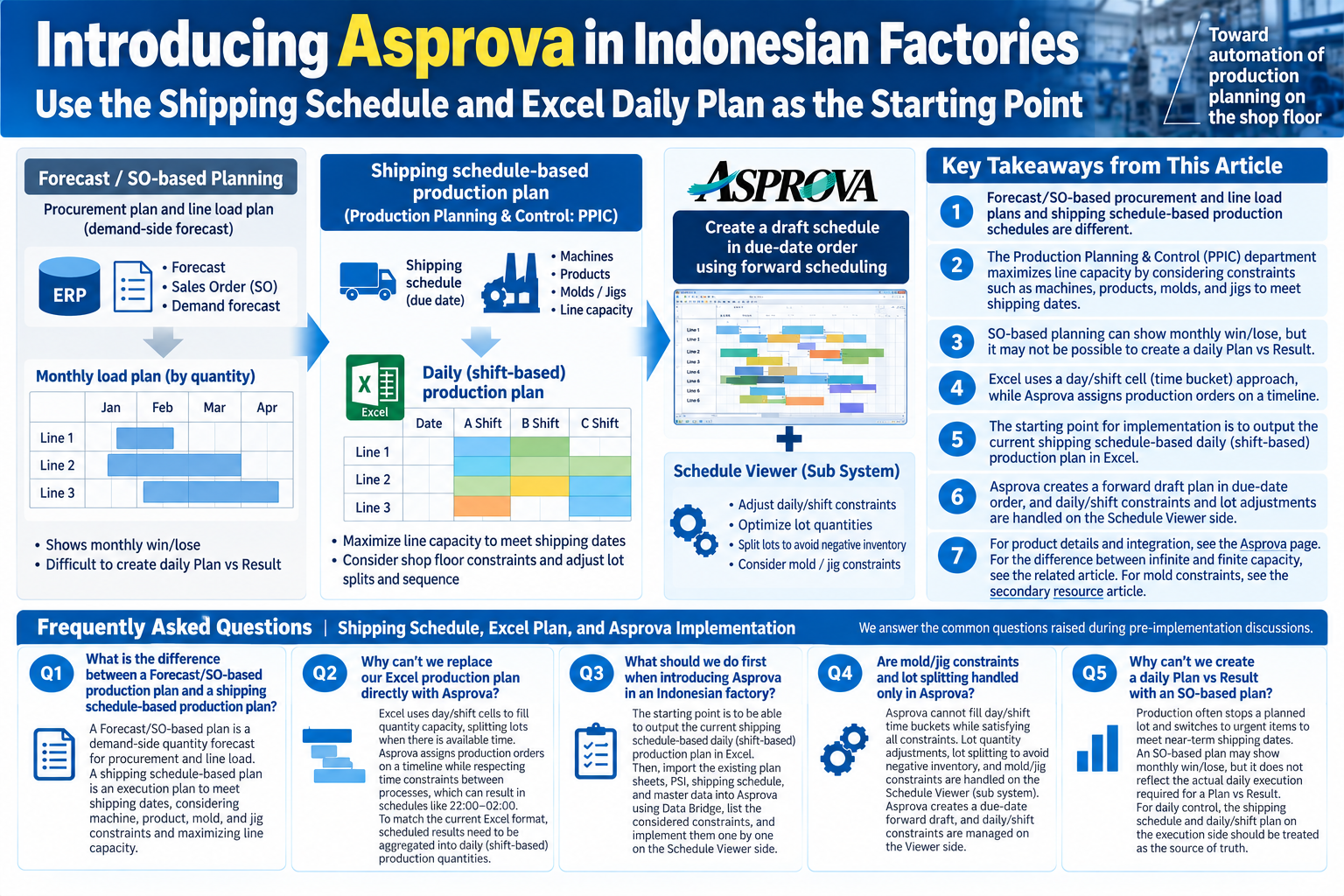
When automating production planning in Japanese factories in Indonesia, it's not always true that "if you plan from ERP's Forecast/SO, the shop floor will run smoothly." The work of the Production Control Department (PPIC) filling lines based on the shipping schedule and the plans created from SO or Forecast are different. Without separating these, implementing Asprova won't align with current Excel plans.
Article Positioning: This article organizes the perspective of using the shipping schedule and Excel daily plans as the starting point for Asprova implementation under the production scheduler hub. For differences in quantity and time, refer to infinite and finite capacity, for MRP operation issues, see MRP operation challenges, and for products and Data Bridge/Schedule Viewer, refer to Asprova.
-
-
Production Scheduler in Indonesia
Production planning and load planning are closely related and require verification based on quantities. It is important to compare production quantities,…
続きを見る
What this article covers
- Order and load planning based on Forecast/SO and production scheduling based on the shipping schedule are different.
- The Production Control Department (PPIC) maximizes line capacity by considering constraints like machines, items, molds, and jigs to meet shipping deadlines.
- SO-based plans may reveal monthly wins and losses but may not produce daily Plan vs Result reports.
- Excel fills cells for days/shifts (time buckets), while Asprova allocates orders on a timeline.
- The starting point for implementation is the ability to produce daily (shift-based) plans from the current shipping schedule in Excel.
- Asprova handles forward proposals by earliest due date, while Schedule Viewer manages day/shift constraints and lot adjustments.
- Refer to Asprova for products and integration, infinite vs finite capacity differences, and mold constraints in the auxiliary resources article.
Problems Arising in Automating Production Planning
Order and load planning based on Forecast and production scheduling based on the shipping schedule must be considered separately to succeed.
The Production Control Department bases production schedules on the shipping schedule, considering constraints like machines, products, molds, and jigs to maximize line capacity. Production plans created from ERP's SO or Forecast fundamentally differ from this approach.
Manufacturing lines focus on meeting shipping schedules. To meet immediate shipping needs, original plan lots may be halted and postponed, prioritizing urgent items. Therefore, SO-based production plans may reveal monthly wins and losses but cannot create the daily Plan vs Result reports required internally.
Differences Between Excel Production Plans and Asprova's Philosophy
In Indonesian Production Control Departments, Excel cells are considered as one day or one shift, aiming to maximize quantity capacity by increasing utilization. If there is free time, they try to fill it by splitting lots of products they want to produce.
In contrast, Asprova is a system that allocates orders while respecting time constraints between processes, targeting free time. It cannot automatically control which products to allocate when and how many, in the same way as filling Excel cells.
Asprova allocates manufacturing orders on a timeline in quantity units, so orders like "from 22:00 to 2:00 the next day" can occur, which is unlikely in Excel. To align Asprova's scheduling results with current Excel-based production plans, production quantities need to be divided daily (shift-based).
The direction is the same: filling capacity per day (shift) with producible quantities, and per order with operating hours per day. However, those accustomed to Excel cells as time buckets may find it difficult to adapt to the cycle time-based approach without time buckets, where start and end are allocated on a timeline.
Asprova Implementation Policy in Indonesian Factories
The starting point is being able to output the current shipping schedule-based daily (shift-based) production plans in Excel, created by the Production Control Department. From here, constraints are implemented one by one.
Asprova cannot fill time buckets while satisfying constraints, so the next role falls to the subsystem (Schedule Viewer).
- Lot quantity adjustments for maximizing capacity
- Lot splitting to avoid negative inventory
- Constraints like molds and jigs
The division of roles is as follows: Asprova creates a draft schedule for forward production by earliest due date, while the subsystem handles constraints on day (shift) based formats.
- Receive the current Excel production plan and PSI table created by the person in charge
- Receive the base shipping schedule and master data, and import them into Asprova using Data Bridge to ensure nothing is missed
- Conduct interviews to understand the conditions considered during creation
- List the conditions, prioritize them, and implement them one by one in Schedule Viewer
In Indonesian manufacturing sites, customer order quantities and delivery dates frequently change. The cycle for creating production plans is also shortening, increasing the significance of automating the creation process. Refer to the auxiliary resources article for mold and operator placement, and the manufacturing order and Plan vs Result article for viewing manufacturing orders and results.
Related Links
- Production Scheduler Hub: https://bahtera.jp/en/indonesia-scheduler/
- Asprova (Data Bridge / Schedule Viewer): https://bahtera.jp/en/asprova/
- Infinite and Finite Capacity: https://bahtera.jp/en/infinite-finite/
- MRP Operation Challenges: https://bahtera.jp/en/forecast-order/
- Mold and Operator Constraints: https://bahtera.jp/en/asprova-operator-schedule/
- Manufacturing Order and Plan vs Result: https://bahtera.jp/en/plan-result/
- Company Profile: https://bahtera.jp/en/profile/
FAQ | Shipping Schedule and Excel Plans, Asprova Implementation
We summarize frequently asked questions that arise repeatedly during pre-implementation meetings.
What is the difference between production planning based on Forecast or SO and production scheduling based on the shipping schedule?
Order and load planning from Forecast or SO are demand-side quantity forecasts. In contrast, the production schedule created by the Production Control Department from the shipping schedule is an execution plan that maximizes line capacity by considering constraints like machines, items, molds, and jigs to meet shipping deadlines. If you treat these as the same in ERP planning, it won't align with shop floor interruptions (switching to urgent items).
Why can't Excel production plans be directly replaced with Asprova?
In Excel, cells are considered as one day or one shift, and if there is free space, lots are split to fill quantity capacity. Asprova allocates order quantities on a timeline while respecting time constraints between processes. Therefore, orders like "from 22:00 to 2:00 the next day" can occur, which is unlikely in Excel. To align with current Excel tables, scheduling results need to be divided into daily (shift-based) production quantities.
What should be done first when implementing Asprova in Indonesian factories?
The starting point is being able to output the current shipping schedule-based daily (shift-based) production plans in Excel, created by the Production Control Department. Then, import the current plan table, PSI table, shipping schedule, and master data into Asprova using Data Bridge, list the conditions considered, and implement them one by one in Schedule Viewer.
Are mold and jig constraints and lot splitting handled solely by Asprova?
Asprova cannot fill time buckets (day/shift cells) while satisfying constraints. Lot quantity adjustments for maximizing capacity, lot splitting to avoid negative inventory, and constraints like molds and jigs are handled by the subsystem (Schedule Viewer). Asprova drafts forward by earliest due date, while day/shift format constraints are handled by the Viewer. Refer to the auxiliary resources article for mold setup.
Why can't SO-based plans create daily Plan vs Result?
Manufacturing lines focus on meeting immediate shipping needs, so original plan lots may be halted and postponed, prioritizing urgent items. SO-based plans may reveal monthly wins and losses but cannot create the daily Plan vs Result reports required internally. For daily views, the shipping schedule and execution-side day/shift plans must be considered correct.