


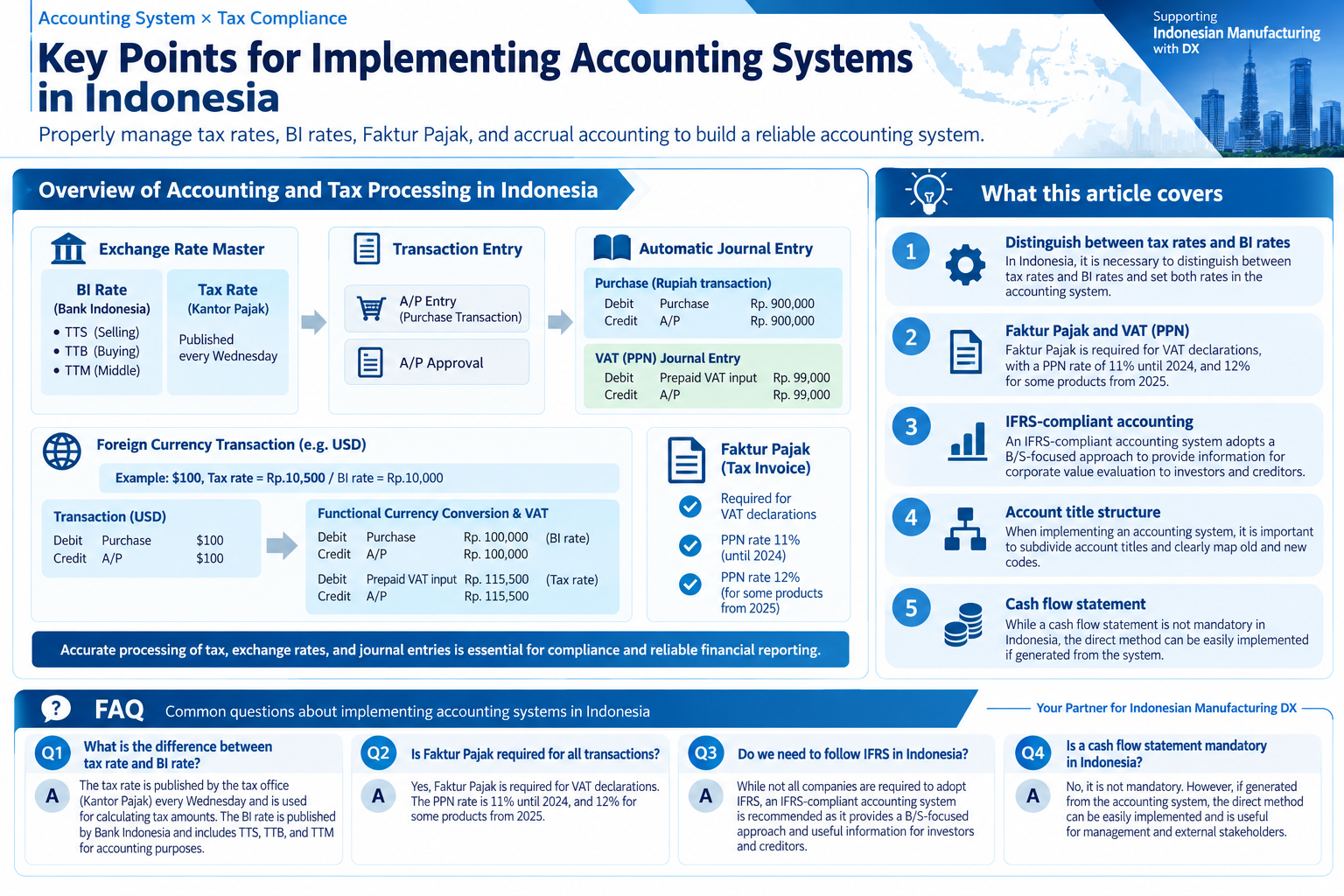
When implementing an accounting system in Indonesia, it is important to distinguish between tax rates and central bank transaction rates. Additionally, it is crucial to prepare a Faktur Pajak (Tax Invoice) for VAT declarations and confirm the timing of revenue and expense recognition based on the accrual basis.
-
-
Accounting Systems in Indonesia
The adoption rate of SaaS-based accounting systems in Indonesia is less than 8%, despite the advancement of SaaS technology. The continuous launch of new…
続きを見る
What this article covers
- In Indonesia, it is necessary to distinguish between tax rates and BI rates and set both rates in the accounting system.
- Faktur Pajak is required for VAT declarations, with a PPN rate of 11% until 2024, and 12% for some products from 2025.
- An IFRS-compliant accounting system adopts a B/S-focused approach to provide information for corporate value evaluation to investors and creditors.
- When implementing an accounting system, it is important to subdivide account titles and clearly map old and new codes.
- While a cash flow statement is not mandatory in Indonesia, the direct method can be easily implemented if generated from the system.
Tax rate and BI rate
For calculating tax amounts related to foreign currency transactions, it is mandatory to use the Tax Rate published by the tax office (Kantor Pajak) every Wednesday. Therefore, the exchange rate master in the accounting system must include both the BI (Bank Indonesia) rate and the Tax rate. The BI rate includes TTS (selling), TTB (buying), and TTM (middle rate), and there is no case where TTS and TTB are set separately for selling and buying transactions.
For a company with Rupiah as its functional currency, when conducting a Rupiah transaction, VAT at 11% is automatically calculated upon A/P Entry and A/P Approval, and the following journal entry is automatically generated as a Transfer voucher.
- (Debit) Purchase Rp. 900,000 (Credit) A/P Rp. 900,000
- (Debit) Prepaid VAT input Rp. 99,000 (Credit) A/P Rp. 99,000
Since VAT journal entries are made in Rupiah, no currency conversion occurs for Rupiah transactions, regardless of whether the functional currency is Rupiah or Dollar. However, for foreign currency transactions like Dollar, currency conversion using the Tax rate is required for the VAT portion.
For example, if the Tax rate is $1=Rp.10,500, $100×11%x10,500=Rp.115,500 becomes the VAT journal entry for both transaction currency and functional currency. However, if the BI rate is $1=Rp.10,000, it would be as follows:
- (Debit) Purchase $100 (Credit) A/P $100
- (Debit) Purchase Rp.100,000 (Credit) A/P Rp.100,000 ←BI rate $1=Rp10,000
- (Debit) Prepaid VAT input Rp.115,500 (Credit) A/P Rp.115,500 ←Tax rate $1=Rp10,500
In this case, it is necessary to obtain both the BI rate and the Tax rate from the exchange rate master on the debt entry screen, but if it is difficult on the system, the following three operational methods are used to cope.
Manual Calculation of VAT
The system automatically calculates both the transaction and VAT portions using the BI rate from the exchange rate master, but the VAT portion is manually calculated using the Tax rate and corrected, leaving a memo of the Tax rate in the application field.
Separate Entry for Transaction and VAT Portions
In this case, the A/P voucher No for the transaction journal and the Transfer voucher No for the VAT journal will differ, so it is necessary to manage the linkage using the Invoice number as a key.
End-of-month Batch Reversal for VAT Portion
At the time of transaction occurrence, both the transaction and VAT portions are automatically generated in the Original currency, and a batch reversal is performed at the end of the month.
- (Debit) Purchase $100 (Credit) A/P $110
- (Debit) VAT clearing $10
The amount of Faktur Pajak (Tax Invoice) is aggregated monthly and batch reversed.
- (Debit) Prepaid VAT input Rp.105,000 (Credit) VAT clearing $10
Faktur Pajak for VAT Declaration
In Indonesia, the invoice method is adopted, and VAT is calculated based on the Tax Invoice. Japan also operates the invoice method following the introduction of reduced tax rates in 2021. Indonesia's PPN rate is 11% until 2024, changing to 12% from January 2025. However, the 12% rate applies only to certain luxury goods.
For regular transactions, the taxable amount DPP (Dasar Pengenaan Pajak) is multiplied by 11/12 to calculate the taxable amount DPP nilai lain for applying PPN 12%, and the 12% tax rate is applied to this, resulting in an effective tax amount equivalent to 11%.
In the bookkeeping method, tax amounts such as consumption tax are calculated from the recorded tax-inclusive amounts, while in the invoice method, the tax amounts listed on the invoices are aggregated. This makes it easy to calculate even if the tax rates differ for each item or service. For tax payment or refund claims, a Faktur Pajak (Tax Invoice) is required, which always accompanies the invoice.
Faktur Pajak is issued from the e-Faktur system before 2024 and from the online coretax system after 2025. This eliminates the need to develop a dedicated form in the accounting system.
IFRS Compliance in Accounting Systems
Japanese accounting standards emphasize the income statement (P/L), which is based on the assumption of a high-growth economy, allowing future forecasts to be made solely from the current period's profit and loss. After creating the P/L, asset, liability, and capital items, which are the sources of revenue and expenses for the next period, are additionally recorded as a balance sheet (B/S). This approach, which uses tax law valuations as accounting valuations and processes them as special profits and losses when depreciation is completed, is called the revenue-expense approach.
On the other hand, IFRS accounting standards aim to provide investors and creditors with the information necessary for corporate value evaluation, emphasizing B/S by accurately creating it through fair value evaluation of fixed asset impairment, revaluation, and available-for-sale financial assets. This allows understanding whether the asset situation can generate cash flow in the future.
Consolidated financial reporting based on IFRS is mandatory, but tax reporting must be prepared according to each country's unique standards. This is called the asset-liability approach. As a global standard, all rules are defined in English, and each country's requirements, including tax considerations, are not considered, being defined from a global perspective.
While IFRS compliance is mandatory for investors and creditors in accounting, it is not guaranteed that the tax office can accommodate this. Therefore, it is ideal for the accounting system to implement a multi-standard ledger function.
There are two cases for IFRS compliance in the system: system modification and operational change. The matters proposed to customers during system implementation are as follows.
Revenue Recognition on a Realization Basis
Revenue is recognized based on the shipping or acceptance criteria, and the occurrence of receivables varies depending on the timing of invoice issuance. The following is an example of journal entry generation in the case of acceptance criteria.
In the case of the tripartite method
- No journal entry
- (Debit) A/R 100,000 (Credit) Sales 100,000
In the case of the perpetual record method
- (Debit) A/R Accrued 60,000 (Credit) Inventories 60,000
- (Debit) COGS 60,000 (Credit) A/R Accrued 60,000
- (Debit) A/R 100,000 (Credit) Sales 100,000
There may be cases where NG is discovered during customer inspection after invoice dispatch or during input in the manufacturing process. The method for correcting issued invoices (accrued A/R) in such cases is as follows.
- Perform inventory adjustment with the issuance of replacement products and return receipt without changing the invoice (Tukar guling).
- Cancel and reissue the invoice for only the OK portion.
- Issue a correction invoice with shipment return processing, then register a new order for the NG portion.
- After closing processing, issue a negative invoice with return order processing and shipment return.
If the NG portion is disposed of at the customer's site and only the invoice amount is corrected, issue a Credit Note (payable obligation) from your company and have the customer issue a Debit Note (receivable obligation) for correction.
In the case of the perpetual record method, which reduces inventory assets in real-time with shipment, it is possible to record COGS at the time of shipment. However, if invoice issuance is subsequent, manage the synchronization of inventory and accounting during the period from shipment to acceptance completion using an A/R Accrued account for Accrued Revenue.
Unified Inventory Valuation Method
It is necessary to unify the inventory valuation method within the consolidated company, and it is common to align with the method of the Japanese headquarters. The FIFO method, moving average method, standard cost method (standard unit price method), and total average method are recognized under IFRS, while the LIFO method is not recognized.
Separate Management of Actual Inventory and Accounting Inventory
By conducting a month-end inventory count, COGS is determined, and despite the decrease in inventory assets due to shipments during the month, the accounting remains at the beginning balance. This mismatch is managed as assets for unrealized sales (Accrued Revenue) using supplementary reports.
In this case, do not generate inventory transaction journal entries at the time of shipment, and determine inventory assets by replacing the beginning and ending balances with batch processing at the end of the month. Calculate COGS using the tripartite method (beginning balance + purchases - ending balance) and determine the current period's profit.
Revaluation of Tangible Fixed Assets (Manual Handling)
Under IFRS, it is necessary to revalue tangible fixed assets annually and review depreciation methods and useful lives. For example, when calculating vehicle value during asset inheritance, the market sales value may be 200,000 yen even if the tax law basis is 0 yen. In Japan, the tax law basis is often adopted for accounting, and periodic revaluation is not executed, so such cases are reduced with regular revaluation. However, this is more of an operational issue than a system correction.
Cash Flow Statement (Direct Method) is Mandatory
In Indonesia, the cash flow statement is not mandatory and is often not prepared, but if generated from the system, the direct method can be easily implemented by obtaining data from the GL using the cash flow code set at the time of transaction entry.
Multi-standard Ledger
While tax is based on each country's unique standards, consolidated financial statements are prepared in compliance with IFRS (B/S emphasis). Although IFRS compliance is mandatory for investors and creditors in accounting, it is not guaranteed that the tax office can accommodate this.
Therefore, it is ideal for the accounting system to implement a multi-standard ledger function, specifically managing accounting journal data separately and allowing optional aggregation at the time of output.
Subdivision of Account Titles
When implementing an accounting system, account titles (Chart Of Account = COA) are essential. For companies that have outsourced bookkeeping to accounting consultants, it is a good opportunity to review their code system. However, if the mapping between old and new codes is not clear, it will be challenging to set the beginning balance and compare trial balances (T/B), leading to discrepancies in account balances.
Accounting consultants perform numerous bookkeeping services, adopting a common bookkeeping method to improve work efficiency. For example, even if material imports from Japan are managed as Goods-In-transit (GIT) in FOB (Free On Board) transactions, it is not guaranteed that the accounting consultant's bookkeeping reflects this.
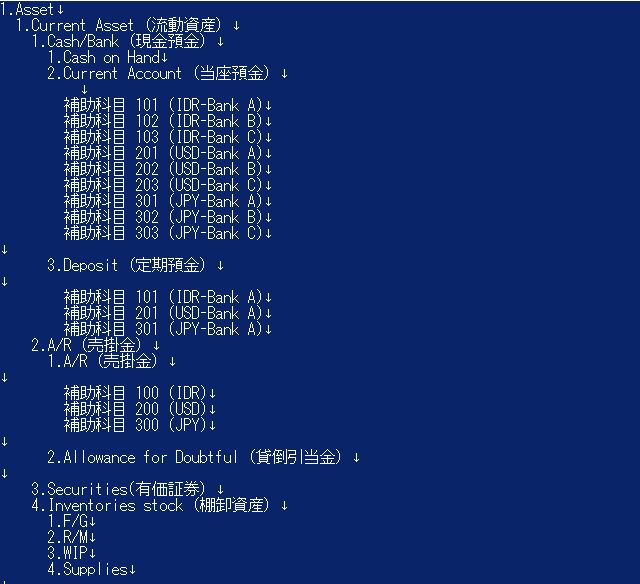
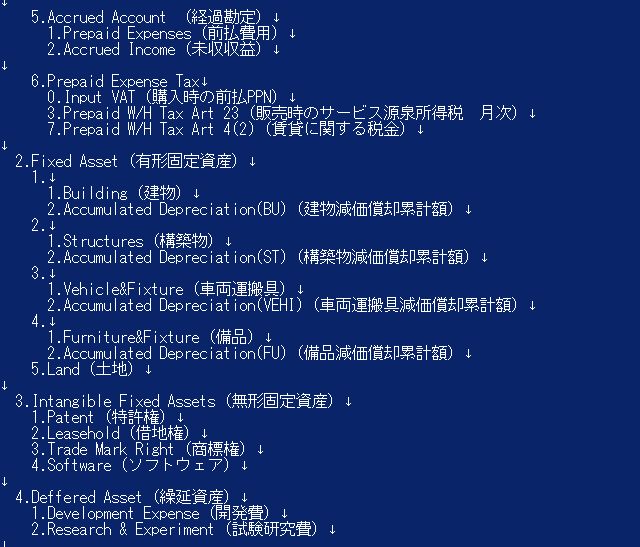
Account titles are often composed of a combination of 3-4 digit main accounts and 3-digit sub-accounts. For cash and bank accounts, it is common to separate sub-accounts by currency for cash and by "bank + currency" for deposits. The general ledger (G/L) includes department codes, customer codes, and currency codes, so it is often unnecessary to subdivide A/R and A/P accounts by department, currency, or customer, and they are usually grouped by the nature of the customer.
However, if the accounting system being implemented has a feature where the P/L menu has templates for department-specific management reports but can only retrieve amounts from expense accounts for cost reports, it may be necessary to separate revenue accounts by customer. Although accounting software is often said to be similar, these functional constraints are considered unique features of the package.
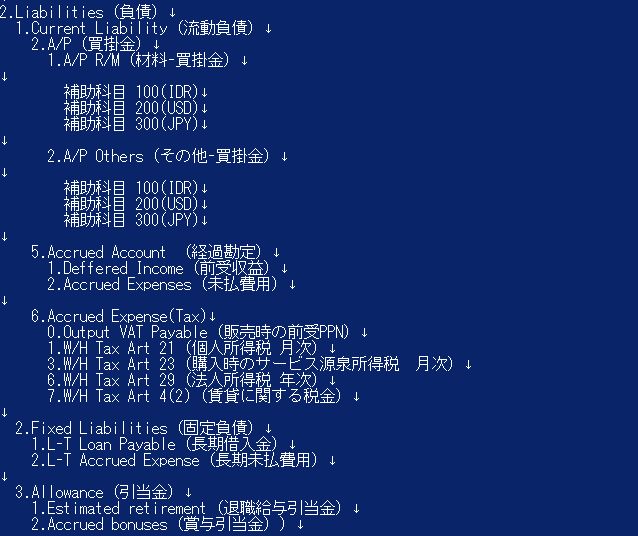

Balance of Balance Sheet (B/S) and Income Statement (P/L)
Accounting journal entries begin at the time of business commencement, and when personal funds are invested, they become company assets and are recorded on the B/S. This is the moment when personal money becomes company assets.
For example, when a foreigner invests personal funds of 60 juta to establish a PT (limited liability company) in Indonesia, the company's assets are recorded at the time the shareholder ratio is registered in the company establishment certificate (AKTA Pendirian Perseroan Terbatas) with Indonesian directors (Direktur) and auditors (Komisaris) as shareholders, and it is incorporated into the capital of the establishment B/S (Nuraca).
- (Debit) Bank 60,000,000 (Credit) Capital 60,000,000
Capital is the legal capital paid in by shareholders, and net assets include legal capital surplus and retained earnings (Earned surplus). Liabilities are obligations to repay, while net assets are not.
Liabilities are divided into current liabilities and fixed liabilities, with a repayment period of one year as the boundary.
- Assets = Liabilities + Net Assets
At the time of company establishment, only assets and net assets are recorded on the B/S, but as various expenses occur and the first sales occur, P/L accounts become necessary, and the balance is achieved with the following formula.
- Assets + Expenses = Liabilities + Net Assets + Revenue
Finalizing Account Titles
Account title codes start with assets (head 1), liabilities (head 2), and net assets (head 3), followed by revenue (head 4). Subsequently, expenses (head 5~) are subdivided into direct manufacturing costs, indirect manufacturing costs, selling and administrative expenses, etc.
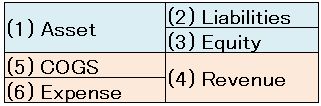
1. Allowance for Doubtful
This is an account for amortizing the loss amount of current assets. In the indirect method, it is recorded as a negative asset (head 1) under accounts receivable on the B/S during closing adjustment journal entries, and as a positive expense (head 6) under selling and general administrative expenses on the P/L.
- (Debit) Allowance for Doubtful (positive expense) (Credit) Allowance for Doubtful (negative asset)
2. Depreciation
This is an account for the depreciation of tangible fixed assets. In the indirect method, it is recorded as a negative asset (head 1) under tangible fixed assets (excluding land) on the B/S during closing adjustment journal entries, and as a positive expense (head 6) under selling and general administrative expenses on the P/L.
- (Debit) Equipment Depreciation (positive expense) (Credit) Accumulated Depreciation of Equipment (negative asset)
3. Amortization
This is an account for the amortization of intangible fixed assets. In the direct method, it is recorded as a negative asset during closing adjustment journal entries, and as a positive expense (head 6) under selling and general administrative expenses on the P/L.
- (Debit) Amortization of Intangible Fixed Assets (positive expense) (Credit) Software (asset)
4. Estimated Retirement
This account manages the provision for retirement benefits that are expected to occur in the future, estimating the amount to be borne in the current period and recording it as an expense for the current period. During closing adjustment journal entries, it is recorded as a positive liability (head 2) under provisions on the B/S, and as a positive expense (head 6) under selling and general administrative expenses on the P/L.
- (Debit) Provision for Retirement Benefits (positive expense) (Credit) Provision for Retirement Benefits (positive liability)
5. Deferred Assets (Development Costs, Research and Testing Costs)
Of the funds spent as expenses, the portion that should be borne in future periods is temporarily regarded as an asset and deferred, allocating it over the period during which the effect of the expense is expected. Since it is an expense that will generate results in the future, it is temporarily placed as an asset on the B/S.
6. Accrued Accounts (Accrued Revenue, Accrued Expenses)
For services that are continuously provided or received, of which some become revenue or expenses over time, if there is a discrepancy between the timing of cash receipts and disbursements and the timing of profit and loss recognition in the income statement, this account is used to process it. Accrued revenue, which is non-merchandise, is placed as an asset on the B/S, and accrued expenses are placed as a liability on the B/S.
7. Manufacturing Costs and Selling and Administrative Expenses
The cost calculation target is only manufacturing costs (head 5), and selling and administrative expenses (head 6) are not included in the cost calculation target, even though the same expense items are listed. Material costs and subcontracting costs are calculated monthly on a moving average basis from data within the production management module. Labor costs and expenses are allocated according to actual work hours, and depreciation is allocated according to production volume.
8. Taxes

VAT (PPN) and withholding tax on domestic service revenue (PPh23) are set as In (asset) and Out (liability), while personal income tax (PPh21) is only a liability.
PPN (Input-VAT-Prepaid as Asset, Output-VAT Payable as Liability)
At the Time of Purchase (In)
- (Debit) Pch (Purchase) 100 (Credit) A/P (Accounts Payable) 110
- (Debit) Input-VAT Prepaid (asset) 10
- (Debit) A/R (Accounts Receivable) 110 (Credit) Sales 100
- (Credit) Output-VAT Payable (liability) 10
PPh23 (PPh23 Prepaid as Asset, PPh23 Payable as Liability)
- (Debit) Bank 108 (Credit) A/R (Accounts Receivable) 110
- (Debit) PPh23 Prepaid (asset) 2
- (Debit) A/P (Accounts Payable) 110 (Credit) Bank 108
- (Credit) PPh23 Payable (liability) 2
PPh21 (W/H Tax21 as Liability)
- (Debit) Salary (Base Salary) (Credit) Bank
- (Credit) PPh21 Payable (liability)
9. Supplies
Office consumables are converted into selling and general administrative expenses during inventory processing at the time of closing.
- (Debit) Supplies (Inventory) (Credit) Cash
- (Debit) Supplies Expense (Consumables Expense) (Credit) Supplies (Inventory)
Purpose of Closing Processing (Closing Adjustment Journal Entries and Profit Calculation)
1. Correction of Amounts for Accounts without Counterparties
- Depreciation (Indirect Method) Fixed Asset's Negative Assetization (Cumulative Amount) and COGSization (Manufacturing) or Selling and Administrative Expenseization (Office Equipment)
- Amortization (Direct Method) Intangible Fixed Asset's Selling and Administrative Expenseization
- Allowance for Doubtful A/R's Negative Assetization and Selling and Administrative Expenseization (Provision Amount)
- Estimated Retirement A/R's Negative Assetization and Selling and Administrative Expenseization (Provision Amount)
- Stock Taking of Supplies (Expenseization of Inventory) Convert the used portion of supplies into consumables expense (selling and administrative expense).
2. Calculation of COGS (Cost Of Goods Sold)
In the tripartite method, where inventory receipts during the month use the purchase account (expense), COGS (expense) is calculated at the end of the month using "beginning inventory + purchases - ending inventory".
1. Replace beginning and ending product inventory using contra accounts.
- (Debit) Beginning Product Inventory 50 (Credit) Product 50
- (Debit) Product 30 (Credit) Ending Product Inventory 30
2. Transfer to the COGS account along with the cost of goods manufactured (COGM) to calculate the current period's COGS.
- (Debit) COGS 50 (Credit) Beginning Product Inventory 50
- (Debit) Ending Product Inventory 40 (Credit) COGS 40
- (Debit) COGS 30 Product Manufacturing Cost 30
3. Transfer All P/L Accounts (Including COGS) to the Income Summary Account to Calculate Net Income
Transfer the current period's net income from the P/L to the EARNED SURPLUS (PRE-MONTH) on the B/S, and then transfer it to Retained Earning (Retained Earnings). Before calculating the current period's net income, calculate the gross profit using the Net Income account and subtract selling and administrative expenses to determine operating income.
- Gross Profit > Operating Income > Ordinary Income > Pre-tax Income > After-tax Income (Current Period's Net Income)
Profit and Loss Recognition on an Accrual Basis (Shipping and Acceptance Criteria)
Under IFRS, expense recognition based on the accrual basis is fundamental. The criteria for recognizing revenue on an accrual basis include shipping and acceptance criteria. The method of recognizing profit and loss at the timing of acquiring cash or cash equivalents (monetary assets such as accounts receivable and notes) is sometimes referred to as the Realization Basis.
Perpetual Record Method (Acceptance Criteria)
- (Debit) Inventories 100 (Credit) A/P Accrued 100
- (Debit) A/P Accrued 100 (Credit) A/P 100
- (Debit) Shipment Clearing 100 (Credit) Inventories 100
Under the acceptance criteria, sales are recorded after acceptance completion at the customer's site.
- (Debit) A/R 120 (Credit) Sales 120
- (Debit) COGS 100 (Credit) Shipment Clearing 100
Perpetual Record Method (Shipping Criteria)
- (Debit) Inventories 100 (Credit) A/P Accrued 100
- (Debit) A/P Accrued 100 (Credit) A/P 100
Based on the realization principle, sales are recorded using the shipping criteria.
- (Debit) A/R Accrued 120 (Credit) Sales 120
- (Debit) COGS 100 (Credit) Inventories 100
- (Debit) A/R 120 (Credit) A/R Accrued 120
Frequently Asked Questions | Accounting System Implementation
These are the points first confirmed during implementation in Indonesia.
What is important in account title design?
Balancing the granularity of transactions on the ground with the reporting granularity of the general ledger is important. If it is too detailed or too coarse, operations will break down.
How much tax knowledge is necessary?
The minimum knowledge directly related to journal entries, such as VAT and withholding, is essential. Details are divided with the tax hub.
What are the conditions for success?
Agreement on business flow, master maintenance, and period closing rules are the conditions. Operations need to be decided before screens.