


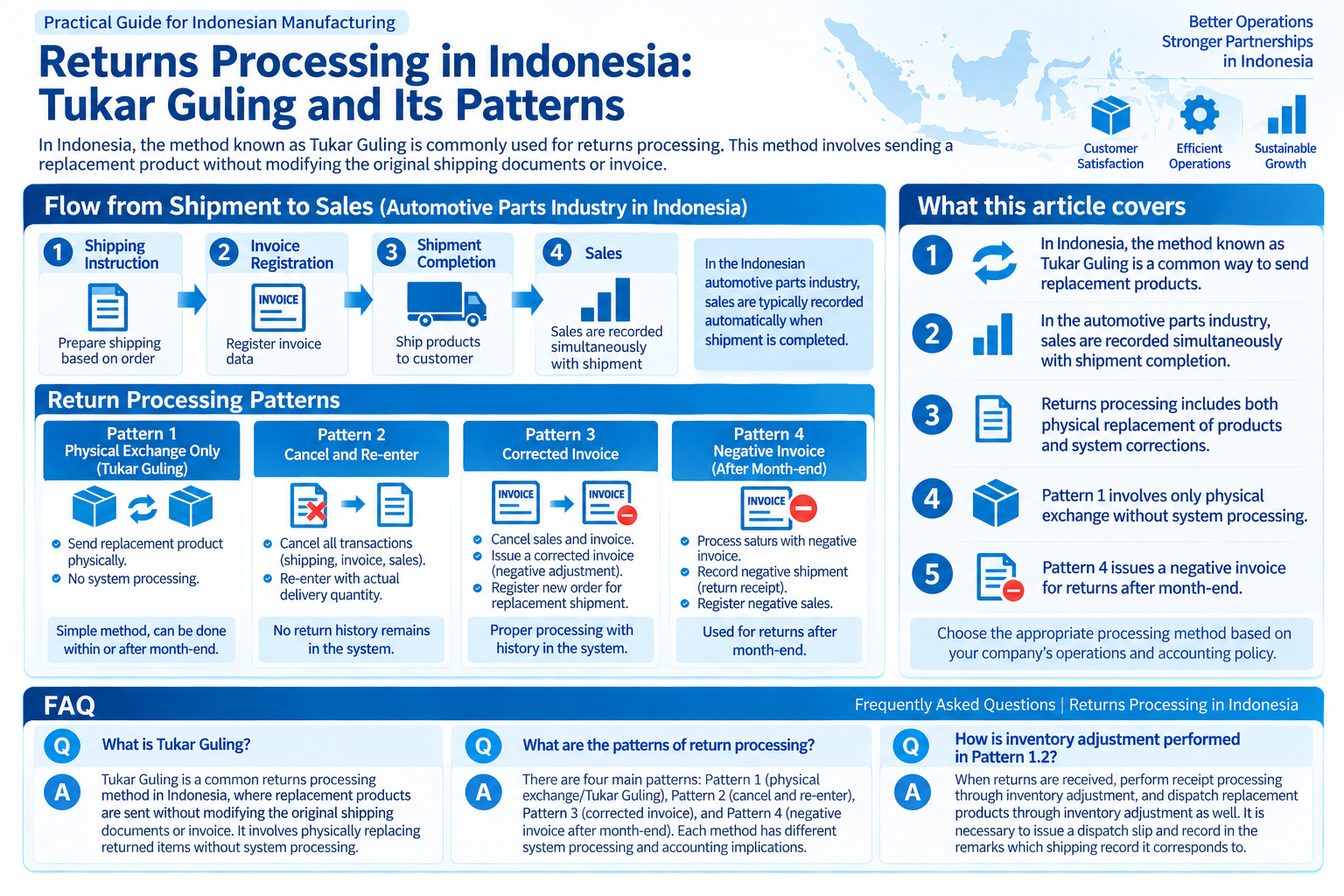
In Japanese factories in Indonesia, especially in the automotive parts sector, it is common for sales to be recorded simultaneously with shipping completion. Returns are not merely 'returning goods' because inventory, sales, and lots move simultaneously, necessitating design within the production management system (ERP).
-
-
Production Management Systems in Indonesia
The ultimate goal in manufacturing is to improve productivity and meet delivery deadlines. Understanding the differences between manufacturing cost, cost of…
続きを見る
Positioning of this article: This is the definitive guide on 'return shipping' under the production management hub. It is not about trade documents like Bills of Lading or trading company discussions, but rather how to correct factory shipping records and maintain lot traceability. For shipping execution, refer to the picking list, for products refer to Hanafirst ERP, and for overall selection refer to ERP selection.
What this article covers
- This article is the definitive guide on return shipping within production management systems (ERP), not a general discussion on trade documents.
- In Indonesia, Tukar Guling (replacement exchange) is common, and not correcting documents can easily disrupt lot traceability.
- For automotive parts with simultaneous shipping and sales, returns require simultaneous design of inventory, sales, and lots.
- The patterns can be categorized into four types: 'physical exchange only', 'full cancellation and re-entry', 'current month invoice correction', and 'post-month-end negative return'.
- In factories requiring lot traceability, it is essential to record return receipts and replacement shipments in the system and link them to the original shipping number.
- Detailed products are Hanafirst, selection criteria are ERP selection, and shipping execution can be traced to the picking list article.
Why Return Shipping is a Core Topic in Production Management Systems
When returns occur due to quality claims or customer NGs, the following questions arise simultaneously:
- Has the warehouse inventory increased (return receipt)?
- Have sales and accounts receivable been corrected (current month/post-month-end)?
- Which shipping lot returned, and which lot was used as a replacement (traceability)?
The Tukar Guling method, commonly used in Indonesia, involves sending replacements and physically exchanging them. While this is quick on the ground, if documents and lots are not corrected, system lots and actual items will misalign. If lot traceability is a requirement in ERP selection, return patterns should also be included in the same requirements.
Basic Flow from Shipping to Sales
There is an order to the processes linking shipping to sales, but in the Indonesian automotive parts industry, simultaneous shipping and sales is the norm. Sales processing is automatically completed upon shipping completion.
- Shipping instruction
- Invoice registration
- Shipping completion
- Sales
Based on this flow, return patterns vary depending on 'how far back to return' and 'when (within the month or post-month-end) to return'.
Four Patterns of Return Processing (Overview)
In Indonesia, the Tukar Guling method, which involves sending replacements, is common during returns. The return processing patterns are as follows:
- Pattern 1: Simply physically exchange the return and replacement (Tukar Guling). No system processing, or only inventory adjustment.
- Pattern 2: Cancel everything and re-enter from scratch with the actual delivery quantity after the return.
- Pattern 3: Cancel sales and invoice, then issue a corrected invoice with a negative adjustment for the original shipping quantity through return shipping processing.
- Pattern 4: Post-month-end return sales order and return shipping to record negative invoice, negative shipping, and negative sales.
The easiest method is to send replacements without doing anything in the system, which can be handled both within the month and post-month-end. However, in factories requiring lot management, this ease comes at the cost of broken traceability.
Pattern 1|Tukar Guling (Physical Exchange)
Pattern 1.1|No System Processing
- Ship 10 units and record sales of 100
- 2 units found NG, return received but not processed in the system
- 2 replacement units shipped but not processed in the system
If lot management is not required, operations continue, but if traceability is needed, system lots and actual items will not match.
Pattern 1.2|Leave Only Inventory Adjustment for Inbound and Outbound
- Ship 10 units and record sales of 100
- 2 units found NG, return received and recorded as inventory adjustment
- 2 units shipped as replacements recorded as inventory adjustment
The issue is that the replacement shipment and shipping record are not linked in the system. Issuing a shipping slip and leaving the original shipping number in the remarks is the minimum required operation. In factories using Trace Back like Hanafirst, this linkage makes a difference in later claim handling.
Pattern 2|Full Cancellation and Re-entry
- Ship 10 units and record sales of 100
- 2 units found NG, cancel everything upon return receipt
- 8 units shipping instruction, shipping completion, invoice registration, and sales processing
- Return 2 units moved to inspection warehouse
This method is applicable when history can be boldly erased. The more audit and lot history are emphasized, the safer patterns 3/4 are.
Pattern 3|Current Month Return Shipping + Corrected Invoice (Recommended)
The proper system processing is to perform return shipping processing for the relevant shipment, register a new order if replacement shipping is needed, and leave a note in the remarks indicating which order/shipment it is a replacement for.
- Ship 10 units and record sales of 100
- 2 units found NG
- Cancel sales and invoice, process return shipping, and receive 2 units in return warehouse
- Issue corrected invoice for 'shipping 100 - return 20', re-register sales
- Register new order and process shipment for 2 replacement units (indicate original shipment in remarks)
The image of the generated accounting entries is to indirectly adjust sales by linking to the invoice number.
- Current month (accounts receivable) (Debit) AR 100 (Credit) Sales 100
- Current month (sales adjustment) (Debit) Sales adjustment 10 (Credit) AR 10
Pattern 4|Post-Month-End Negative Return
If the return occurs after the month-end, record negative invoice, negative shipping, and negative sales through return sales order processing.
- Ship 10 units and record sales of 100 in the previous month
- 2 units found NG in the current month, record negative 2 units in return sales order entry
- Issue negative invoice for negative 2 units
- Record negative 2 units in return shipping entry and receive 2 units in return warehouse
- Register negative 20 sales
Issuing a new invoice number for return sales order and recording negative sales performance in return shipping ensures that the cost of sales in cost accounting is correctly adjusted.
- Previous month (accounts receivable) (Debit) AR 100 (Credit) Sales 100
- Current month (sales adjustment) (Debit) AR -10 (Credit) Sales adjustment -10
Connection with Lot Traceability and ERP Selection
Return design is not merely a 'feature list' of ERP but a practical test of whether it can trace back from shipping to process to raw materials. Even when leaving Tukar Guling, setting rules to record (1) return receipt lot, (2) replacement shipment lot, and (3) original shipping number in the system makes it easier to strengthen Trace Back later.
Designing in conjunction with shipping site verification (picking) reduces errors during returns.
Frequently Asked Questions|Return Shipping in Indonesian Factories
Based on the positioning of this article and site operations, we organize frequently asked questions.
Is this article about production management or trade practices?
It is about return shipping, inventory, sales, and lots within production management systems. For trade documents like Bills of Lading or invoice methods, refer to related articles in the business hub.
What happens to lot traceability when replacements are issued under Tukar Guling?
This article is the definitive guide. Physical exchange alone will misalign system lots and actual items. The principle is to leave the return receipt lot, replacement shipment lot, and original shipping number, as detailed in patterns 1-4 (URL: https://bahtera.jp/en/shipping-return/).
What is Tukar Guling?
It is a common return handling method in Indonesia where replacements are sent, and the original shipping slip or invoice is not corrected (or minimally corrected). While quick on the ground, it easily disrupts lot traceability, which is the main point of discussion.
What should be avoided in factories with lot management?
Only physical exchange without leaving anything in the system. Record return receipts and replacement shipments, and link them to the original shipping number.
Which pattern should be chosen?
If you want to withstand audits within the month, pattern 3 is the principle, and post-month-end, pattern 4 is the principle. Only pattern 2 if history can be erased. If using pattern 1 as an emergency site response, at least raise it to inventory adjustment and remarks linkage (1.2).
What is the difference from the picking list article?
Picking is about shipping execution (item verification), while this article is about return correction after shipping. Both together form the definitive guide to the shipping process.
Related Links
- Production Management Hub — Entry point for production management systems in Indonesian factories
- Hanafirst ERP — Definitive product for lot traceability and shipping records
- ERP Selection — Selection criteria and role sharing with planning
- Shipping & Picking List — Shipping execution and lot verification
- Return Shipping (Tukar Guling) — Inventory, sales, and lot design during returns
- Bills of Lading and Invoice — Trade document side (Business Hub)