


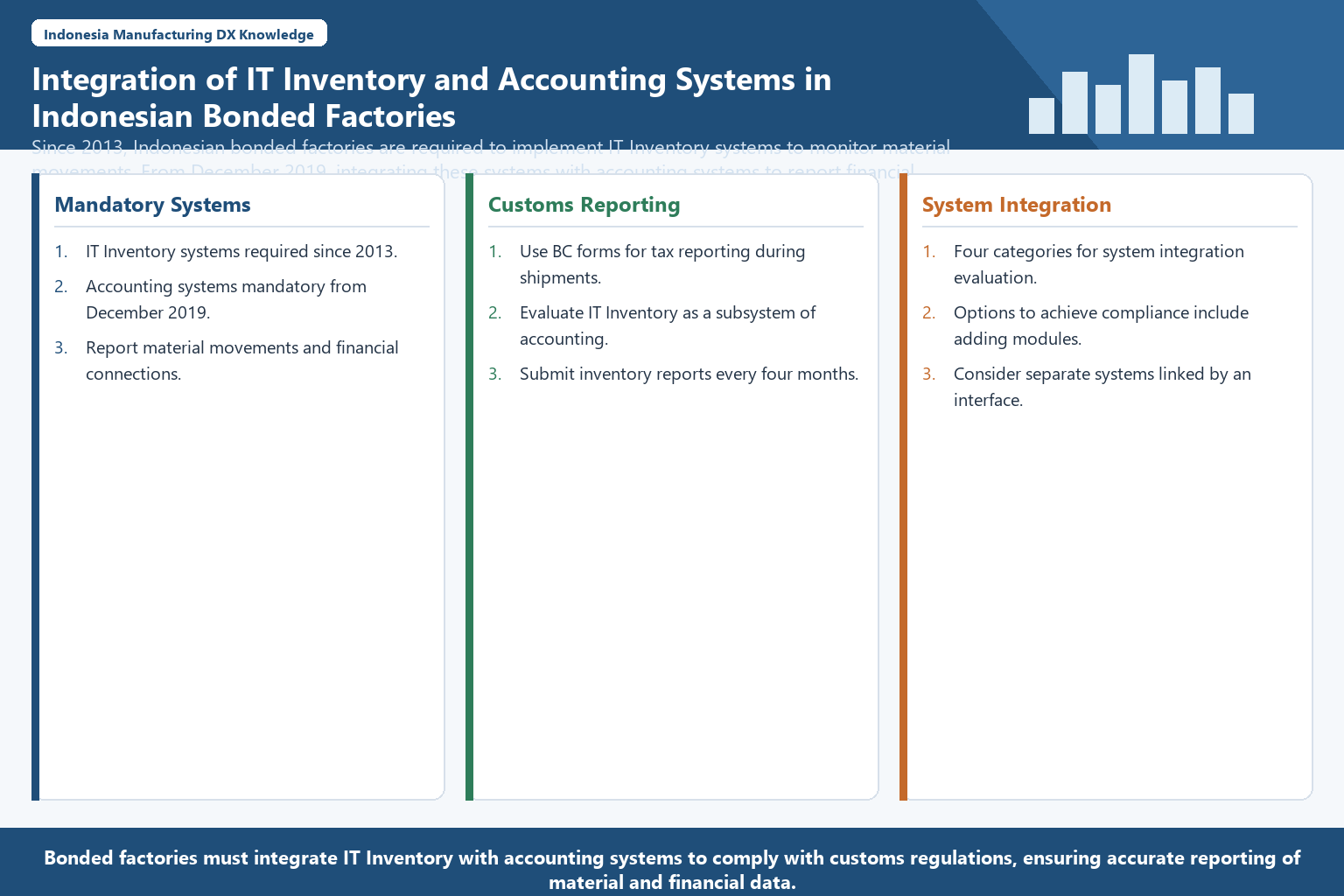
In 2013, customs mandated the implementation of IT Inventory systems in bonded factories to monitor the movement of materials, work-in-progress, products, and scrap. From December 2019, the installation of accounting systems to report the connection between quantity movements and accounting values has also been required.
-
-
Production Management Systems in Indonesia
The ultimate goal in manufacturing is to improve productivity and meet delivery deadlines. Understanding the differences between manufacturing cost, cost of…
続きを見る
What this article covers
- Since 2013, Indonesian bonded factories are required to implement IT Inventory systems.
- From December 2019, the installation of accounting systems to report the connection between quantity movements and accounting values is mandatory.
- In bonded warehouses, tax reporting is conducted using BC forms during inbound and outbound processes.
- Customs evaluates whether the IT Inventory system functions as a subsystem of the accounting system.
- Bonded factories must submit inventory status reports every four months by the 10th of the following month.
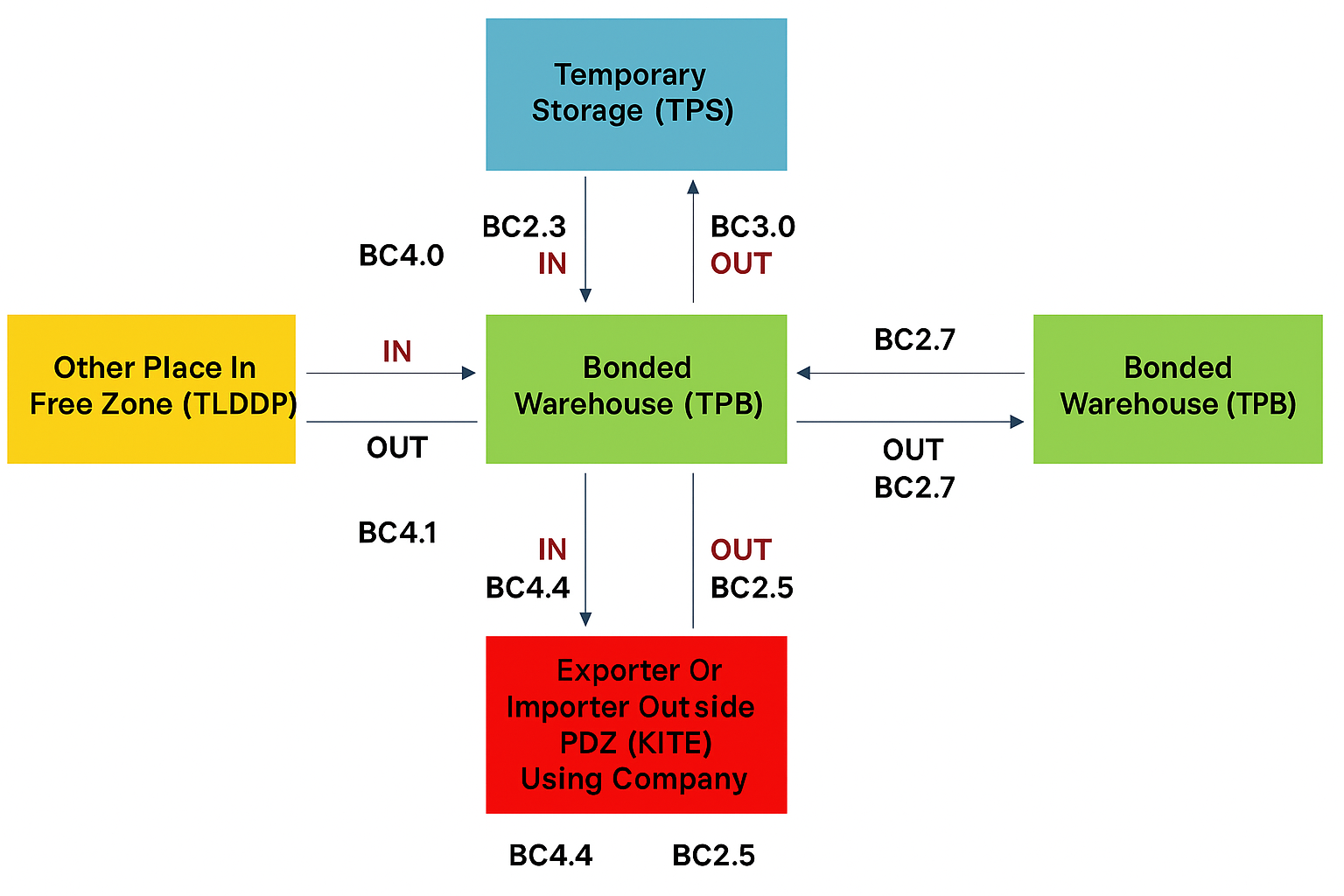
BC Forms Required for Inbound and Outbound in Bonded Warehouses (TPB)
Bonded refers to the temporary deferment of customs duties, and in Indonesia, bonded zones are called Kawasan Berikat (KB or Kaber). Areas outside bonded zones are referred to as Daerah Pabean Indonesia Lainnya (DPIL).
Bonded locations are structures or regions that meet specific requirements for storing goods for particular purposes, known as Bonded Warehouses (Tempat Penimbunan Berikat = TPB). Locations outside TPB are called Tempat Lain Dalam Daerah Pabean (TLDDP).
| BC Form | Description (Indonesian) | Description (Japanese) |
| BC2.0 | Pemberitahuan Impor Barang (PIB) | Import Declaration |
| BC3.0 | Pemberitahuan Ekspor Barang (PEB) | Export Declaration |
| BC1.0 | Rencana Kedatangan Sarana Pengangkut/Jadwal Kedatangan Sarana Pengangkut (RKSP/JKSP) | Arrival Schedule Notification: Information on the transport vessel and arrival schedule of incoming cargo |
| BC1.1 | Pemberitahuan Inward Manifes/Outward Manifes | Import Cargo Arrival Notification: |
| BC2.3 | Pemberitahuan Impor Barang Untuk Ditimbun Di Tempat Penimbunan Berikat (TPB) dari Tempat Penimbunan Sementara (TPS) | Bonded Transport Declaration: Import declaration for storage in a bonded warehouse from a temporary storage area (TPS such as ports) |
| BC2.4 | Pemberitahuan Ekspor Barang dari perusahaan penerima fasilitas KITE (KEMUDAHAN IMPORT TUJUAN EKSPOR) ke Tempat Penimbunan Berikat (TPB) | Export Declaration from a company benefiting from KITE (Import Facilitation for Export Purposes) to a bonded warehouse. |
| BC2.5 | Pemberitahuan Impor Barang Dari Tempat Penimbunan Berikat (TPB) ke perusahaan penerima fasilitas KITE (KEMUDAHAN IMPORT TUJUAN EKSPOR) | Import Declaration from a bonded warehouse to a company benefiting from KITE. |
| BC2.6.1 | Pemberitahuan Pengeluaran Barang Dari Tempat Penimbunan Berikat (TPB) Dengan Jaminan | Declaration for goods leaving a bonded warehouse to another location within the customs territory (outside TPB) with a guarantee. |
| BC2.6.2 | Pemberitahuan Pmasukan Kembali Barang Yang Dikeluarkan Dari Tempat Penimbunan Berikat (TPB) Dengan Jaminan | Return entry declaration for goods previously dispatched from a bonded warehouse to another location within the customs territory with a guarantee. |
| BC2.7 | Pemberitahuan Pengeluaran Barang Dari Tempat Penimbunan Berikat (TPB) Ke Tempat Penimbunan Berikat Lainnya. | Declaration for goods leaving a bonded warehouse to another bonded warehouse. |
| BC4.0 | Pemberitahuan Pemasukan Barang Asal Tempat Lain Dalam Daerah Pabean (TLDDP) Ke Tempat Penimbunan Berikat (TPB) | Entry declaration for goods moving from another location within the customs territory (outside TPB) to a bonded warehouse. |
| BC4.1 | Pemberitahuan Pengeluaran Barang Asal Tempat Lain Dalam Daerah Pabean Dari Tempat Penimbunan Berikat | Declaration for goods leaving a bonded warehouse to another location within the customs territory. |
| BC1.6 | Pemberitahuan Impor Barang Untuk Ditimbun Di Pusat Logistik Berikat (PLB) | Import declaration for storage in a bonded logistics center. |
| BC2.8 | Pemberitahuan Impor Barang Dari Pusat Logistik Berikat | Import declaration from a bonded logistics center. |
Customs Monitoring of Inventory Management and CCTV in Bonded Factories
In 2011, a law was enacted by the Minister of Finance and Indonesian Customs mandating the implementation of an online system (IT Inventory) for bonded factories to allow customs to monitor inventory management. This was enforced from January 2013, and as of May 2019, all bonded factories have implemented it.
Bonded factories must submit printed records of the receipt and payment history and inventory status of raw materials, work-in-progress, products, and scrap every four months by the 10th of the following month.
Customs is particularly interested in the linkage between the BC number assigned to the delivery note (Surat Jalan) at the time of raw material receipt and the new BC number assigned to the delivery note at the time of product shipment. It is crucial to ensure that duty-free imported raw materials are properly processed into products within the bonded factory and shipped appropriately.
- Receipt information (BC number, item, quantity, unit price, etc.) ⇒BC2.6.2, BC2.3, BC2.4, BC2.7, BC4.0
- Shipment information (BC number, item, quantity, amount, BC number at raw material receipt, raw material amount, etc.) ⇒BC2.6.1, BC2.7, BC3.0, BC4.1, BC2.5 ⇒It is necessary to register with CEISA (Customs-Excise Information System and Automation) and obtain an approval number for shipment.
- Information on the receipt, shipment, inventory adjustment, and current inventory of products, work-in-progress, raw materials, and scrap (item, quantity, etc.)
When registering shipment information with CEISA, it is necessary to refer to the relevant receipt BC number to obtain the unit price for calculating the raw material amount used in the product. However, maintaining a perfect linkage from raw materials to products is challenging. Therefore, it is common to refer to the BC number using FIFO (First-In, First-Out) method.
Additionally, the above information must be accessible online by customs, similar to the online distribution of CCTV footage installed at two locations: the warehouse entrance and the container loading area. This is referred to as the IT Inventory system.
Depending on whether the above documents can be submitted by the 10th of the following month, bonded factories are categorized by customs into hijau (green), kuning (yellow), or merah (red). For companies categorized as red, customs conducts thorough checks on both documents and actual goods for imported raw materials, which can lead to production line stoppages, production delays, and delivery delays to customers, causing significant business impacts.
Although managing BC numbers related to inbound and outbound operations in KB (bonded factories) may seem complicated, understanding the following points should help.
- Customs is primarily interested in which materials (mainly raw materials) are used in the products that KB exports, and the key to managing this linkage is the BC number. It is necessary to show the linkage between the BC number at the time of export and the BC number at the time of import to customs.
- The BC number is issued by the party exporting the goods, and it is obtained by registering the transaction with CEISA and obtaining approval from customs.
- If KB's trading partner is Non-KB, CEISA is not implemented, so KB obtains the BC number.
- If KB receives raw materials from a KB supplier, the supplier registers with CEISA and obtains BC27 (since they are the exporting party), so KB does not need to register with CEISA. However, if returning raw materials, KB registers with CEISA and obtains BC27 (since they are the exporting party).
- If KB receives raw materials from a Non-KB supplier, KB registers with CEISA (since Non-KB does not implement CEISA) and obtains BC40, and if returning raw materials, KB registers with CEISA and obtains BC41 (since Non-KB does not implement CEISA).
- If KB ships products to a KB customer, KB registers with CEISA (since they are the exporting party) and obtains BC27, and if receiving product returns, the customer has obtained BC27 (since they are the exporting party), so KB does not need to register with CEISA.
- If KB ships to a Non-KB customer, KB registers with CEISA (since they are the exporting party) and obtains BC41, and if receiving product returns, KB registers with CEISA and obtains BC40 (since Non-KB does not implement CEISA).
In the IT Inventory system accessible online by customs officers, the following seven reports must be presented.
- Laporan Pemasukan Barang (Inbound Report)
- Laporan Pengeluaran Barang (Outbound Report)
- Laporan Posisi WIP (WIP Position Report)
- Laporan Penganggung jawaban mutasi bahan baku/bahan penolong (Raw Material/Procured Goods Movement Responsibility Report)
- Laporan pertanggung jawaban mutasi barang jadi (Finished Goods Movement Responsibility Report)
- Laporan pertanggung jawaban mutasi mesin dan peralatan (Machine/Equipment Movement Responsibility Report)
- Laporan pertanggung jawaban mutasi reject dan scrap (NG/Scrap Movement Responsibility Report)
Mandatory Integration of IT Inventory and Accounting Systems in Bonded Factories
Since 2013, customs monitoring of inventory management has required an IT Inventory system to confirm the movement of raw materials, work-in-progress, products, and scrap. From December 2019, the installation of an online accounting system to report how these quantity movements relate to accounting values has been mandated.
Specifically, customs investigates whether the IT Inventory system in bonded factories (Pengusaha Kawasan Berikat) functions as a subsystem of the accounting system and evaluates it in four categories. A rating of 1 is passing, 2 is guidance, and 3 and 4 are failing.
- Perusahaan KB hanya menggunakan 1 (satu) aplikasi sistem pencatatan pembukuan dan IT Inventory merupakan bagian dari sistem pencatatan tersebut. ⇒IT Inventory and accounting system are linked within the same application
- Perusahaan KB menggunakan 2 (dua) aplikasi, di mana yang pertama adalah aplikasi sistem pencatatan pembukuan utama dan yang kedua adalah IT Inventory, di mana keduanya saling terintegrasi dan menggunakan sumber data yang sama dalam pencatatan keluar masuk barang (termasuk di dalamnya IT Inventory sebagai interface). ⇒IT Inventory and accounting system are separate applications but linked via an interface
- Perusahaan KB menggunakan 2 (dua) aplikasi, di mana yang pertama adalah aplikasi sistem pencatatan pembukuan utama dan yang kedua adalah IT Inventory, tetapi keduanya berdiri sendiri dan tidak saling terintegrasi, masingmasing menggunakan sumber data yang berbeda dalam pencatatan keluar masuk barang. ⇒IT Inventory and accounting system are separate applications and not linked.
- Perusahaan KB hanya menggunakan IT Inventory dalam pencatatan keluar masuk barang, dan pencatatan lainnya masih dilakukan secara manual atau berbantuan komputer, misal hanya menggunakan MS Excel. ⇒Accounting system is not implemented and managed with Excel.
Since bonded factories have already implemented IT Inventory, the following options are available to achieve a rating of 1.
- Add an accounting module to the existing IT Inventory system.
- Develop an additional accounting module.
- Replace with a new system that includes both IT Inventory and accounting systems.
All options are burdensome for bonded factories, so introducing a separate accounting system from the existing IT Inventory system and linking them via an interface to aim for a rating of 2 is also considered.
Case Study: Customs policies are expected to become clearer in the future, but the accounting system required as a subsystem is a "for customs display" accounting system separate from the core system already implemented by bonded factories, and the scope of display may be limited to a list of receivables and payables.
Key Point: Bonded accounting may be required as a subsystem for customs display, separate from the core system.
Frequently Asked Questions|IT Systems in Indonesian Bonded Factories
Based on the content of this article, frequently asked questions are briefly organized.
When was the IT Inventory system mandated in Indonesian bonded factories?
The implementation of the IT Inventory system in Indonesian bonded factories has been mandatory since January 2013. This system is designed to allow customs to monitor inventory management.
What documents must bonded factories submit to customs?
Bonded factories must submit information on receipts, shipments, and inventory adjustments of products, work-in-progress, raw materials, and scrap to customs. This information is managed by registering with the CEISA system and obtaining approval numbers.
What are the evaluation criteria for the integration of IT Inventory and accounting systems?
The evaluation criteria for the integration of IT Inventory and accounting systems are divided into four categories. A rating of 1 is passing, 2 is guidance, and 3 and 4 are failing. These criteria evaluate how the systems are integrated.