


What this article covers
- Hanafirst ERP identifies only the problematic tasks and systemizes the necessary functions in a short time and at low cost.
- Being API-driven, new functions can be added independently, minimizing the impact on existing systems.
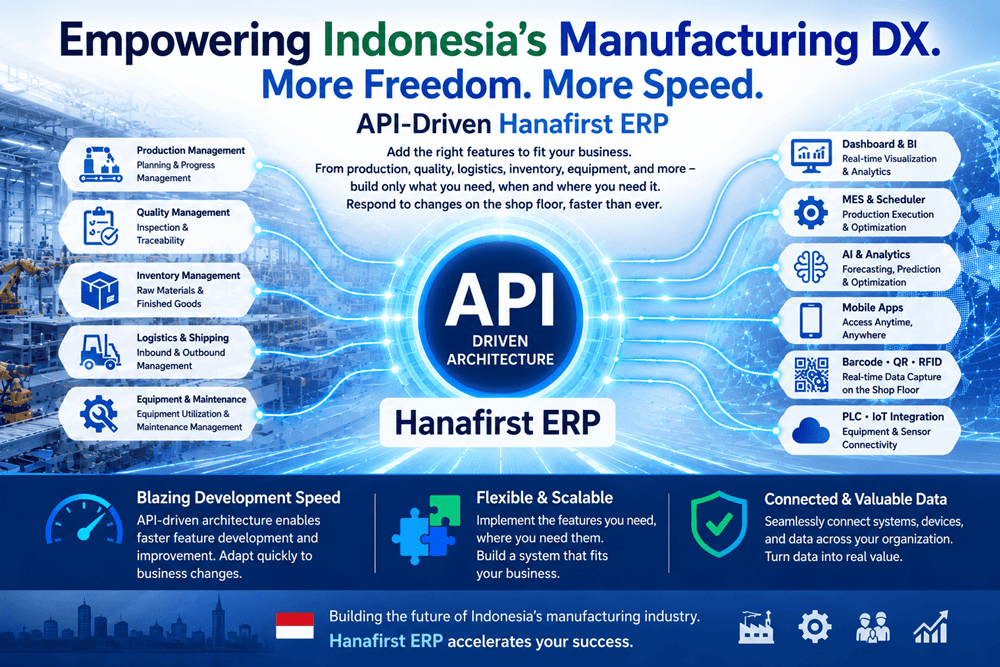
- It can freely integrate with production management, quality, inventory, logistics, equipment, AI, IoT, and PLC.
- You can systemize only the operations you want to improve quickly without rebuilding the entire system.
- Accumulating small improvements like adding QR codes, inspection screens, and equipment integration leads to competitiveness.
- The Hanafirst ERP explainer video covers thorough lot traceability and how API-driven delivery deploys only the functions you need, quickly.
- The Product Trace Back demo shows how to trace shipment through raw materials and suppliers in one report and submit it for customer claims.
Every factory has different challenges. That's why you build only the features you need.
Hanafirst ERP identifies only the truly problematic tasks on the shop floor and systemizes only the necessary functions in a short time and at low cost.
With an API-driven architecture, new functions can be freely added and integrated, allowing the system to evolve while continuously improving operations.

Why is implementation and improvement fast?
Traditional ERPs required large-scale modifications every time new screens or functions were added.
Since Hanafirst ERP is structured around APIs, necessary functions can be developed and added independently. This minimizes the impact on existing systems while achieving operational improvements in a short time and at low cost.

What changes with API-driven architecture?
An API-driven architecture allows for free integration with production management, quality control, inventory management, logistics, equipment, AI, IoT, and PLC.
Instead of rebuilding the entire system, only the operations you want to improve can be systemized quickly, allowing for flexible adaptation to changes on the shop floor.

How does it help improve your factory?
In manufacturing environments, small improvements like "adding QR codes," "creating inspection screens," and "integrating with equipment" contribute to competitiveness.
With Hanafirst ERP, such improvements can be systemized in a short time, continuously evolving into a mechanism optimal for your business flow.

Please feel free to contact us.
Demo video | Hanafirst ERP lot traceability
Hanafirst ERP is an API-driven ERP platform redesigned from the ground up for manufacturing in Indonesia. Its core idea is thorough lot traceability—tracing history from raw-material receipt through production, WIP, Finished Goods, and customer delivery. This video explains how Hanafirst addresses operations that are invisible, inconsistent, and disconnected, and how you can deploy only the functions you need with short lead times and lower cost.
- Data-management philosophy centered on lot traceability
- Compounding small improvements (QR, inspection screens, equipment integration) via APIs
- Core process coverage: procurement, sales, inventory, production, subcontracting, logistics
- Traceback when issues arise, plus project flow (interviews → prototypes → phased go-live; typically 4–6 months)
Hanafirst ERP|Lot traceability (YouTube)
Demo video | Hanafirst ERP Product Trace Back
When a customer raises a product claim, open the dedicated Product Trace Back screen, review the trail as one report, and submit it as-is. Customer is required; add Product Lot / Label Lot / Order No / DO / item / ship date, then Search. The report traces shipment → Finished Goods → process actuals → raw materials used → supplier receipts—downstream back upstream in one pass.
- Menu: Produksi → Report → Trace Back Produk
- Claim-ready tracking report you can print and submit
- Flexible search keys (lot / order / DO / item / date)
- Use Print for customer packs and internal root-cause investigation
Hanafirst ERP|Product Trace Back demo (YouTube)
FAQ | Hanafirst ERP
Points repeatedly confirmed in implementation decisions are briefly organized according to the content of this article.
Why focus only on necessary functions?
Since factory challenges differ from one factory to another, identifying and systemizing only the problematic tasks rather than large-scale overall optimization modifications is more effective in a short time and at low cost.
Why is implementation and improvement faster than traditional ERP?
Because it is structured around APIs, necessary functions can be developed and added independently. This allows for screen additions and integrations while minimizing the impact on existing systems.
What becomes easier to integrate with API-driven architecture?
It becomes easier to freely integrate with production management, quality control, inventory management, logistics, equipment, as well as AI, IoT, and PLC. You can digitize only the operations you want to improve without rebuilding the entire system.