


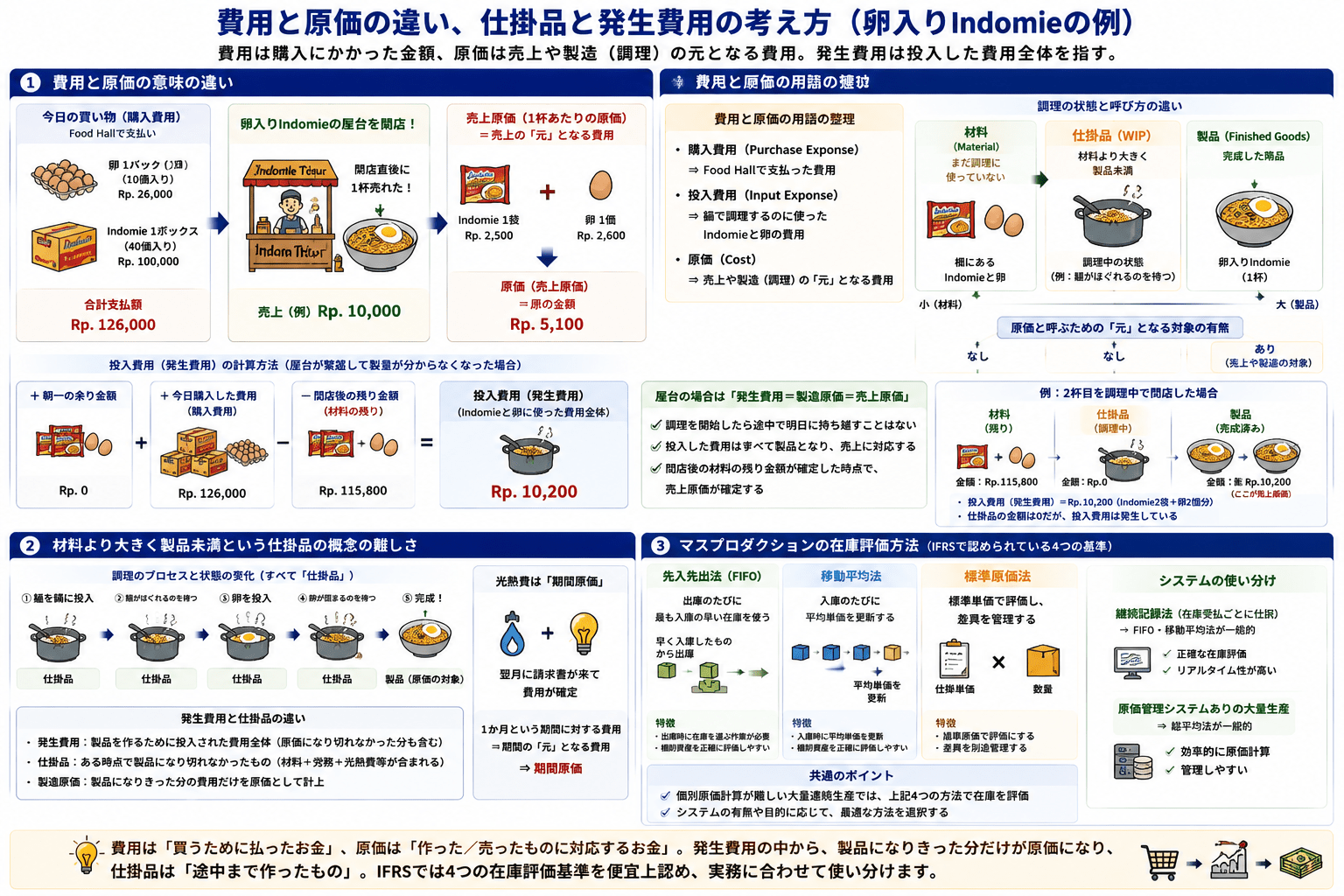
Expense refers to the amount spent on purchases. Cost refers to the expenses incurred for sold goods or manufactured products. Incurred expenses indicate the total expenses invested in making a product, including those that did not become costs. Items larger than materials but less than products are called work-in-progress (WIP).
-
-
Cost Management Systems in Indonesia
Mass production factories in Indonesia adopt comprehensive cost accounting. Custom order production factories adopt individual cost accounting.
続きを見る
What this article covers
- Expense is the amount spent on purchases, while cost is the expense incurred for sold products.
- The cost of egg Indomie is Rp.5,100 per bowl.
- Incurred expenses refer to the total expenses invested in making a product.
- WIP refers to a state larger than materials but less than products.
- Utility costs are determined when the bill arrives at the beginning of the next month.
Difference in Meaning Between Expense and Cost
Today, I bought a pack of eggs (10 pieces) for Rp.26,000 and a box of Indomie (40 pieces) for Rp.100,000 at the Food Hall in Summarecon Mall. I paid a total of Rp.126,000. For example, if I opened a stall selling egg Indomie to neighbors and sold one bowl right after opening, the cost would be Indomie Rp.2,500 + egg Rp.2,600 = Rp.5,100.
Cost means the same as "origin," with the amount Rp.5,100 being the cost of one bowl of egg Indomie sold. This is different from the purchase amount of Rp.126,000, but both are called expenses (purchase expense and input expense), which can cause confusion.
- Purchase Expense is the expense paid at the Food Hall
- Input Expense is the expense for Indomie and eggs used in cooking
- Cost is the expense that serves as the origin for sales or manufacturing
If the "origin" is a manufactured product (one bowl of egg Indomie), it is called manufacturing cost, and if it is a product recorded as sales, it is called cost of goods sold (COGS). Now, for the second customer, I started cooking the second bowl with one pack of Indomie and one egg, which are in a state "larger than materials but less than products." If forced to categorize, it would be the cost of WIP.
If the stall becomes popular, it becomes unclear how many Indomie and eggs were used in a day, so typically, the input expense is calculated by adding the leftover amount from yesterday in the morning to the expense of today's purchase and subtracting the remaining amount after closing.
- + Morning leftover amount Rp.0
- + Today's purchase expense Rp.126,000
- − Remaining amount after closing Rp.115,800
- ---------------------------
- Input Expense (Incurred Expense) Rp.10,200
In the case of a stall, once cooking starts, it is not carried over halfway, and the expense invested always becomes a product and an expense against sales. Therefore, "incurred expense = manufacturing cost = COGS," and the concept of incurred or manufacturing expense is unnecessary. The COGS is determined when the remaining amount of Indomie and eggs after closing is confirmed.
The Difficulty of the Concept of WIP, Larger than Materials but Less than Products
Materials refer to Indomie and eggs purchased at the Food Hall and stored on the shelf. Products refer to egg Indomie cooked according to the specified recipe. Anything else "larger than materials but less than products" is called WIP. For example, the state of waiting for noodles to loosen in the pot or waiting for eggs to solidify after being added is also WIP.
When calculating the amount of materials (Indomie and eggs), WIP (items in the pot being cooked), and products (egg Indomie) at closing, the amount for WIP is 0, but the input expense has incurred for 2 packs of Indomie and 2 eggs, which becomes the COGS.
Incurred expenses refer to the total expenses invested in making a product, including parts that did not become costs, which are direct material costs. From this, only the expenses that became products are included in the manufacturing cost, and those that did not become products are called WIP.
The difference between expense and cost, the meaning of WIP, and the difference between incurred expenses and WIP were explained using egg Indomie as an example. Costs include not only materials but also utilities and labor costs. Since I cook myself, there are no labor costs, but utility costs are determined when the bill arrives at the beginning of the next month, and dividing by the number of business days reveals the daily utility cost.
If the "origin" is the expense for a period of one month, it is called period cost, as it becomes a cost when it occurs as an expense.
Frequently Asked Questions | Expense and Cost of Egg Indomie
Based on the content of this article, frequently asked questions are briefly organized.
What is the difference between expense and cost?
Expense refers to the amount spent on purchases, while cost refers to the expenses incurred for sold goods or manufactured products. Expenses include purchase and input expenses, and cost is the expense that serves as the origin for sales or manufacturing. Understanding these differences makes cost management in economic activities easier.
How do you calculate the cost of egg Indomie?
The cost of egg Indomie is Rp.5,100, which is the sum of the cost of one pack of Indomie Rp.2,500 and one egg Rp.2,600. This amount indicates the expense that serves as the origin when selling one bowl of egg Indomie. It is different from the total purchase expense of Rp.126,000, so caution is needed.
What is WIP?
WIP refers to a state larger than materials but less than products. For example, the state of waiting for noodles to loosen in the pot or waiting for eggs to solidify after being added applies. WIP includes expenses that did not become products and are not included in the manufacturing cost.