


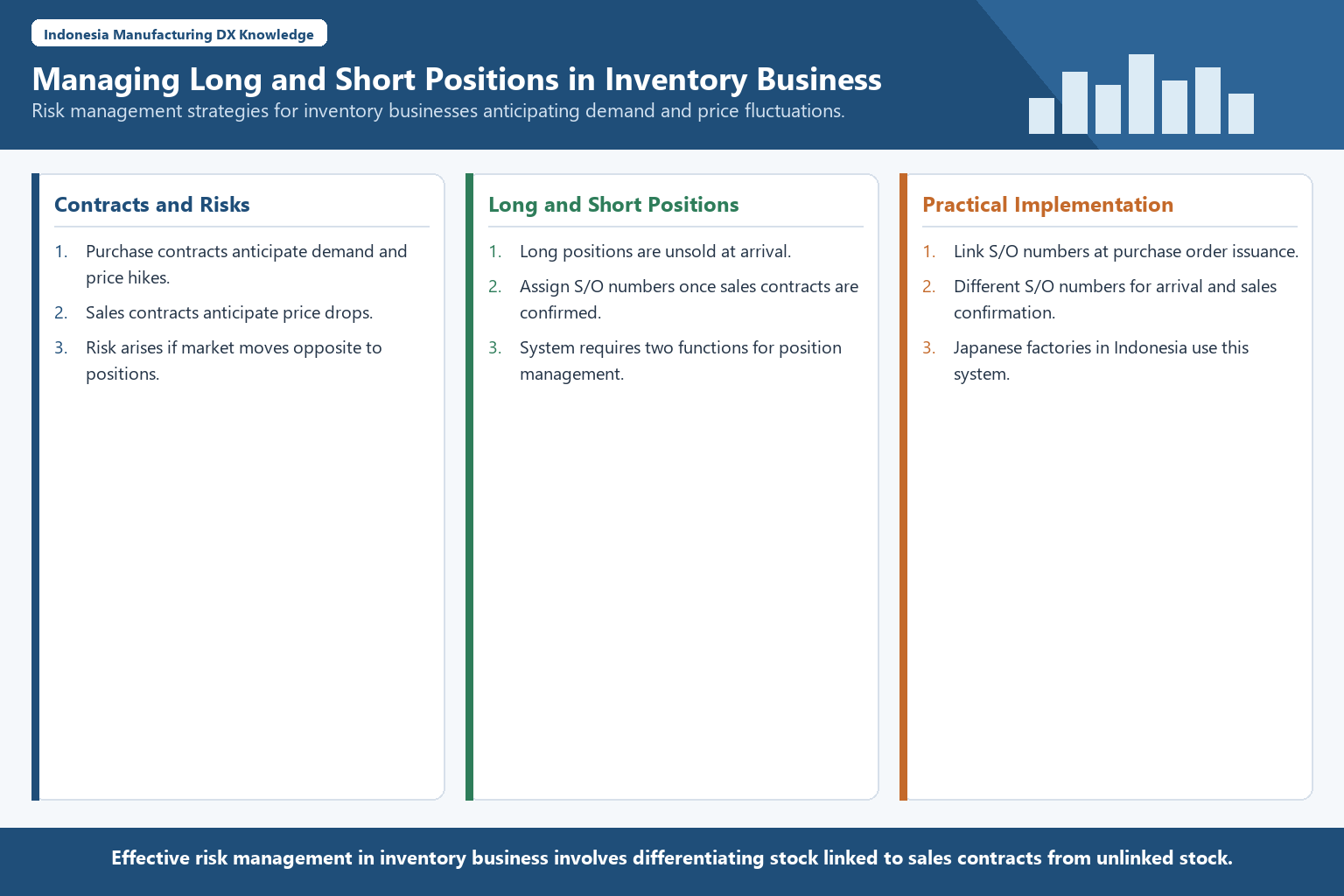
In the inventory business, purchase contracts anticipating future demand and material price surges, as well as sales contracts anticipating price drops, occur. In such cases, risks arise when the market moves in the opposite direction, so it is necessary to distinguish between inventory linked to sales contracts and those not linked.
-
-
Production Management Systems in Indonesia
The ultimate goal in manufacturing is to improve productivity and meet delivery deadlines. Understanding the differences between manufacturing cost, cost of…
続きを見る
What this article covers
- In the inventory business, buying and selling contracts anticipating future demand and price fluctuations are crucial.
- For risk management, it is important to distinguish between inventory linked to sales contracts and those not linked.
- At the time of the purchase contract, link the sales contract number to manage it in the inventory management system.
- Long positions are managed as items without confirmed sales contracts at the time of receipt.
- Japanese factories in Indonesia have implemented a system assigning different S/O numbers for long position management.
Sales and Purchase Contracts
In the inventory business, purchase contracts anticipating future demand and material price surges, as well as sales contracts anticipating price drops, occur. This is similar to stock trading warrants. When long and short positions move in the opposite direction of the market, risks arise. To manage these risks, it is necessary to distinguish between inventory linked to sales contracts and those not linked.
To make this distinction, at the time of the purchase contract, that is, when issuing the P/O, it is necessary to link it with the sales contract (S/O number) and manage it in the inventory management system along with the receipt number.
Long and Short
Items for which sales contracts are not confirmed at the time of receipt are entered as long positions, and an S/O number is assigned when the sales contract is confirmed. To manage these positions, two functions are required in the system.
- Assigning S/O numbers at the time of receipt
- Assigning S/O numbers to long position inventory after receipt
The second function considers implementation to separate long positions and others by location in inventory movement.
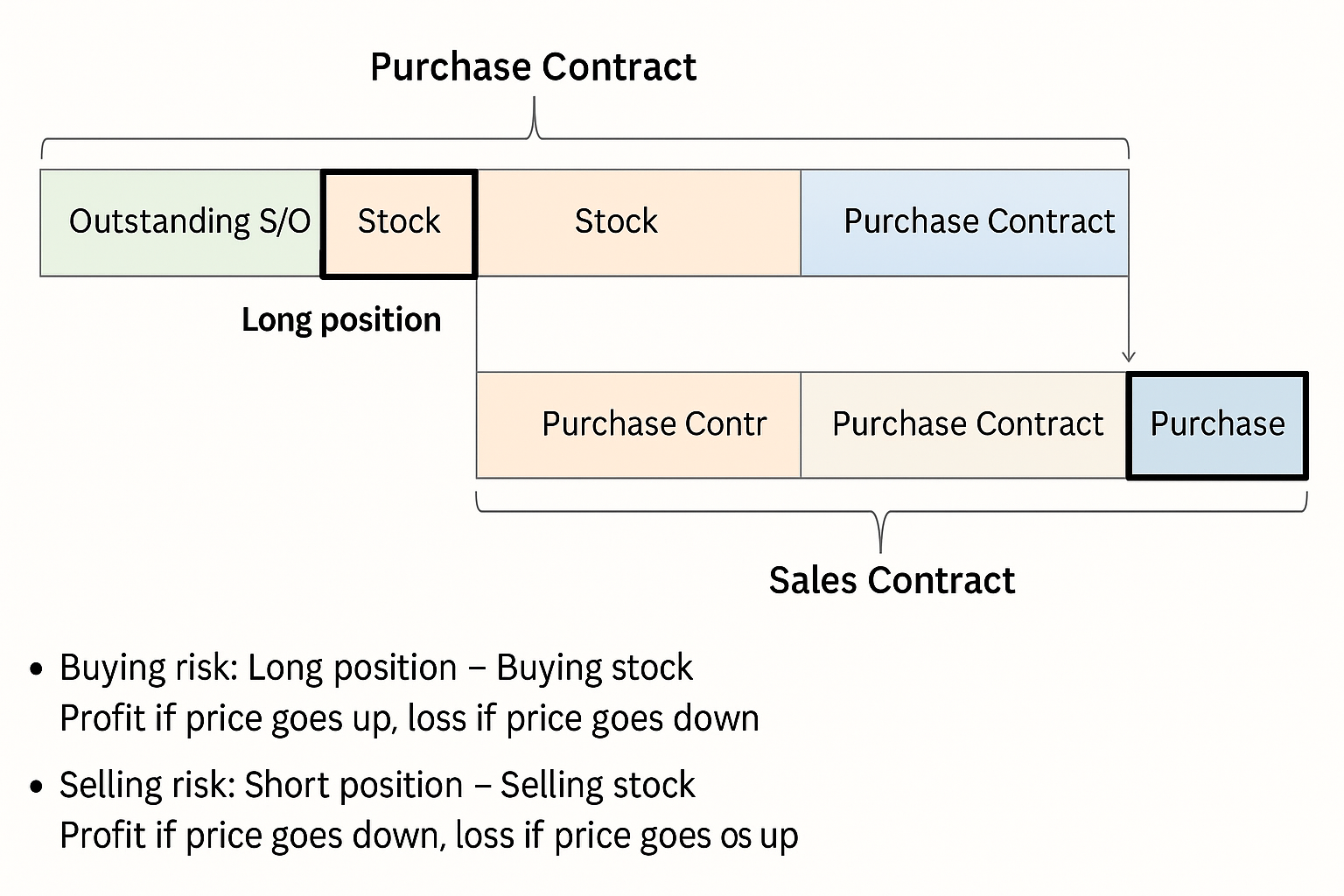
Case Study: In Japanese factories in Indonesia, a system is introduced to assign different S/O numbers at the time of receipt and when the sales contract is confirmed to streamline long position management.
Key Point: Assigning different S/O numbers at different stages of receipt and post-receipt is crucial for long position management.
Frequently Asked Questions | Risk Management in Inventory Business
We summarize frequently asked questions in line with the content of this article.
How is risk management conducted in the inventory business?
In the inventory business, sales and purchase contracts anticipating future demand and material price fluctuations occur. For risk management, it is necessary to distinguish between inventory linked to sales contracts and those not linked. This reduces risks when the market moves in the opposite direction.
What is a long position?
A long position refers to items for which sales contracts are not confirmed at the time of receipt. These items are assigned an S/O number when the sales contract is confirmed. Proper S/O number assignment in the system is crucial for long position management.
How are S/O numbers managed?
S/O numbers are managed by linking them with sales contracts at the time of the purchase contract. By assigning different S/O numbers at the time of receipt and when the sales contract is confirmed, they are efficiently managed in the inventory management system. This system is introduced in Japanese factories in Indonesia.