


To convert accrual-based results on the P/L to a cash basis, subtract unsettled receivables and add depreciation expenses where liabilities and cash do not move. When preparing a cash flow statement, it is necessary to be aware of the conversion from accrual to cash basis.
-
-
Accounting Systems in Indonesia
The adoption rate of SaaS-based accounting systems in Indonesia is less than 8%, despite the advancement of SaaS technology. The continuous launch of new…
続きを見る
What this article covers
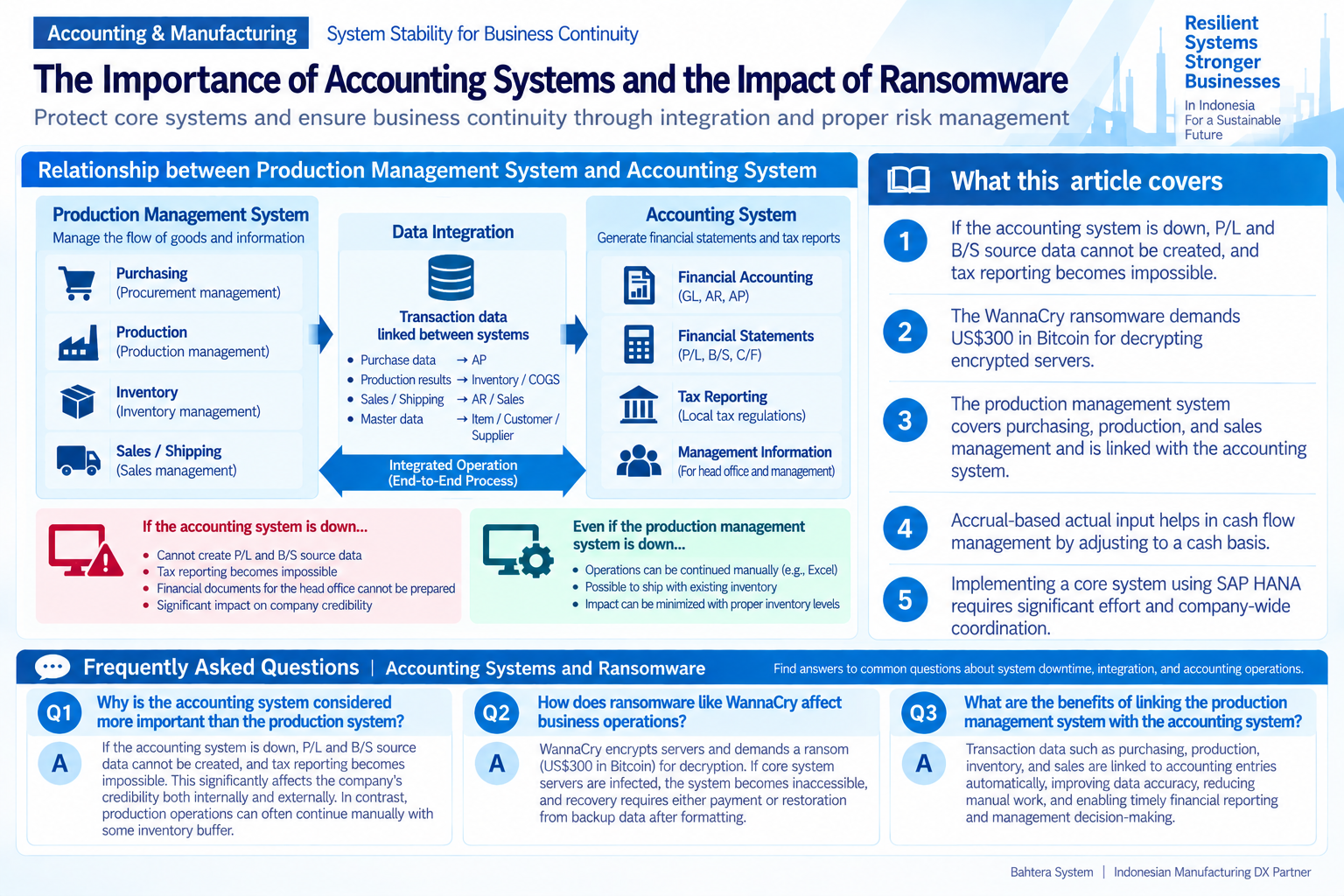
- If the accounting system is down, P/L and B/S source data cannot be created, and tax reporting becomes impossible.
- The WannaCry ransomware demands US$300 in Bitcoin for decrypting encrypted servers.
- The production management system covers purchasing, production, and sales management and is linked with the accounting system.
- Accrual-based actual input helps in cash flow management by adjusting to a cash basis.
- Implementing a core system using SAP HANA requires significant effort and company-wide coordination.
Why Accounting Systems Are Considered More Mission-Critical Than Production Management Systems
Recently, there has been an increase in cases where the core system servers of Japanese companies in Indonesia have been infected by ransomware called WannaCry, making them inaccessible. As a result, it is necessary to format the hard disk and restore the DB backup for recovery. The decryption of the encrypted server requires a payment of US$300 in Bitcoin.
This amount is close to the cost of formatting and recovery from backup data at a system company, and depending on the importance of the data, payment may be considered.
Recently, when the server of a production management system was infected by WannaCry and recovery work was being carried out, the president of the company remarked, "It was fortunate that it was not the accounting system server." However, a week later, the accounting system server was also infected. When the accounting system is paralyzed, the original data for P/L and B/S to be submitted to the accounting consulting company cannot be created, and tax reporting becomes impossible.
Financial documents for the Japanese headquarters cannot be prepared either, greatly affecting the company's image, making it natural to feel "fortunate in misfortune."
In the case of a production management system, even if infected by WannaCry, as long as raw materials and product inventory are kept with some leeway, shipment preparation becomes a manual response, preventing shipment delays.
- Production Management System Downtime There is a risk of disrupting daily operations, but efforts can be made to continue operations by responding outside the system using Excel.
- Accounting System Downtime As long as correct figures are prepared by the end of the month, it is not a problem if daily operations are disrupted due to system downtime, as long as data is entered collectively afterward. However, if not restored by the end of the month, it will have a significant impact internally and externally.
Ultimately, in terms of business system priority in corporate management,
is inevitable.
What Does It Mean for Production Management Systems and Accounting Systems to Be Linked?
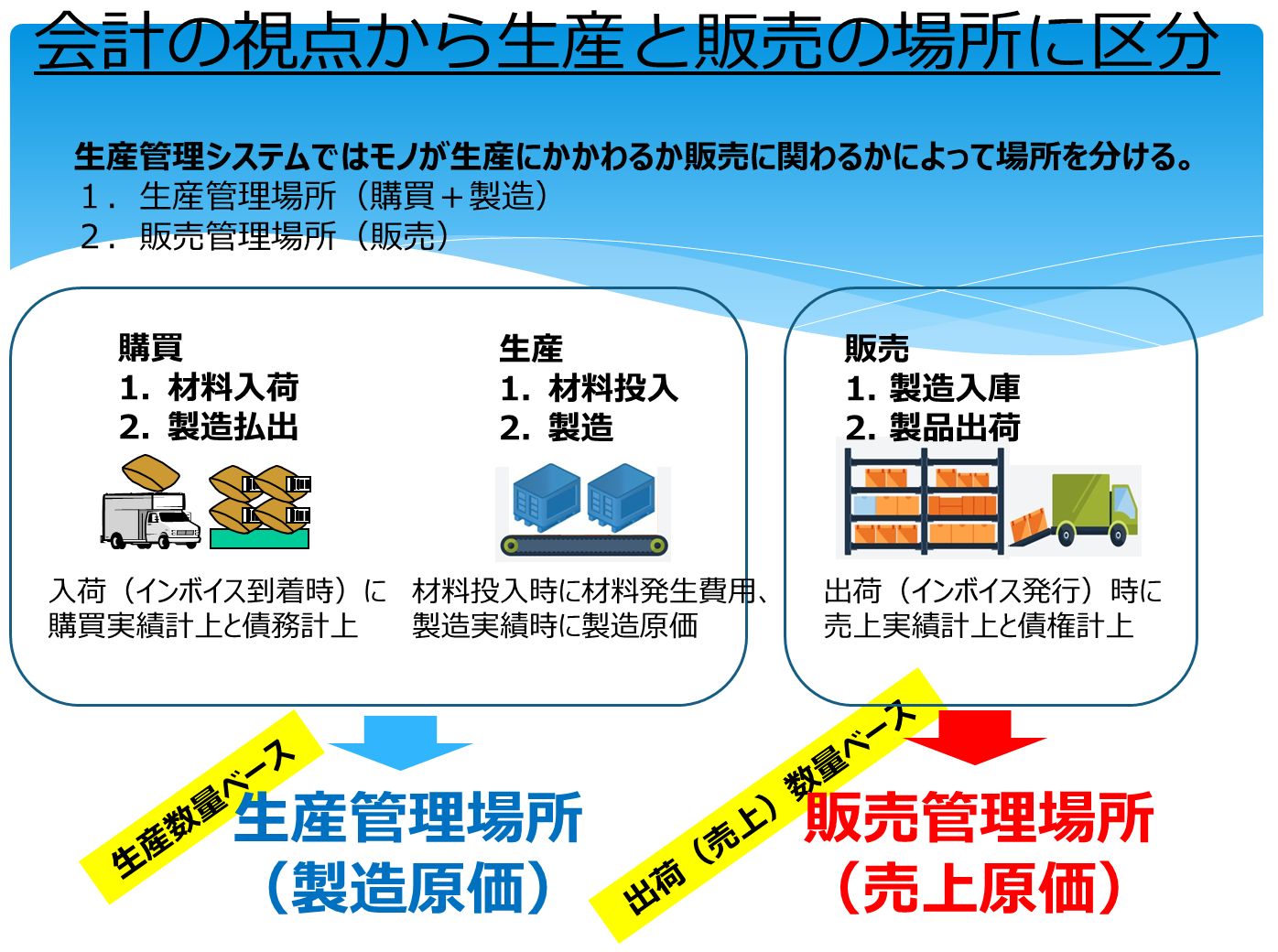
The production management system covers purchasing management, production management, and sales management. When entering purchase results in purchasing management or sales results in sales management, receivables and payables data are generated in the accounting system, and journal entries are automatically posted to the ledger. The linkage between production management and accounting refers to the generation of accounting journal entries from inventory issuance results in the production management system, automatically updating the ledger balance of asset accounts, and synchronizing the valuation amount for inventory management with the balance of asset accounts in accounting.
The advantage of this linkage is that it maintains the consistency of the entire business system, and if correct results are entered on the production management side, the input load on the accounting system side is reduced, and correct figures are recorded. However, if incorrect results are entered, incorrect figures will also be reflected in the accounting system, requiring cancellation processing of results input in chronological order for corrections, making flexible response difficult in emergencies.
Case: If disposal processing due to NG is not performed after entering manufacturing results, excess WIP inventory will accumulate in the system, and if pointed out during an audit, making adjustments in bulk can result in a large deficit on the P/L. Additionally, the act of arbitrarily accumulating WIP inventory to show profit on the books will inevitably cause problems in the future.
The results of adjustments made to align accounting figures will remain as a burden somewhere on the production management side, requiring reconciliation in subsequent months. Repeatedly postponing problems will eventually necessitate processing as a large special loss at the end of the fiscal year.
Business Systems Are Entered on an Accrual Basis
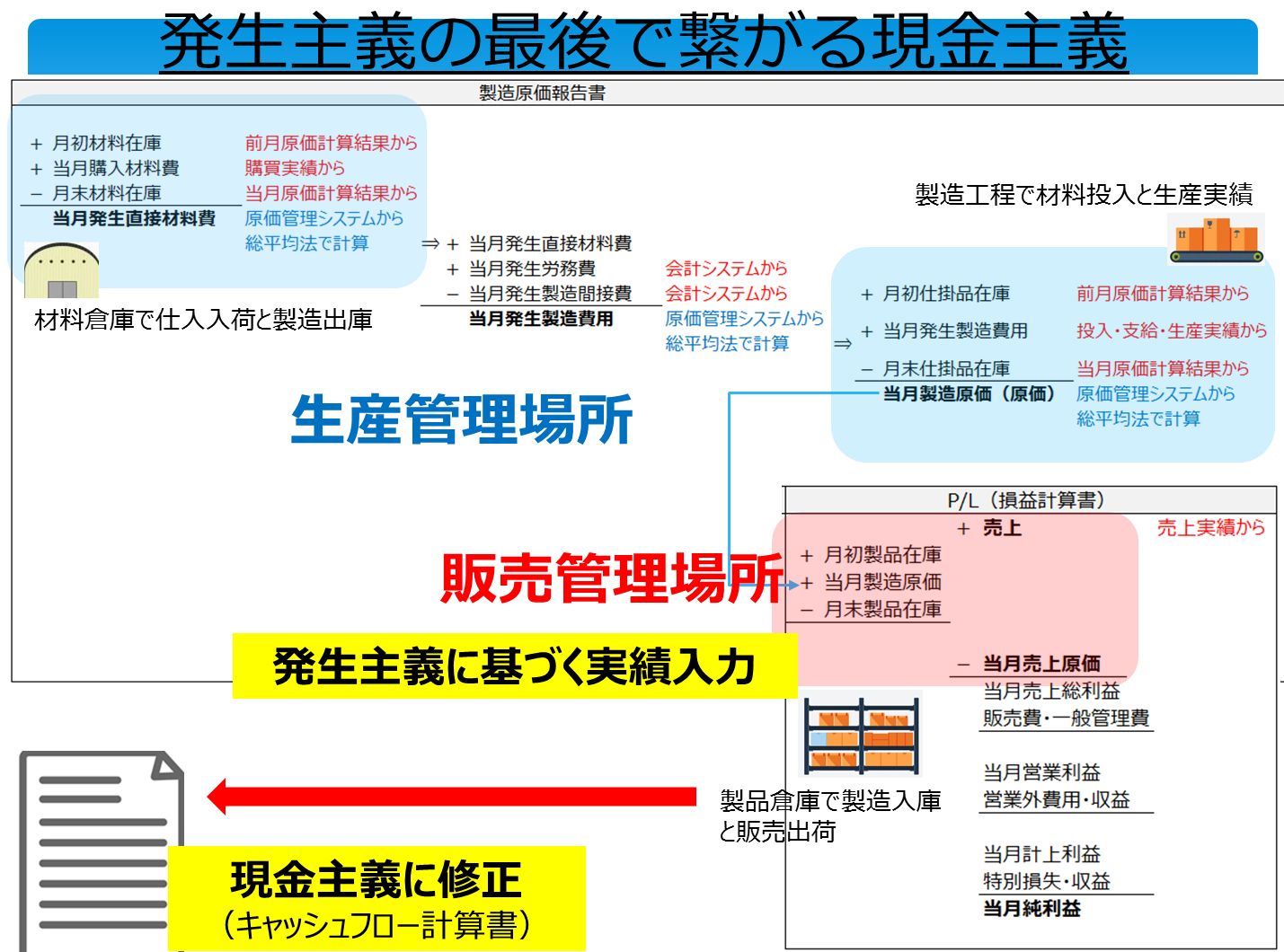
There may be little meaning in linking an accounting system, which is satisfied if a correct T/B (trial balance) is completed at the end of the month, with a production management system that supports daily operations through the issuance of slips based on actual input. However, the awareness of where and how things move in production management and sales management, and how they are expensed in accounting, is important.
Based on actual input in the production management system, the issuance of inventory (goods) in the production management location is an incurred expense, and receipt is recorded as WIP inventory in asset accounts. In the sales management location, receipt is recognized as manufacturing cost, and issuance is recognized as COGS.
ERP systems have systems that link inventory issuance results as incurred expenses on the accounting system, updating inventory amounts in real-time using FIFO (First-In, First-Out) or moving average methods, and systems that calculate incurred expenses by holding month-end inventory and subtracting the difference between the beginning of the month and purchases during the month. All actual inputs are made on an accrual basis, with the transaction occurrence date as the posting date.
Based on this accrual-based actual input, cash flow management involves making adjustments to understand the movement of liquid assets, i.e., cash on hand, by converting to a cash basis. A company making a profit means showing profit on the P/L.
- Expenses and revenues that have occurred but are unpaid
- Depreciation expenses
By adjusting these and preparing a cash flow statement, management information for responding to recent settlements on a cash basis can be obtained.
The Challenges of Systems That Operate in Tandem from Sales and Purchasing to Production and Accounting
In 2024, Glico failed in its core system migration led by Deloitte, causing issues such as the inability to ship products like Pucchin Pudding, and Kubota experienced production suspension troubles with its core system renewal led by Accenture, highlighting SAP implementation troubles.
The 'linked mechanism' from sales and purchasing to manufacturing and accounting using SAP HANA is excellent in terms of functional beauty, but it requires a significant amount of work, including requirement gathering, development to resolve gaps during the implementation period, and company-wide cut-off adjustments during the switch.
In Indonesia, relatively large manufacturers sometimes introduce SAP as part of a global core system unification initiative, but it is usually led by the headquarters with major Japanese SIers traveling for several months, so the Indonesian subsidiary often only uses the finished product.
From the perspective of providing core system implementation services using our own products in Indonesia, there may be a tendency to avoid responsibility for selection by requesting high-priced consultants for well-known packages, questioning whether the initial costs for licenses and implementation support, as well as annual license maintenance and running costs, pay off. However, these are not the fundamental causes of trouble.
There is an opinion that 'SAP HANA is not suitable for Japanese manufacturing,' but this is not a matter of suitability. It is considered a problem of the mechanism itself, where the difficulty lies in realizing a 'linked mechanism' with many related departments involved in a large organization in a single package.
Frequently Asked Questions | Linking Accounting and Production
It is a point of discussion connecting the flow of goods and money.
Why is accounting considered more mission-critical?
Because external reporting and financial and tax deadlines are clear, and errors immediately affect credibility and compliance.
What does it mean to be linked?
It means that production and inventory results fall into journal entries and costs at the timing of accrual, reducing manual double entry.
What are common stumbling points?
Discrepancies between shipping/receiving standards and on-site input, and unreceived/unrecorded items at month-end. Standards should be agreed upon first.