


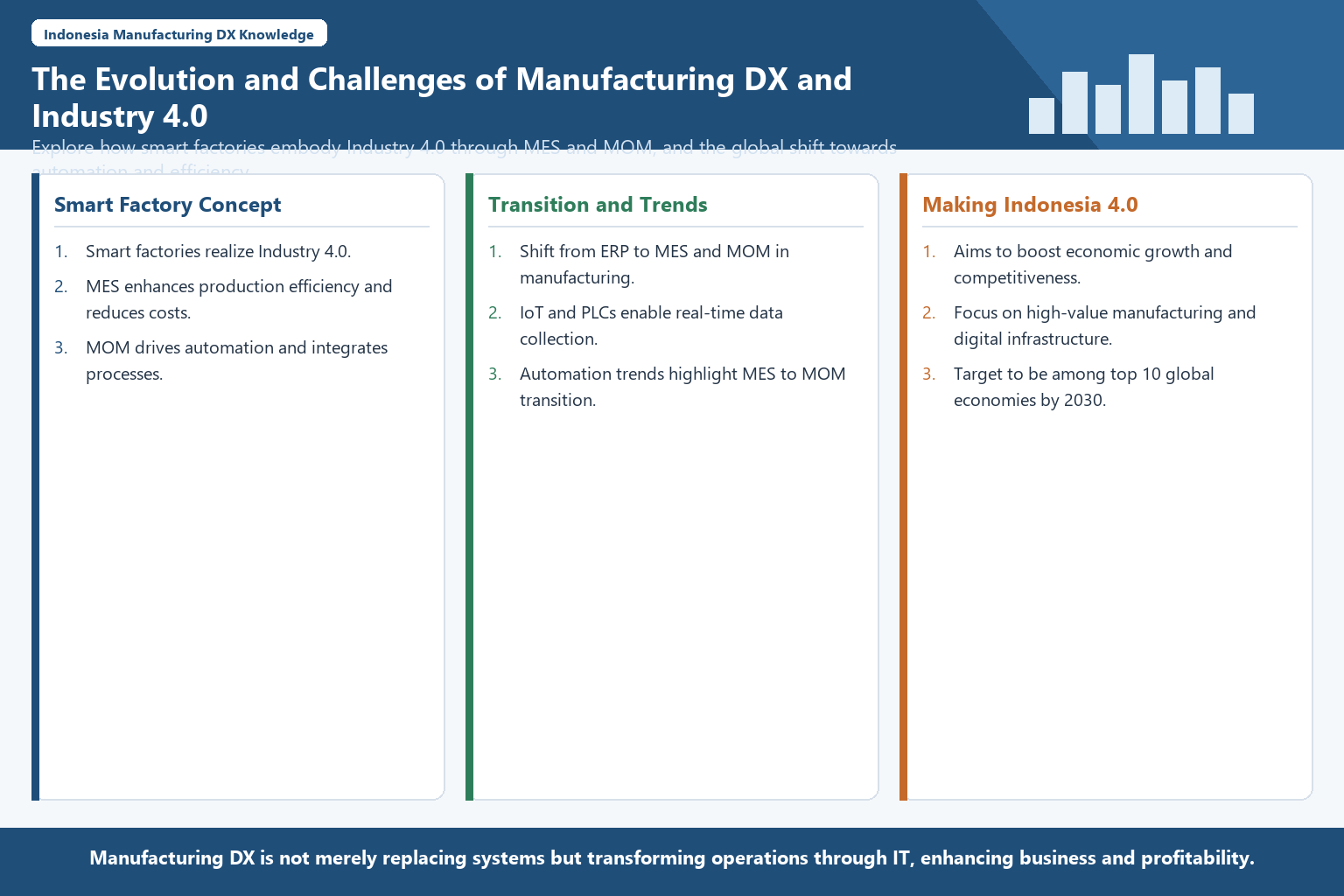
The concept of a smart factory is the embodiment of Industry 4.0 through the digital transformation (DX) of the manufacturing industry. Specifically, it aims to improve production efficiency and reduce manufacturing costs through MES (Manufacturing Execution System) and promotes automation through MOM (Manufacturing Operations Management).
-
-
Production Management Systems in Indonesia
The ultimate goal in manufacturing is to improve productivity and meet delivery deadlines. Understanding the differences between manufacturing cost, cost of…
続きを見る
What this article covers
- Smart factories are the embodiment of Industry 4.0, with MES and MOM playing crucial roles.
- The transition from ERP to MES and further to MOM is advancing, promoting automation and efficiency on the shop floor.
- MES has 11 functions aimed at improving production efficiency and reducing manufacturing costs.
- Indonesia's manufacturing industry aims for economic growth and enhanced international competitiveness through Making Indonesia 4.0.
- Paperless and IoT integration eliminate transcription errors during system implementation, enhancing efficiency.
Transition from ERP to MES and then to MOM
From December 4 to 7, 2019, Indonesia's largest manufacturing exhibition, "Manufacturing Indonesia 2019," was held at JIExpo Kemayoran. We exhibited a booth introducing the production scheduler Asprova, but due to the downturn in Indonesia's two-wheeler and four-wheeler industries, we felt that there were fewer visitors compared to previous years.
However, many people from Asian countries such as Singapore and South Korea visited for system sales related to IoT and factory automation.
A common theme in their discussions was the shift of manufacturing systems from ERP (Enterprise Resource Planning) to MES (Manufacturing Execution System).
ERP is a system that integrates business functions such as production management, production planning, sales and purchasing management, and inventory management, while MES focuses on management at the shop floor level, including people and machines.
In the future, it is expected to transition to MOM (Manufacturing Operations Management), which integrates production processes such as planning, scheduling, manufacturing management, labor management, and quality management, promoting automation and unmanned operations.
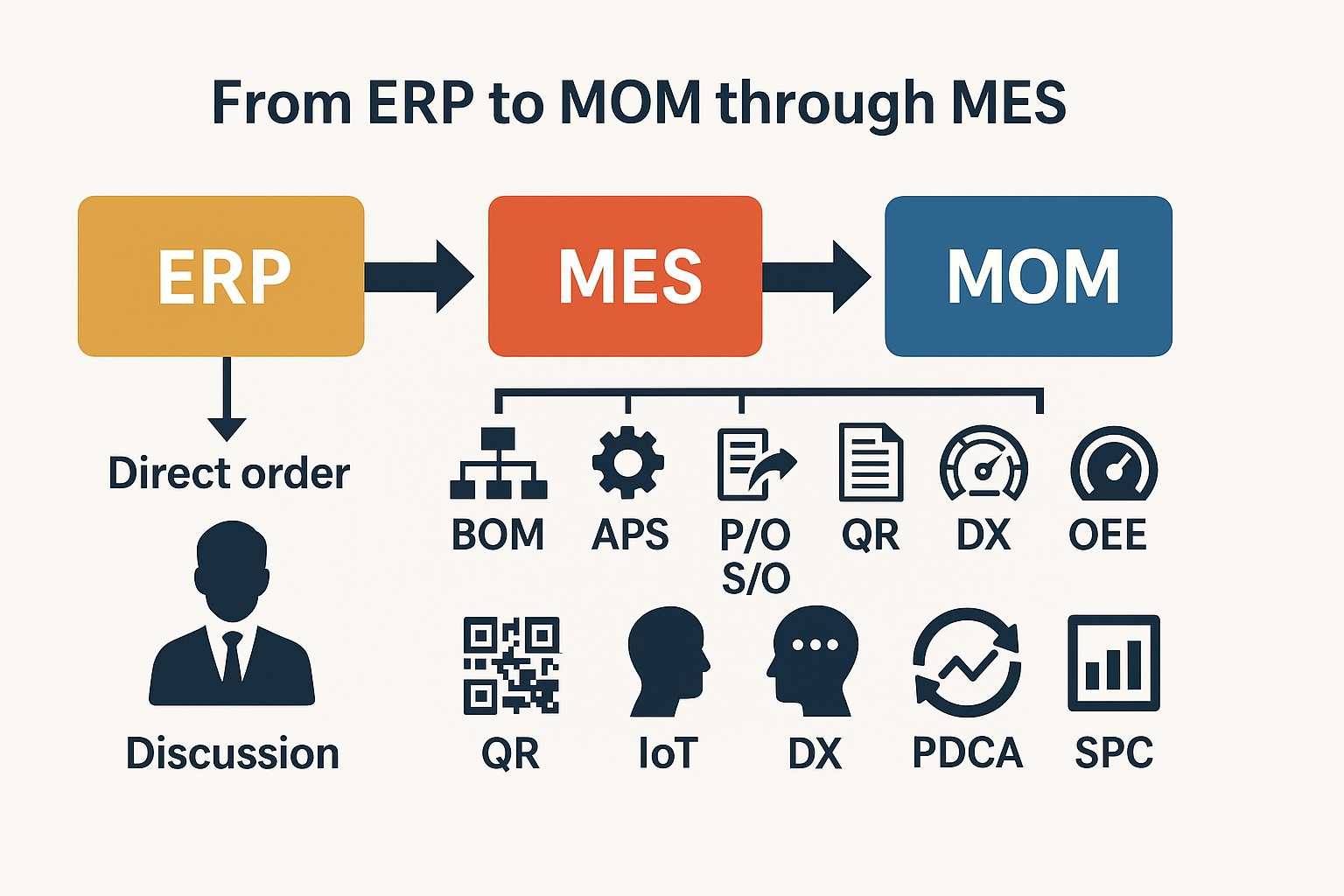
In Indonesia, the term MES is strongly associated with shop floor terminals for inputting production and labor results. Therefore, when asked, "Is the production scheduler a function of MES?" I initially answered "NO." However, realizing that MES refers to a reorganization of traditional ERP system functions from a shop floor perspective, I started answering "YES."
Case Study: In a solution proposed by a Singaporean manufacturing IT vendor to realize Industry 4.0, IoT technology is used to collect shop floor information in real-time from PLCs (Programmable Logic Controllers). This allows for the automation and unmanned operation of everything from setting production plans to machine replacement when defects occur, highlighting the transitional phase of manufacturing systems.
Key Point: The movement to collect shop floor information in real-time with PLCs and IoT and automate in conjunction with planning indicates the transition from MES to MOM.
If the purpose of systemization is to save labor, improve efficiency, and prevent errors, then DX is not about replacing existing systems but about business reform that allows for such conveniences through IT. To carry out business reform, reforming shop floor operations is essential, and creating a concept to realize shop floor operation reform through IT is the profound significance of DX.
The concept of a smart factory, realized through the DX of the manufacturing industry, is defined after reorganizing traditional production management and execution management system terms, making its overview very difficult to grasp.
Case Study: The term "Smart Factory," often seen on Japanese websites, often received lukewarm reactions from people overseas, as it is a Japanese-made English term that is not understood outside of Japan.
Key Point: "Smart Factory" is a Japanese-made English term and may not be understood overseas.
New Definition of MES
According to MESA, a U.S. organization promoting MES, MES is positioned between the ERP layer and the PLC layer, issuing work instructions to workers based on production schedules, monitoring the movement of raw materials and work-in-progress in real-time, and directly connecting to production equipment to understand operating conditions and detect abnormalities.
- ERP: Management by process and department unit ⇒ Accurate information management (movement of goods)
- MES: Management by machine and work unit ⇒ Improvement of production efficiency and reduction of manufacturing costs (labor hours, machine operating conditions)
- MOM: Advancement of MES automation
The difference between ERP and MES lies in the unit of management, but MES collects and manages shop floor-level information to improve production efficiency and reduce manufacturing costs, while MOM promotes digital automation to create smart factories.
MES is defined as having 11 functions. Work scheduling, allocation and monitoring of production resources, and dispatching production units are areas where traditional production schedulers excel, while the rest reorganizes information managed by ERP at the shop floor level.
- Operations/Detail Sequencing
- Resource allocation and status
- Dispatching production unit
- Performance analysis
- Maintenance management
- Process management
- Quality management
- Data collection/acquisition
- Production tracking and genealogy
- Labor management
- Document control
The development of MES and MOM is the advancement of information management, ultimately needing to lead to "delivering good products without delay." The smart factory transformation through DX is a crucial national strategy to enhance export competitiveness, with emerging countries worldwide redefining Industry 4.0 to suit their own countries, working on adding high value to manufacturing and strengthening international competitiveness.
The Prevalence of Japanese-speaking Indonesians
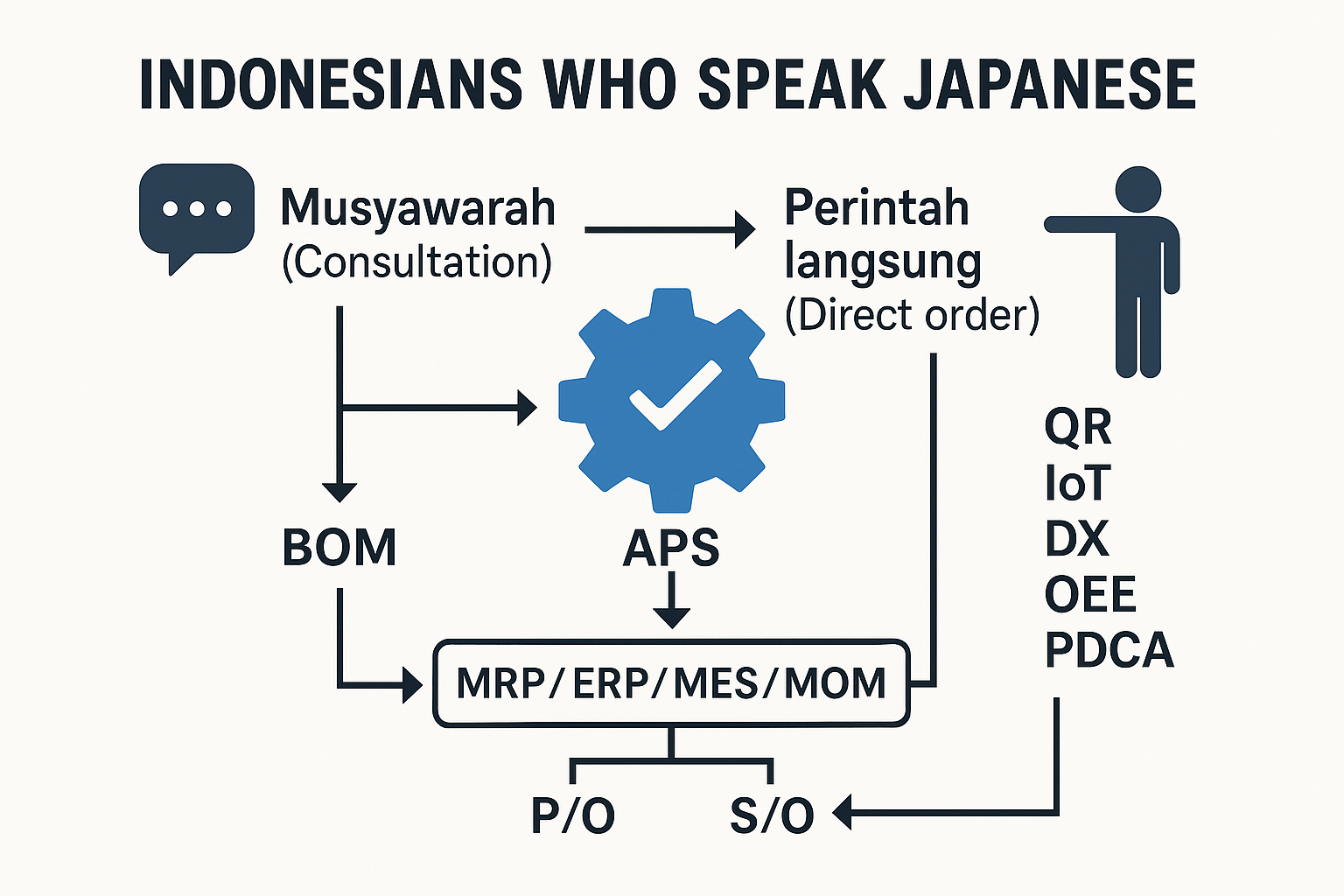
At this manufacturing exhibition, we were able to set up a booth in a corner of JETRO's Japan Pavilion. As a result, many Indonesian visitors working in Japanese manufacturing and service industries came, and I was surprised by how many spoke fluent Japanese.
Japanese companies in Indonesia have a Galapagos-like aspect of valuing business practices based on trust relationships from past achievements and being Japanese-only. Therefore, being able to speak Japanese creates a unique market opportunity for Indonesians.
Japanese-speaking Indonesians visiting the booth happily shared, "I lived in Osaka for three years" or "I was in Hamamatsu as a technical intern." However, due to the frequent highlighting of issues such as harsh labor conditions and unpaid wages in the technical intern training program, I hesitated to ask, "Did you enjoy living in Japan?"
Fortunately, the Indonesians I spoke with this time shared their enjoyable memories of Japan. With Indonesians who have honed their Japanese language skills as technical interns and stayed in Japan, working as city tour guides or interpreters, there seems to be a new issue of fluctuations in the inbound business market.
Specific Initiatives for Industry 4.0: Making Indonesia 4.0
Industry 4.0 is a global movement to promote the Fourth Industrial Revolution using IT technology. It aims to transfer software-centric IT technology to hardware, linking hardware and networks to enable rapid and accurate data collection and analysis, improving productivity and quality.
In Indonesia, the Ministry of Industry announced "Making Indonesia 4.0" in April 2018 as an initiative for Industry 4.0, aiming to become one of the world's top 10 economies by 2030. This includes 10 national priority initiatives.
- Improvement of raw material flow:
- Creating added value through domestic processing
- Increasing the local procurement rate of raw materials by domestic companies.
- Redesign of industrial estates:
- North Java automotive industry belt concept along the highway extended to East Java.
- Development of the new Patimban port in Subang, West Java (scheduled for 2023) to eliminate the concentration on Tanjung Priok port
- Establishment of standards for sustainability:
- Revitalization of SMEs:
- Development and strengthening of national digital infrastructure:
- Attraction of foreign investment:
- Enhancement of industrial human resources capabilities:
- Subsidies for ecosystems:
- R&A (Research and Development) by government, private sector, and universities
- Application of incentives for technology development investment:
- Relaxation of policies and regulations:
In the 2000s, Indonesia's manufacturing industry struggled to shift to technology-intensive sectors, and the manufacturing industry's GDP contribution rate fell from 20% under the Suharto regime to 16%. Making Indonesia 4.0 aims to revitalize the manufacturing industry, raising the GDP contribution rate to 25% by 2030 and increasing the economic growth rate from 5% to 6-7%.
How Paperless and IoT Change the Work of Implementing Business Systems
Paperless and IoT bring significant changes to the work of implementing business systems. First, in paperless, EDI (Electronic Data Interchange) of P/O and invoices, tablet input, and automatic posting from sequencers for production results collection are important. This eliminates transcription errors when entering information written on paper into the system.
- Transcription errors when entering information written on paper into the system. ⇒ Paperless
- Input errors into the system. ⇒ IoT
Paperless can be realized as part of business improvement, completely eliminating the possibility of transcription errors. However, to eliminate input errors into the system, IoT of the production line is necessary. This requires completely eliminating human information input tasks.
Due to the impact of Industry 4.0, the content of business system implementation is also changing. With IoT, information necessary for business improvement is collected quickly and accurately, requiring the development of system interfaces. Additionally, systems that effectively utilize data visualization, sharing, and systematization for business improvement are needed.
- Information collection and integration are important. As information is quickly collected through IoT, the development of system interfaces is necessary.
- Information analysis and visualization are required. Real-time production results collection and inventory with RFID tags become possible, making data visualization important.
Making Indonesia 4.0 aims to enhance the added value of Indonesia's manufacturing industry and strengthen international competitiveness. This requires improving reliability, flexibility, and responsiveness across the entire supply chain.
System integration across the supply chain is required, and business systems within companies must be designed and implemented based on relationships with upstream suppliers and downstream customers in the supply chain.
Frequently Asked Questions | Manufacturing DX and Industry 4.0
Based on the content of this article, we summarize frequently asked questions briefly.
What is the difference between MES and ERP?
MES focuses on management at the shop floor level, aiming to improve production efficiency and reduce manufacturing costs. On the other hand, ERP is a system that integrates business functions such as production management and inventory management. MES is considered a reorganization of ERP functions from a shop floor perspective.
What is a Smart Factory?
A smart factory is a concept of Industry 4.0 realized through the DX of the manufacturing industry. By utilizing MES and MOM, it promotes the automation and unmanned operation of production processes, aiming for efficiency and labor-saving. In Japan, the term "Smart Factory" is used, but it may not be understood overseas.
What are Indonesia's initiatives for Industry 4.0?
Indonesia announced "Making Indonesia 4.0," aiming to become one of the world's top 10 economies by 2030. This initiative includes enhancing the added value of the manufacturing industry and strengthening international competitiveness, aiming to raise the GDP contribution rate to 25%.