



To correct input errors in actual results, it is usually necessary to go back and correct the manufacturing results. However, if the product has already been shipped and sales have been recorded, it is difficult to roll back everything. Therefore, it is common to correct the quantity through inventory adjustment and correct the manufacturing cost through accounting entries.
-
-
Cost Management Systems in Indonesia
Mass production factories in Indonesia adopt comprehensive cost accounting. Custom order production factories adopt individual cost accounting.
続きを見る
What this article covers
- Corrections to actual results after product shipment and sales recording are done through inventory adjustment and accounting entries.
- In the total average method, the unit price of manufacturing cost and COGS is based on the unit price of beginning inventory or products manufactured in the current month.
- Incorrect input of actual results does not lead to correct manufacturing cost calculation even if inventory adjustment is made.
- In the three-part method, costs incurred in the current month are calculated based on end-of-month inventory, and overstated amounts are transferred to SGA.
- Evaluating material unit price at entry with the pre-adjustment total average unit price results in little change to the post-adjustment total average unit price.
Differences between Total Average Method and Three-Part Method in Cost Calculation
The difference between manufacturing cost and cost of goods sold (COGS) is whether it is the cost of products completed in the current month or the cost of products shipped in the current month. Since COGS does not include additional costs to the manufacturing cost, the unit price of COGS is either the unit price of products shipped from the beginning inventory or the unit price of products manufactured in the current month.
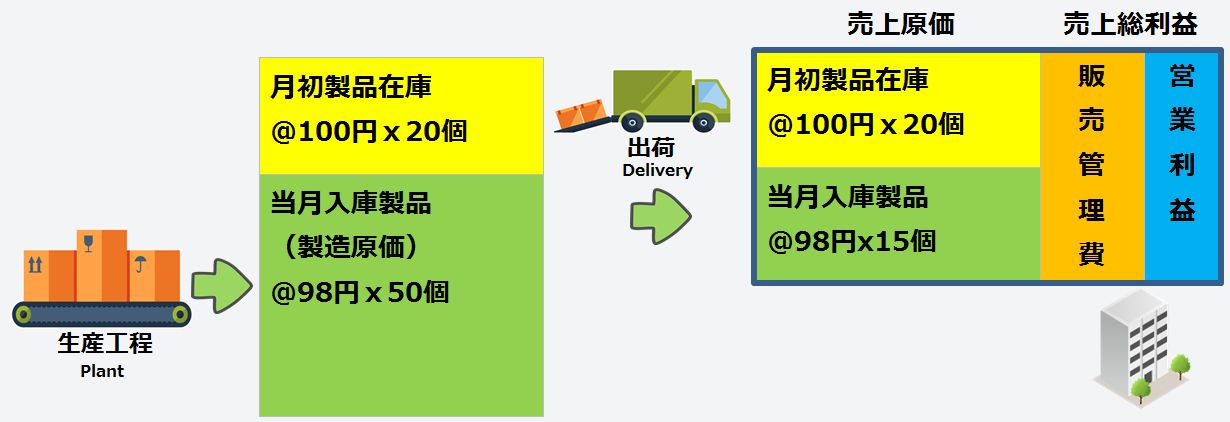
- Cost incurred on input basis is direct material cost ⇒ Total average unit price of materials x input quantity
- Cost incurred on production basis is manufacturing cost ⇒ Total average unit price of input items x input quantity + processing cost = Total average unit price of products x production quantity
- Cost incurred on shipment basis is COGS ⇒ Total average unit price of products x shipment quantity

The direct material cost, manufacturing cost, and COGS for the current month can also be calculated using the three-part method by controlling the end-of-month inventory and subtracting from the beginning inventory and costs incurred in the current month.
- Direct material cost = Beginning material inventory amount + Current month material purchase amount - End-of-month material inventory amount
- Manufacturing cost = Beginning WIP inventory amount + (Direct material cost + Processing cost) - End-of-month WIP amount
- COGS = Beginning product inventory amount + Manufacturing cost - End-of-month inventory amount
Incorrect Input of Actual Results Leads to Incorrect Cost Calculation Based on Total Average Method
If the quantity of input materials is incorrectly entered during manufacturing results input, even if inventory adjustment (indirect in/out) is performed at the end of the month to match the numbers, unless the manufacturing results are canceled and the input results are corrected, the direct material cost will be over or under-reported, and the manufacturing cost of the product will not be correctly calculated.
- Instead of entering the input result quantity as 1, it was mistakenly entered as 10.
- As a result, the system inventory became significantly less than the actual stock.
- The manufactured products have already passed the inspection process, are managed with serial numbers, and have passed labels attached, so the input results cannot be corrected.
- To correctly adjust the system inventory, a quantity match was performed through inventory adjustment (indirect in).
In this case, since the theoretical value in the system is 9 units less than the actual stock, the inventory quantity is corrected by indirectly entering 9 units. If the unit price at the time of entry is evaluated at the total average unit price before indirect entry, the total average unit price before and after inventory adjustment remains almost the same, and the manufacturing cost also remains almost the same.
- The correct total average unit price of materials and manufacturing cost
- Total average unit price of materials = (Beginning inventory @100 x 10 units + Purchase @140 x 5 units) / (10 units + 5 units) = @113.33
- Manufacturing cost = @113.33 x 1 unit + Processing cost 0 = 113.3
- Total average unit price of materials and manufacturing cost when input results are incorrectly entered
- Total average unit price of materials = (Beginning inventory @100 x 10 units + Purchase @140 x 5 units) / (10 units + 5 units) = @113.33
- Manufacturing cost = @113.33 x 10 units + Processing cost 0 = 1133.3← Overstated cost
- If the unit price at the time of entry is the total average unit price before entry
- Total average unit price of materials = (Beginning inventory @100 x 10 units + Purchase @140 x 5 units + Inventory adjustment @113.33 x 9 units) / (10 units + 5 units+ 9 units) = @113.32
- Manufacturing cost = @113.32 x 10 units + Processing cost 0 = 1133.2
- If the unit price at the time of entry is 0
- Total average unit price of materials = (Beginning inventory @100 x 10 units + Purchase @140 x 5 units + Inventory adjustment @0 x 9 units) / (10 units + 5 units+ 9 units) = @70.83
- Manufacturing cost = @70.83 x 10 units + Processing cost 0 = 708.3
Whether the unit price at the time of indirect entry of materials is set to the total average unit price at that time (No3) or to 0 (No4), the manufacturing cost of the product remains incorrect, and unless the input results in the production management system are corrected, the manufacturing cost of the product in the cost management system will not be correctly corrected.
Adjustment Entries from the Accounting Side Based on the Three-Part Method
It is not possible to correctly correct the manufacturing cost of products in management accounting based on the total average method, but it is possible to transfer the overstated direct material cost for 9 units to selling, general, and administrative expenses (SGA) from financial accounting based on the three-part method.
-
- Total average unit price of materials = (Beginning inventory @100 x 10 units + Purchase @140 x 5 units+ Inventory adjustment @113.33 x 9 units) / (10 units + 5 units+ 9 units) = @113.32
- Manufacturing cost = @113.32 x input quantity 10 units + Processing cost 0- Inventory adjustment @113.32 x 9 units = 113.32
If the input results are overstated, the entry process for the materials that became less than the actual stock in the system will subtract the overstated direct material cost and deduct it from the manufacturing cost. The decrease in direct material cost is indirectly transferred to materials through other account transfer accounts.
- (Debit) Materials 1019.88 (Credit) Other Account Transfer 1019.88

If the input results are insufficient, the insufficient materials are reduced, and the unconsumed direct material cost is increased through other account transfer accounts. This is done without going through the production management system, using the accounting system to expense only the used portion, similar to the treatment of auxiliary materials and sub-materials directly charged.
- (Debit) Other Account Transfer 1019.88 (Credit) Materials 1019.88
The three-part method calculates the costs incurred in the current month inductively from the result (end-of-month inventory), and when correcting input errors during production through inventory adjustment, the following points need attention.
- Input errors remain incorrect in terms of direct material cost in manufacturing cost unless the input results themselves are corrected, even if inventory adjustment is made to match the actual stock.
- The total average unit price is not affected by shipment results, and only the end-of-month inventory decreases by the amount reduced by shipment, so neither direct material cost nor manufacturing cost changes.
- The total average unit price is affected by entry results, but when the entry amount is evaluated at the total average unit price before adjustment, the total average unit price after adjustment hardly changes.
- The overstated input results are deducted from the manufacturing cost through accounting entries via other account transfers.
Frequently Asked Questions | Correction Methods in Cost Calculation
In line with the content of this article, frequently asked questions are briefly organized.
How to correct input errors in actual results?
To correct input errors in actual results, it is usually necessary to go back and correct the manufacturing results. However, if the product has already been shipped and sales have been recorded, it is common to correct the quantity through inventory adjustment and correct the manufacturing cost through accounting entries.
What are the differences between the total average method and the three-part method?
The total average method calculates costs using the total average unit price of input items or products. On the other hand, the three-part method calculates direct material cost, manufacturing cost, and COGS by subtracting from the beginning inventory and costs incurred in the current month based on the end-of-month inventory.
What impact do input errors have on manufacturing cost?
If input results are incorrectly entered, direct material cost will be over or under-reported, and the manufacturing cost of the product will not be correctly calculated. Even if inventory adjustment is made to correctly adjust the system inventory, unless the input results are corrected, the manufacturing cost will not be correctly corrected.